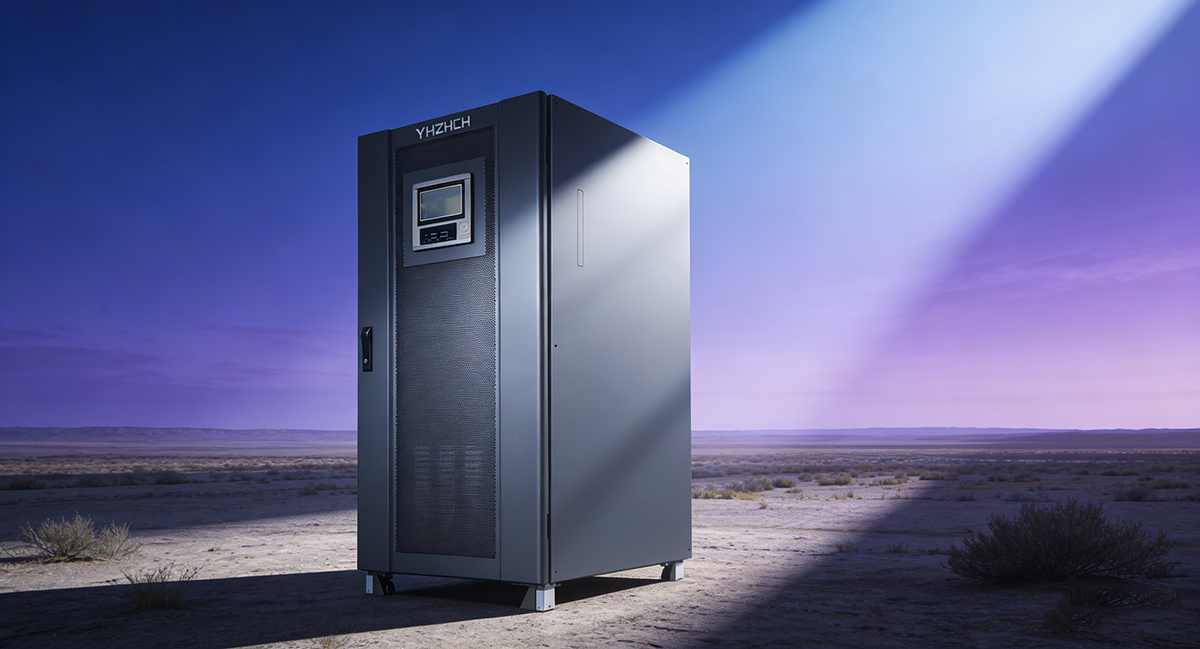
Harmonic suppression of power frequency on-line UPS is to control the input/output harmonic distortion rate (THD) at a low level through the cooperation of multi-pulse phase shift cancellation, passive/active filtering, PWM control and power frequency isolation.
First, where does the harmonic come from (look at the source first)
Rectifier side (input): The traditional 6-pulse SCR rectifier is a nonlinear load, which generates a large number of odd harmonics of 5th, 7th, 11th, 13th … order, and the input THDi usually reaches 25%–30%.
Inverter side (output): IGBT high-frequency PWM inverter produces switching frequency and its frequency doubling harmonics. If it is not filtered, the output THDu will exceed the standard.
Power frequency machine core: 50/60Hz power frequency isolation transformer is reserved, which has the functions of isolation, impact resistance and basic filtering.
Second, the input side harmonic suppression (friendly to the power grid)
1. 12 pulse phase-shifting rectification (mainstream scheme)
A phase shift transformer (Δ-Δ+Δ-Y) is used to generate a 30 phase difference and drive two groups of six-pulse rectifier bridges in parallel.
Principle: The 5th and 7th harmonics generated by two groups of rectifier bridges are equal in amplitude and opposite in phase on the DC bus, and cancel each other out.
Effect: The input THDi is reduced from ~30% to 5%–10%, and the 5th harmonic is less than 3% and the 7th harmonic is less than 1.5%.
Higher pulse (18/24 pulse): further cancel higher harmonics, THDi can be less than 3%, and it is mostly used in ultra-high power scenes.
2. IGBT high-frequency rectification+PFC (new generation power frequency machine)
IGBT is used for high-frequency Boost/PFC rectification to replace traditional SCR rectification.
Principle: PWM control makes the input current follow the sinusoidal voltage waveform and realize the unit power factor (PF≈0.99).
Effect: THDI input is less than 3%–5%, and there is no need for phase-shifting transformer, so the efficiency is higher and the volume is smaller.
3. Passive/Active Filtering (Supplementary Scheme)
Passive LC filter: series inductor+parallel capacitor, which filters out the 5th, 7th, 11th and other low-order harmonics, with low cost but large volume, and is only effective in fixed frequency band.
Active power filter (APF): Real-time detection of harmonics, reverse compensation current generated by IGBT to cancel harmonics, THDi can be less than 1%, with fast dynamic response and wide compensation range.
Third, the output side harmonic suppression (pure electricity to the load)
1. PWM control of inverter+LC/LCL output filtering
SVPWM/SPWM modulation is adopted to optimize the switching strategy and reduce the harmonic generation of the inverter itself.
The output end is equipped with LC/LCL filter:
LC: Effectively attenuate the 2nd–10th lower harmonics, and make the output THDU < 2%–3%.
LCL: Considering both low-order and high-frequency switching harmonics, the filtering effect is better, but it needs to prevent resonance.
2. Power frequency isolation transformer (key)
The power frequency machine comes standard with 50Hz output isolation transformer to realize input/output electrical isolation.
Function:
Suppress common mode interference, zero ground voltage and high frequency noise.
Natural attenuation for low-order harmonics, further purifying the output waveform.
Withstand 3-5 times instantaneous overload, protect load and UPS.
3. Closed-loop control and active harmonic suppression
Voltage/current double closed loop+repetitive control/resonance controller, real-time correction of output waveform.
Under unbalanced load, actively suppress the second harmonic (100Hz) of DC bus to avoid harmonic coupling from deteriorating input/output quality.
Fourth, the overall workflow (from power grid to load)
Commercial power → phase-shifting transformer/IGBT PFC→ suppression of input harmonics → rectification to DC.
DC →PWM inverter → generating approximate sine wave →LC/LCL filtering → further filtering harmonics.
After filtering → power frequency isolation transformer → isolation+final purification → output pure sinusoidal electricity to load.
V. Core effect
Input thdi: < 5%–10% (12 pulses), < 3%–5% (IGBT PFC).
Output thdu: < 2%, close to ideal sine wave.
At the same time, it realizes electrical isolation, shock resistance and voltage stabilization, and adapts to key loads such as industry, medical care and data center.


