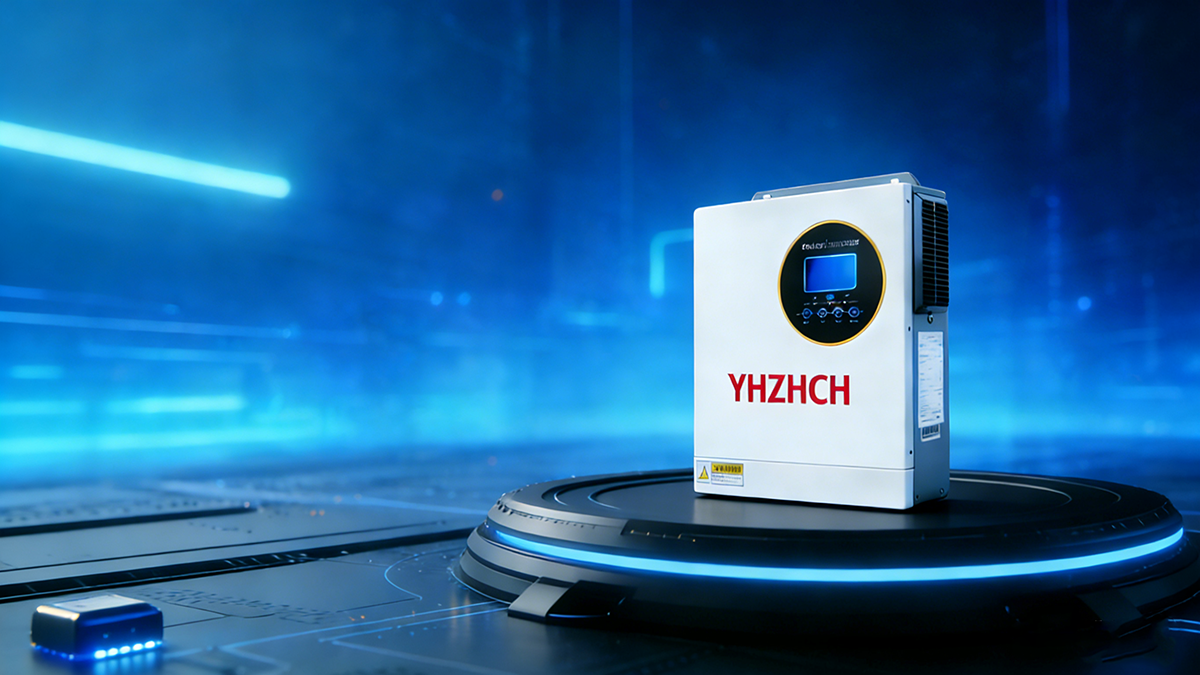
The core of passive temperature control optimization of solar inverter is to maximize natural heat dissipation, reduce thermal resistance, restrain temperature rise, and improve stability and life through material, structure, installation and thermal management design. The following are the mainstream passive optimization strategies:
First, the radiator and heat conduction path optimization (core passive heat dissipation)
1. Heat dissipation material upgrade
Metal with high thermal conductivity: extruded aluminum alloy (thermal conductivity ≥ 200 W/MK) is preferred, giving consideration to light weight and heat dissipation.
Surface treatment: anodizing/blackening/ceramic coating to improve the surface emissivity (ε ≈ 0.8–0.9) and strengthen radiation heat dissipation.
High-end composite: carbon fiber composite (400–500 W/m k) and graphene heat dissipation film (1500–2000 W/MK) are used in small batches, and the heat is rapidly expanded locally.
2. Optimization of heat dissipation structure design
Fin parameters: fin height: spacing = 6:1~8:1, thickness 0.5–1 mm, spacing 2–3 mm, giving consideration to convection and radiation.
Substrate design: the substrate is **≥5mm thick * *, which improves the heat capacity and inhibits the sudden temperature rise.
Integration: heat sink and casing are integrated to reduce thermal resistance.
Air duct isolation: internal baffle separates cold and hot airflow to avoid heat backflow.
3. Efficient thermal interface material (TIM)
Use high thermal conductivity silicone grease/gasket (≥ 6W/MK, such as Shinetsu X-23-7762) between the power module and the radiator to reduce the interface thermal resistance.
Replace aging heat-conducting materials regularly to avoid heat dissipation failure caused by dry cracking.
Second, the heat pipe/vapor chamber technology (passive and efficient heat transfer)
Vacuum copper heat pipe: IGBT is attached to the evaporation end, and radiator is connected to the condensation end. The equivalent thermal conductivity reaches 5000–10000 W/MK, which can realize rapid temperature equalization and long-distance heat transfer.
Vapor Chamber: Planarized heat pipe, suitable for multi-heat source and high-density layout, with lower thermal resistance and better temperature uniformity.
Third, the phase change material (PCM) thermal storage (peak temperature rise suppression)
The enclosure/radiator cavity is filled with paraffin-based PCM (phase transition temperature 45-50℃).
Principle: endothermic melting → thermal storage → cooling and solidification → exothermic, which can stabilize the temperature fluctuation, and the peak value can be reduced by 15-20℃, which is suitable for short-term overload/high temperature working conditions.
IV. Installation and environmental optimization (external passive cooling)
1. Space and ventilation
The distance between single unit and wall is **≥50cm**, and the distance between multiple units is **≥80cm** to avoid short circuit of return air.
A honeycomb air inlet hole (≤1cm) is opened at the bottom, and a rain exhaust hood is set at the top to form a natural convection duct.
It is forbidden to block the air inlet/outlet, and clean the dust regularly (once a month in dusty environment).
2. Shading and radiation protection
Install a sun visor with an inclination of 30 (20cm higher than the equipment) to avoid direct sunlight and reduce environmental heat absorption.
Brush the ground in photovoltaic area with high reflective coating (reflectivity > 0.8) to reduce the micro-environment temperature.
3. Selection of installation location
Give priority to cool, ventilated, north/east-west walls, and avoid western sun exposure and heat sources (such as transformers and exhaust pipes).
V. Internal thermal design and layout optimization (source control)
1. Heat source layout
IGBT, inductor, capacitor and other high-heat components are distributed to avoid local heat accumulation.
The high heat source is close to the radiator/air duct, which shortens the heat path.
2. Low-loss design (reducing heat production)
Select low on/off loss devices (SiC/GaN) to reduce heat generation from the source.
Optimize topology (such as three levels) and soft switching to reduce switching loss.
Optimize PCB layout and line diameter to reduce line loss and heat generation.
Six, passive+intelligent collaboration (passive, intelligent auxiliary)
High temperature derating: built-in temperature sensor, automatic power reduction beyond threshold, independent of fan, protective device.
AI Predictive Temperature Control: Combining irradiation, ambient temperature and wind speed, predict temperature rise in advance, optimize working point and reduce thermal shock.
Implement priority recommendations
Basic optimization: cleaning air duct+replacing high thermal conductivity silicone grease+ensuring installation spacing+shading.
Structural upgrade: optimize radiator/install heat pipe/vapor chamber.
Advanced thermal storage: PCM is added in high temperature/fluctuation scenes.
Source loss reduction: choose low-loss devices and optimize topology.


