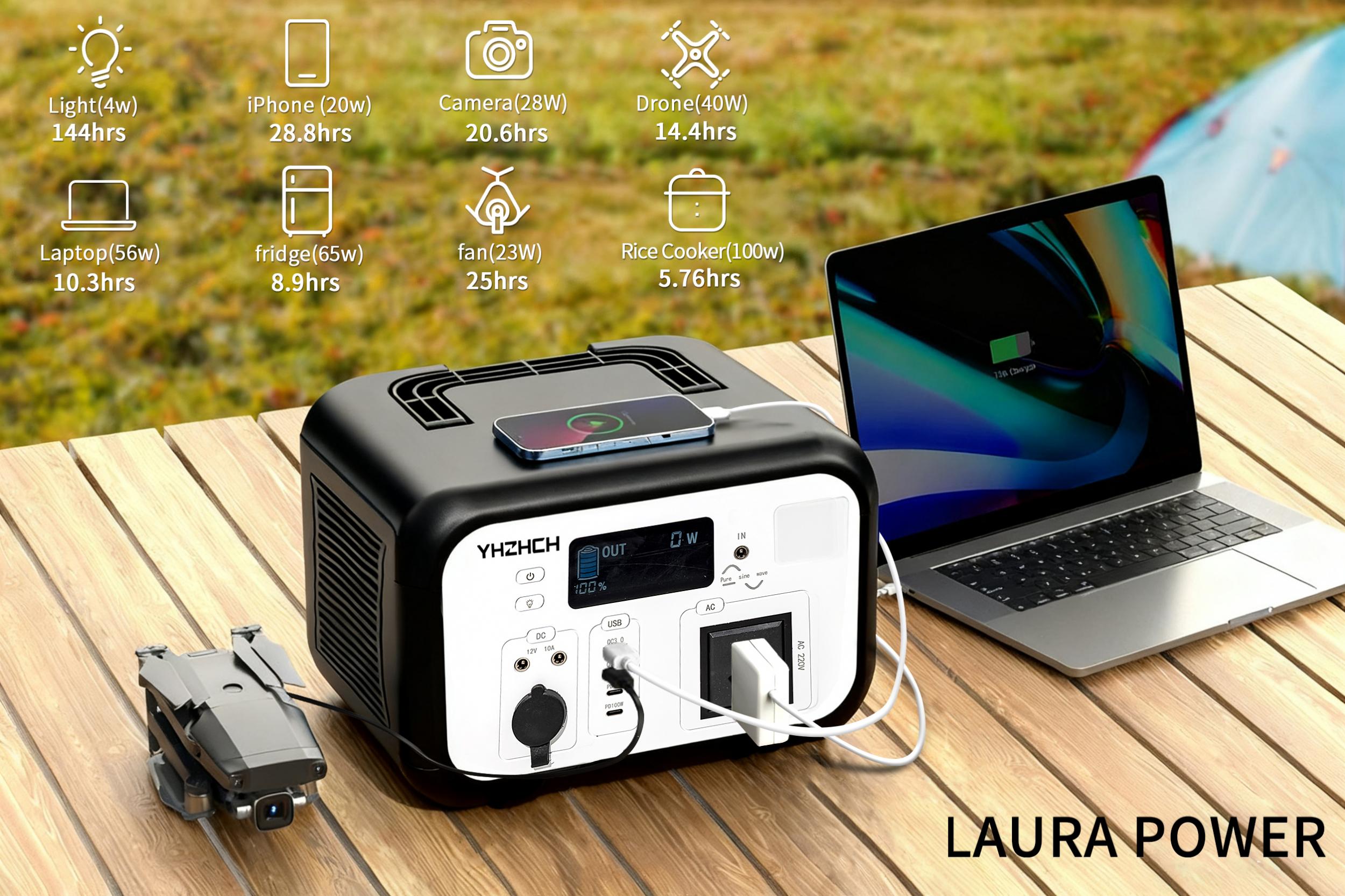
The correct use of portable power supply (charging treasure/mobile power supply) can not only prolong its service life, but also protect the battery of charging equipment and avoid potential safety hazards. It is divided into two parts: efficient use skills and safety precautions, covering the whole scene of daily use, charging and storage, with practical and easy operation.
First, efficient use skills: fast charging does not hurt the machine, and the battery life is more durable.
1. Matching power charging, rejecting "overqualified/small horse-drawn cart"
The output power of the portable power supply should match the rated charging power of the charged equipment: for example, if the mobile phone supports 20PD fast charging, it will be charged with the 20PD port of the charging treasure, which is fast and does not hurt the machine; The charging speed will be greatly slowed down if a 5V/2A ordinary port is used for charging.
When charging high-power devices such as notebooks and tablets, high-power interfaces (such as 65W/100W PD port) that are "suitable for notebooks" must be marked with charging treasure. Ordinary interfaces are prone to charging interruption and equipment heating due to insufficient power.
2. Daily charging: light charging and light discharging to prolong the cycle life of the battery.
The batteries of portable power supply are mostly lithium batteries, and the best use range is 20%-80% of the power. Try to avoid completely exhausting (over-discharging) the power or plugging it in (over-charging) after it is full, so as to reduce the cycle loss of the battery.
Daily recharge: You can recharge the battery when the power drops to about 30%, unplug it in time after it is full, and don't plug it into the charger for a long time.
3. Multi-device charging: allocate interfaces as needed to avoid power competition.
When multiple interfaces of most portable power supplies output at the same time, the total power will be limited (for example, 65W for single port and 30W for dual ports at the same time). If you need to charge the mobile phone and notebook at the same time, give priority to the high-power port for the notebook and the ordinary port for the mobile phone, so as to avoid that both ports cannot be charged quickly.
Don't charge three or more devices at the same time, which will easily lead to overload and heating of the charging treasure and reduce the charging efficiency.
4. Low/high temperature environment: temporary power supply skills
In low temperature environment (such as outdoor in winter, < 0℃), the activity of lithium battery decreases, and the charging treasure will appear "fast power failure and no charging". You can put the charging treasure in your pocket and cover it with heat before using it to avoid charging it directly at low temperature for a long time.
Avoid charging in a high temperature environment (such as in a car in summer, > 45℃). If the charging treasure is hot, stop using it and keep it in a cool place to cool down before continuing. Don't play games/watch videos for the device while charging.
Second, the core precautions: avoid potential safety hazards and protect the equipment and itself.
(1) Safety precautions when charging: the most important thing.
Use the original/certified charger: When charging the charging treasure, you must use the brand original charger or the charger that meets the national 3C certification, and avoid using the "three noes" and "inferior" chargers to prevent the battery from bulging and short-circuiting due to voltage/current instability.
Keep ventilation when charging, and keep away from flammable materials: The charging treasure will generate slight heat during charging. Do not put it in a closed/flammable environment such as bed, sofa and pillow, and do not wrap towels or plastic films to avoid spontaneous combustion caused by heat accumulation.
It is forbidden to charge while using (high-power scenario): Do not use the charging treasure to charge high-power devices such as notebooks and tablets at the same time. At this time, the charging treasure will generate heat in both directions, and the battery load will increase sharply, greatly increasing the security risk.
Stop immediately if any abnormality is found: When charging, if the charging treasure has severe fever, bulging, liquid leakage, odor, ignition, etc., immediately unplug the charger and data cable and put it in an open, cool and non-flammable place. Do not touch or squeeze it, and do not disassemble it by yourself.
(2) Taboos for use/storage: Never do it.
No dropping, squeezing or bumping: There are batteries and circuit boards in the portable power supply. Dropping and squeezing (such as putting a suitcase under heavy weight) will cause the batteries to be deformed and the circuit board to be loose, which will lead to damage, short circuit and fire.
No water and moisture: Do not put the charging treasure in the bathroom, near the water, and do not use it outdoors in rainy days. It will cause internal short circuit after entering the water, and even if it is dried, it may leave a safety hazard. Power off immediately after entering the water, and do not use it again.
No exposure or proximity to high temperature sources: Do not put the charging treasure in the car exposed to the sun in summer, beside the heater or the stove. High temperature will accelerate the aging of lithium batteries, lead to bulging batteries and even lead to thermal runaway.
(III) Equipment Compatibility and Special Scenes: Pit Avoidance Guide
Confirm before charging minority devices: When charging low-power devices such as Bluetooth headsets, smart watches and sports cameras, the small current port (such as 5V/1A) of the charging treasure should be used first. If the large current port is used, some devices may not be charged and the devices will crash due to current mismatch.
Aircraft/high-speed rail carrying specification:
Civil aviation regulations: portable power supply must be carried with you, and it is forbidden to be checked. The rated energy is ≤100Wh (most charging treasures are 10,000-20,000 mAh, about 37-74Wh) and can be carried directly. The 100Wh-160Wh must be approved by the airline, and the 160 Wh is forbidden to be carried.
High-speed rail/motor train: There is no clear rated energy limit, but it is forbidden to carry bulging, damaged or leaking charging treasures.
III. Summary: Core Principles
Power matching: the power of the interface, wire and charger is the same as that of the equipment, so fast charging is efficient and does not hurt the machine;
Be kind to batteries: shallow charge and shallow discharge, stay away from high and low temperatures, bumps and water, and reduce battery loss;
Reject hidden dangers: if you don't use three accessories, stop using them immediately if you find any abnormality, and replace the aging equipment in time;
Standard carrying: it is forbidden to carry charging treasure in civil aviation consignment, and it must meet the rated energy requirements when carrying it with you.


