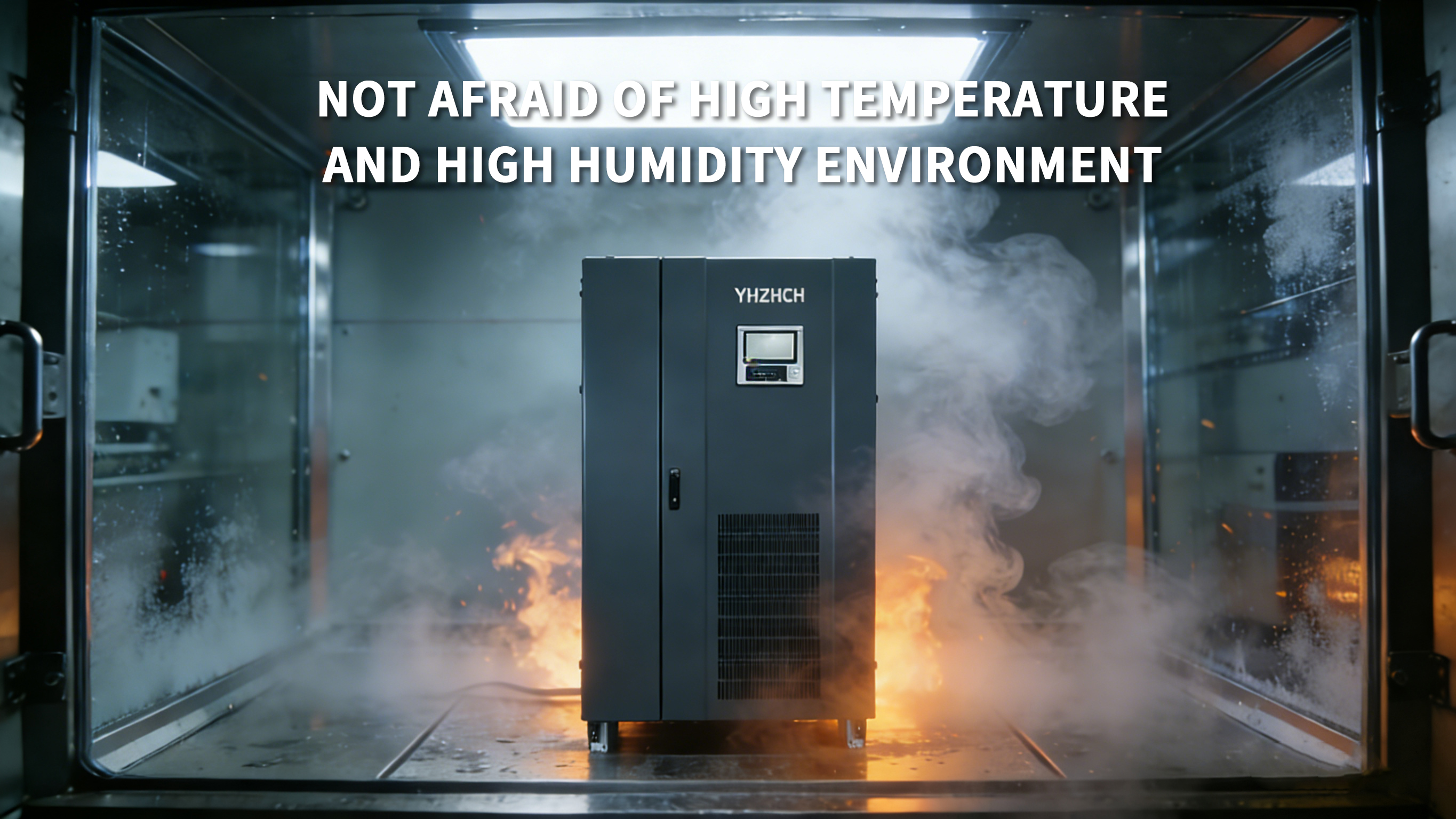
Guide for purchasing power frequency online UPS in high temperature and high humidity environment
Power frequency on-line UPS is the core power supply equipment in high-temperature and high-humidity industrial environment (such as metallurgy, chemical industry, southern coastal factories, outdoor computer rooms, warehousing and logistics centers) because of its impact resistance, strong load-carrying capacity and high stability. The core pain points of such environment are that components are corroded by moisture, heat dissipation efficiency is reduced, insulation performance is reduced, and battery life is sharply reduced. The selection should focus on temperature and humidity resistance design, heat dissipation capacity, anti-corrosion protection, battery adaptation and redundancy reliability.
1. Core hard index: basic parameters suitable for high temperature and high humidity.
1. Working temperature and humidity range: break through the conventional civil standards.
The normal working temperature and humidity of civil UPS is 0~40℃ and 20%~80% RH. In high temperature and high humidity environment, industrial-grade wide temperature and wide humidity model should be selected. The core parameters are as follows:
Working temperature: -10~55℃ (the model supporting short-term overload operation at 60℃ is preferred), and there is no power derating in the high-temperature environment above 40℃ (the conventional model is easy to derate to below 80% at high temperature, which cannot meet the full-load power supply);
Working humidity: 10%~95% RH without condensation (key index, to avoid condensation short circuit of circuit board caused by high humidity);
Storage temperature and humidity: -20~70℃, 5%~98% RH, to meet the working conditions of sudden change of environmental temperature and humidity.
2. Protection grade (IP grade): targeted against dust and water vapor.
Select IP protection level according to the field humidity+dust/water vapor contact degree, focusing on cabinet sealing and interface protection. Recommended level:
High humidity and no direct water vapor: IP32/IP42 (to prevent water droplets and dust from entering the cabinet and meet the requirements of ordinary workshops/computer rooms);
High humidity+slight water vapor/spray (such as chemical workshop and food processing workshop): IP54/IP65 (dustproof and splash-proof, the cabinet is fully sealed, and the fan/radiator has a waterproof and dustproof net);
Outdoor high humidity and high salt fog (such as coastal outdoor computer room): IP66 (completely dustproof and strong water spray prevention)+salt fog protection (C4/C5 level) to avoid sea breeze salt fog from corroding metal components and circuit boards.
Note: The higher the protection level, the higher the cooling design requirements of the cabinet, so it is necessary to match the independent air duct to avoid the cooling failure caused by sealing.
3. Insulation and voltage resistance: to prevent insulation breakdown after being affected with damp.
High temperature and high humidity will reduce the electrical insulation performance and easily lead to short circuit and leakage. Please confirm when purchasing:
Insulation resistance of input/output to casing: ≥20MΩ(500V megohmmeter test);
Power frequency withstand voltage: there is no breakdown and flashover when the input/output circuit outputs 2500VAC/1min to the casing and the input/output circuit;
The circuit board adopts three-proof paint technology (moisture-proof, mildew-proof and salt fog-proof), which is the standard of industrial UPS. It is necessary to confirm that the three-proof paint is made of acrylate/polyurethane (strong temperature resistance and not easy to fall off).
Second, the core structure design: the core advantages of the power frequency machine fall to the ground and adapt to the harsh environment.
The core advantages of power frequency on-line UPS are isolation of power frequency transformer and impact resistance of power devices. In high temperature and high humidity environment, attention should be paid to the details of heat dissipation, anti-corrosion and anti-interference of structural design to avoid design defects leading to failures.
1. Cooling system: the "lifeline" of high temperature environment, rejecting single cooling.
The heat dissipation efficiency directly determines the stability and life of UPS at high temperature. The "fan+natural heat dissipation" of conventional civil aircraft cannot meet the demand, so it is necessary to choose a multi-stage intelligent heat dissipation system. The core requirements are:
Heat dissipation mode: independent air duct+high-power industrial-grade axial flow fan (the air duct separates input/output/power module to avoid hot air backflow, and the fan adopts high-temperature bearing, and the working temperature is ≥ 70℃);
Fan control: intelligent temperature control and speed regulation (automatically adjust the speed according to the temperature inside the machine to avoid time-varying wear at low temperature and low consumption, and dissipate heat at full load at high temperature), and support fan fault alarm/redundancy (double fan design, single fan fault can still maintain heat dissipation);
Power devices: IGBT, rectifier bridge, power frequency transformer and other core devices are attached with heat sink+thermal conductivity silicone grease (thermal conductivity ≥ 3.0W/MK), and power frequency transformer adopts low-loss silicon steel sheet to reduce heat sources.
2. Power frequency transformer: Customize and adapt to harsh environment, strengthen isolation and temperature resistance.
Power frequency transformer is the core of power frequency machine, and attention should be paid to material, insulation and protection under high temperature and high humidity;
Insulation grade: Class H (180℃) or Class C (220℃) (Class B/130℃ for conventional civil aircraft, which is easy to age at high temperature), and the winding adopts high temperature-resistant polyimide wire;
Protective treatment: the transformer core and winding are sealed by dipping paint (vacuum dipping paint) to prevent the insulation from decreasing due to moisture intrusion;
Isolation performance: Full isolation of input and output is standard, which can not only resist power grid surge, but also avoid ground potential drift caused by environmental humidity and protect back-end load.
3. Cabinet and components: anti-corrosion and anti-rust, avoiding the risk of being affected with damp from details.
Cabinet material: cold-rolled steel plate is electrostatically sprayed (thickness ≥2.0mm), and 304 stainless steel cabinet is preferred in coastal high salt fog environment to avoid rust and corrosion of cabinet;
Internal components: industrial-grade wide-temperature components (capacitors, resistors, relays, etc.) are selected, and Japanese/Taiwanese high-temperature electrolytic capacitors (working temperature ≥105℃, service life more than twice that of 85℃ capacitors) are preferred;
Wiring terminal: Tin-plated/silver-plated copper terminal is adopted, and it is equipped with insulation shield to prevent the terminal from poor contact, heating and ablation caused by moisture oxidation.
Third, the battery system: in the "hardest hit area" under high temperature and high humidity, adaptation+protection are two-pronged.
UPS batteries (mostly lead-acid batteries) are the components with the fastest life decay in high temperature and high humidity environment (the life of lead-acid batteries is halved for every 10℃ increase in temperature; Excessive humidity can easily lead to corrosion of battery poles and leakage of electrolyte), and battery selection+installation protection is more critical than UPS host, so it needs to be adapted to the host design:
1. Battery selection: industrial-grade high-temperature resistant valve-regulated lead-acid battery is preferred.
Type: Valve-regulated sealed lead-acid battery (VRLA) (maintenance-free, avoiding evaporation of electrolyte, suitable for high-humidity environment), and colloid battery (with stronger temperature resistance, humidity resistance and deep cycle ability than ordinary lead-acid battery, suitable for frequent charging and discharging under high temperature and high humidity) is preferred;
Temperature resistance index: working temperature **-15~50℃**, floating charging operation temperature is preferably 25℃, but long-term floating charging at 35~45℃ is required (with high-temperature floating charging voltage compensation);
Capacity matching: at high temperature, the actual capacity of the battery will decrease (the capacity at 40℃ is about 85% of that at 25℃), and the capacity should be increased by 1.2~1.5 times of the actual load capacity when selecting the battery.
2. Battery matching design: cooperative protection of host and battery.
The main engine is equipped with intelligent battery management (BMS) system: the core functions include automatic compensation of high-temperature floating charge voltage (reducing floating charge voltage at high temperature to avoid overcharge and water loss), low-temperature charging current limiting, battery temperature monitoring, over-temperature alarm/power-off protection, and the model with battery monomer monitoring is preferred (to avoid the failure of a single battery affecting the whole group);
Battery cabinet protection: IP protection of the same level as UPS host, with built-in dehumidifier (temperature and humidity sensor+condensation dehumidifier) to avoid condensation in the battery cabinet; Anti-corrosion spraying and internal insulation treatment for battery cabinets in coastal high salt fog environment;
Installation method: the battery pack is installed in layers+insulating bracket, the bottom is waterproof, the pole is coated with anti-oxidation grease, and the connecting wire is made of high temperature resistant flame retardant wire.


