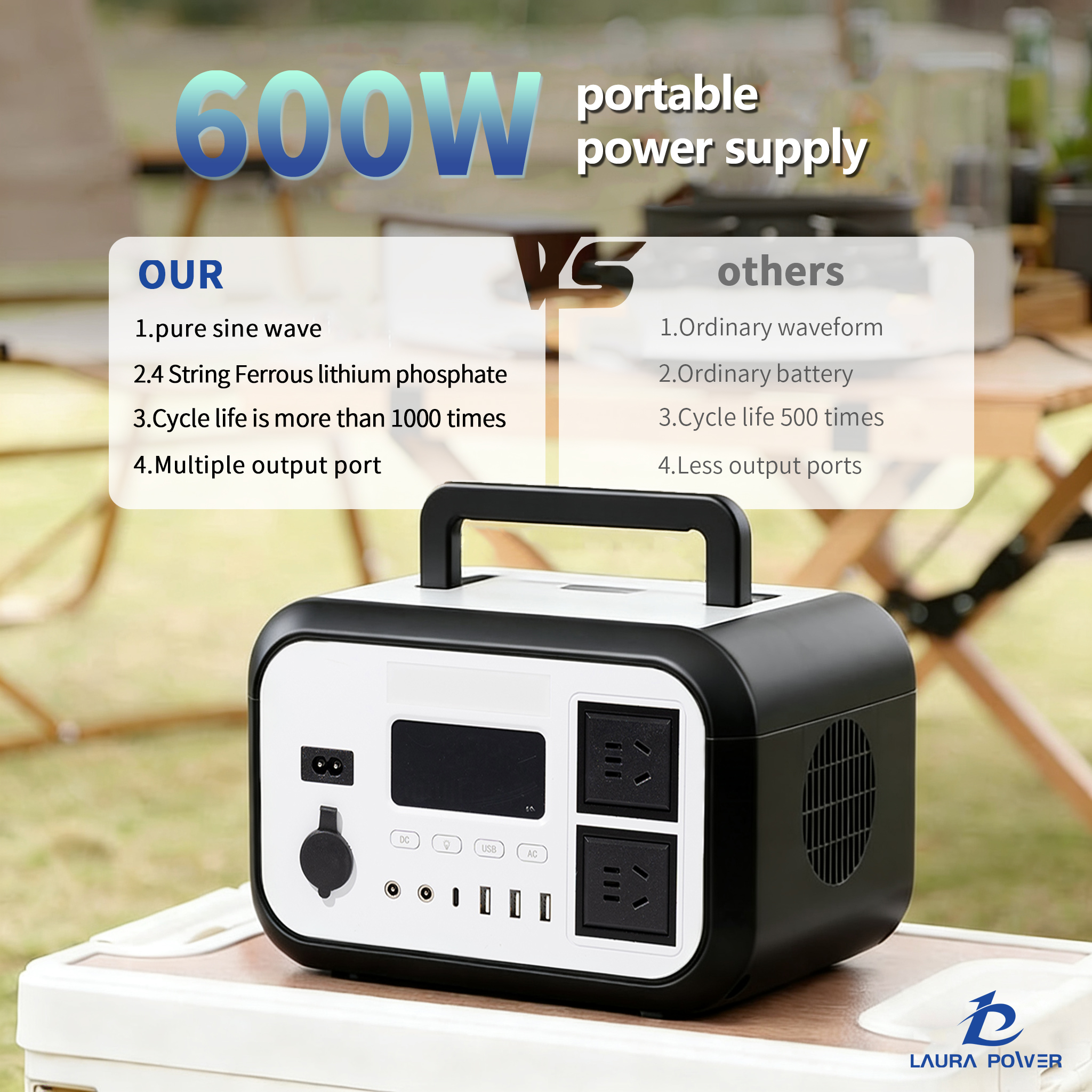
With the upgrading of outdoor life, mobile office and family emergency demand, portable power supply has changed from "niche accessories" to "just-needed equipment". However, in 2026, there are many brands in the market, and problems such as false standard capacity, power fraud and inferior batteries still plague most consumers. Even third-party testing data show that the false standard rate of capacity is as high as 42%, and the false standard of peak power exceeds 35%. This paper teaches you to choose the right portable power supply accurately and refuse to pay for the "digital bubble" from four dimensions: core parameters, battery selection, pit avoidance skills and scene adaptation.
How to choose the capacity? Understand Wh and mAh, and give consideration to demand and compliance.
Capacity is the core of determining battery life, but most people only look at mAh (milliampere hour), ignoring the actual available energy and aviation compliance requirements, which is the first misunderstanding in purchasing.
1. Unit conversion: Wh is the "real endurance scale"
The nominal mAh of portable power supply is the battery capacity (based on 3.7V voltage system), but the actual power output to the equipment is affected by voltage conversion, so Wh (watt-hour) is needed to judge it more accurately. Conversion formula: Wh = mAh × 3.7V ÷ 1000. For example, a 20000mAh battery cell corresponds to Wh of 20000×3.7÷1000=74Wh.
More importantly, the actual exportable capacity ≈ nominal Wh× conversion efficiency, the conversion efficiency of high-quality products is 75%-85%, and the inferior products are only below 50%. For example, the nominal 74Wh power supply, the high-quality model can actually be used about 55-63Wh, and the inferior model may only be about 37Wh, and the battery life is directly halved.
2. Selection on demand: Reject "bigger is better"
Daily commuting/emergency: 5000-10000mAh(18.5-37Wh), palm-sized, weighing 200-300g, which can charge iPhone 16 for 1.5-2 times and Huawei Mate 70 for 1-1.5 times, and there is no pressure to put in a pocket or a small bag, which is suitable for short-distance travel.
Multi-device outing/travel: 10,000-20,000 mAh (37-74 Wh), the mainstream cost-effective choice, which can charge mobile phones, tablets and Bluetooth headsets at the same time, weighing 300-500g, and the backpack is suitable to meet the needs of going out for 1-2 days.
Outdoor camping/family emergency: more than 20000mAh (74Wh+), it is recommended to choose a large-capacity model of 500-2,000 Wh, which can drive electric cookers, car refrigerators, routers and other equipment, and is suitable for camping for two days and one night or family power failure emergency.
3. Virtual capacity standard: Three measures to verify the real endurance
Look at the rated capacity: high-quality products will be marked with "nominal capacity" and "rated capacity" at the same time, and the rated capacity is the actual output power. If only the nominal capacity is marked, you should be wary of the virtual standard;
Measurement of actual charging times: Taking iPhone 15 (about 3349mAh battery) as an example, the power supply with rated capacity of 12000mAh can be charged three times theoretically, and if it is actually charged only twice and the power fails quickly in the middle, it is a virtual standard;
Weighing weight: under the same capacity, inferior products are lighter because of cutting corners. The weight of high-quality products of 20000mAh is ≥400g, and if it is less than 300g, it is likely to be a virtual standard capacity or inferior batteries.
4. Power virtual standard: rejecting "paper parameters"
Test with a small USB voltage ammeter (starting with tens of yuan), insert the tester between the power supply and the equipment, and calculate the actual output power (P=U×I). If the nominal fast charge is 22.5W, the actual output is only 13.5W, or the high-power output quickly drops after a few minutes, which is the power virtual standard.
5. Safety is not guaranteed: certification and protection must be seen.
Regular products must have 3C certification, and the circuit board has more than 8 protections (overcharge, overdischarge, short circuit, overtemperature, overcurrent, etc.); 3. There is no certification or even a protective plate for any product, which is prone to the risk of fever, bulging and spontaneous combustion when used. Do not buy it cheaply.


