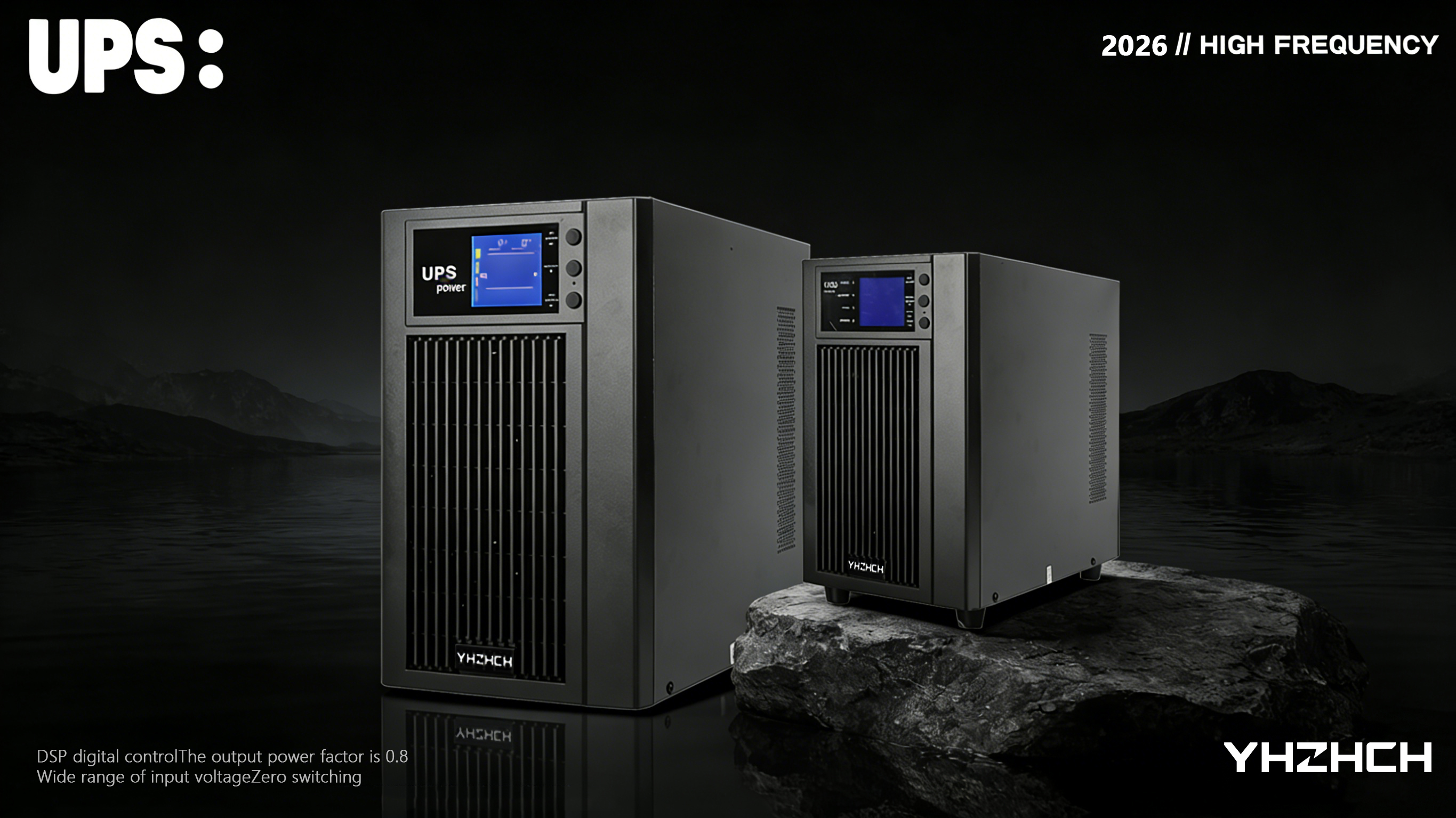
Judging the reliability of high-frequency on-line UPS is the core of selection. The core revolves around five dimensions: hardware foundation, performance index, protection design, quality control certification and actual verification. From parameter marking, component configuration, design details to scene measurement verification, we look at both "paper data" and "actual manufacturability". The following judgment methods can be implemented, taking into account procurement screening and on-site verification:
First, look at the core hardware configuration: the "hardware foundation" of reliability, the more solid, the more stable.
More than 80% of the faults of high-frequency online UPS come from core components, and the brand, specification and grade of components directly determine the basic reliability, which is the core judgment basis. Focus on the following key components:
Power device: the "heart" of high-frequency UPS, giving priority to industrial grade.
The core of rectifier and inverter is IGBT/power MOSFET module, which is the core power device of high-frequency UPS, directly affecting overload, impact resistance and long-term operation ability;
Look at the device specifications: in industrial scenes, it is necessary to choose a model with a temperature tolerance of ≥150℃ and a voltage tolerance of ≥20% to avoid device breakdown caused by power grid fluctuation/high temperature.
Tip: The manufacturer can be required to provide the component list (BOM), and the regular brand will clearly indicate the core component brand, while the miscellaneous brand will be vaguely expressed.
Capacitor/inductor: choose long life and high voltage resistance to avoid bulging/burning.
Electrolytic capacitors: Japanese (nichicon, Ruby) and Taiwanese (Fengbin) long-life capacitors are preferred, and the marked life is ≥ 8,000 hours (105℃). Explosion-proof capacitors should be selected in industrial scenes to avoid high temperature bulging;
Filter inductor/transformer: There is no power frequency transformer for high-frequency UPS, but the filter inductor should be of oxygen-free copper winding and sealed iron core, and the withstand voltage level should match the upper limit of input voltage to avoid electromagnetic interference and winding burning.
Battery management and power distribution components: see quality for details.
Battery charger: Choose intelligent three-stage charging (floating charging/even charging/fast charging) model with battery temperature compensation to avoid battery damage due to overcharge/overdischarge (battery failure is a common cause of UPS shutdown);
Circuit breaker/fuse: Special protection devices of well-known brands (Schneider, Zhengtai) are standard, instead of ordinary terminals, which can accurately cut off short circuit/overload current and avoid fault expansion.
Structure and heat dissipation: determining the reliability of long-term operation
Heat dissipation design: air duct is independent (power area/control area is separated), fan redundancy (N+1), and intelligent temperature control (fan speed is adjusted with load/temperature) to avoid local overheating (high temperature is the biggest culprit of component aging);
Structural material: For industrial scenes, the machine with thickened sheet metal (≥1.2mm) and dustproof design is preferred, and the protection level is ≥IP21 to prevent dust/water vapor from entering the interior and causing short circuit.
Second, look at quality control and certification: third-party endorsement to verify "regularity"
Regular brand UPS will pass strict quality control and authoritative certification, which is a "third-party endorsement" of reliability. Avoid choosing "workshop machine". Focus on the following certification and quality control details:
Domestic/international compulsory/authoritative certification
Domestic requirements: 3C certification (China compulsory product certification) to ensure compliance with domestic safety and performance standards;
Industry/export scenario: CE (EU), UL (USA), TUV (Germany), ISO9001 (quality system) certification, which has strict requirements and can verify product quality control;
Special scenario: medical equipment needs YY0505 (medical electromagnetic compatibility) and data center needs TL9000 (communication industry quality) certification.
Manufacturer quality control process
Regular brands will have the whole process of quality control: components entering the factory for inspection → full inspection of the production process → aging test of finished products (aging at full load for 72 hours or more) → factory sampling inspection, and manufacturers can be required to provide quality control reports, while miscellaneous brands will not have aging tests and leave the factory directly.
Third, look at the actual verification: from the test, case, after-sales verification of "true reliability."
Actual performance, market verification and after-sales guarantee are the final criteria for judging reliability, which can be verified by the following methods:
Field test: simulate extreme working conditions and verify actual performance.
When purchasing acceptance or prototype testing, do three core tests to quickly verify the reliability:
Full load aging test: let UPS run with 100% rated load for 24 hours, and check whether the output voltage/temperature/noise is normal, and there is no alarm or crash;
Overload test: run with 120% load for 5 minutes, and observe whether UPS can run stably without trigger protection;
Power grid abrupt change test: simulate the sudden rise/fall of input voltage (such as 220V→90V→220V) and frequency abrupt change (50Hz→40Hz→50Hz), and check whether the UPS output is uninterrupted and there is no battery switching/alarm.
After-sale and quality assurance: the "last guarantee" of reliability
UPS is power equipment. Whether it can be repaired quickly after a fault directly affects the overall power supply reliability. Focus on:
Warranty period: the warranty period of Yunhai brand is 1~3 years, and the warranty period of core components (IGBT and inverter) is 3~5 years. The warranty period of modular UPS module is longer, and the shorter the warranty period, the less confidence manufacturers have in product reliability.
After-sales outlets: local offline service outlets and technical teams can realize 24-hour on-site maintenance (service coverage should be confirmed in remote areas) to avoid long-term power outage caused by unattended maintenance after failure;
Technical support: provide free on-site survey, scheme design, installation and debugging, and 7×24 hours of technical consultation, which can solve problems in use in time and prevent minor problems from turning into major failures.
The reliability of different scenarios focuses on judgment.
Ordinary office/small computer room: focus on core device brand, basic protection function, MTBF ≥ 100,000 hours, and give consideration to cost performance;
Industrial workshop/remote base station: focus on industrial components, ultra-wide power grid adaptation, dustproof and heat dissipation, and impact overload resistance;
Data center/medical/industrial control: focus on modular redundancy, full-dimensional protection, high MTBF and 7×24 hours after-sales;
Matching scene of generator: focus on wide frequency range, generator mode, anti-harmonic interference and open-phase protection.


