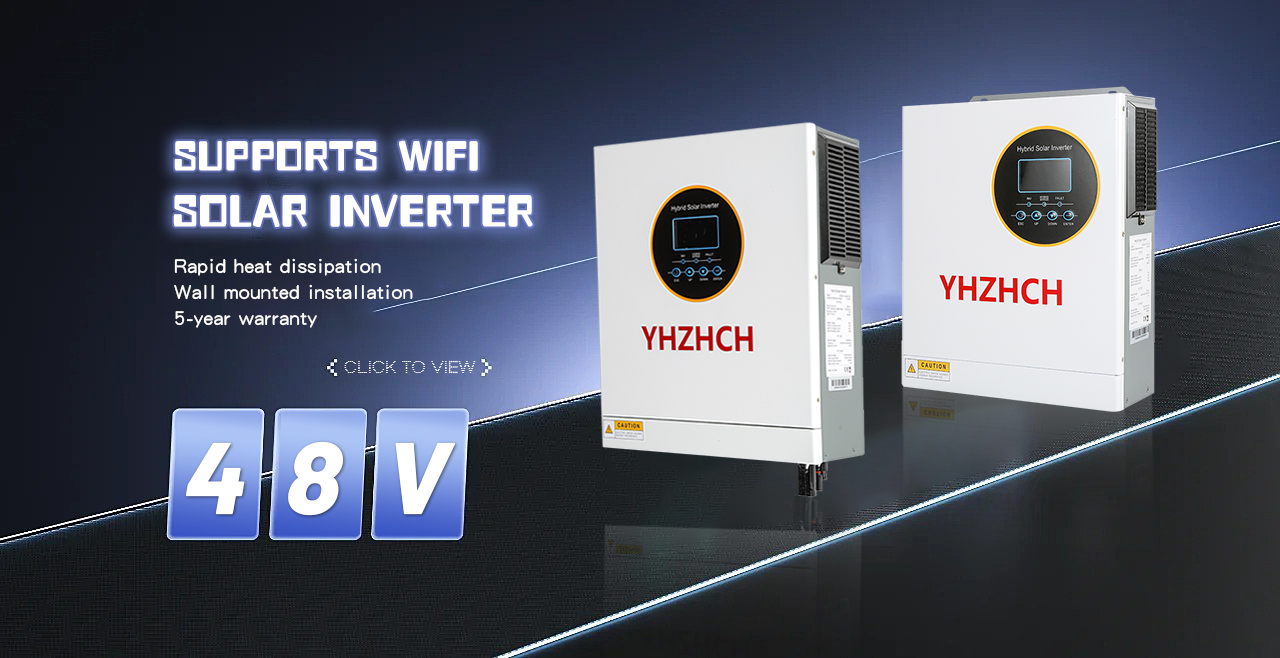
The loss of solar inverter will directly affect the overall power generation efficiency and income of photovoltaic system. To reduce the loss, we need to start from many dimensions such as circuit design, device selection, control strategy, operation and maintenance management, and the specific measures are as follows:
First, optimize the selection and configuration of core power devices
Choose low-loss power switching devices.
The core loss of inverter comes from the conduction loss and switching loss of power switching tubes (such as IGBT and MOSFET). Choose * * MOSFET with low on-resistance (Rds (on)) or IGBT with low saturation voltage drop (Vce (sat))** * first, and balance the switching loss and driving loss at the same time.
For the high-frequency inverter scene, the third generation wide band gap semiconductor devices such as GaN and SiC can be selected, the switching loss is only 1/10~1/5 of that of traditional silicon-based devices, and the on-loss is lower, which can significantly reduce the overall loss.
Optimal matching diode/freewheeling device
Fast recovery diode (FRD) or silicon carbide Schottky diode (SiC SBD) are preferred as the freewheeling diode or rectifier diode of the inverter bridge arm. The former has short reverse recovery time, while the latter has no reverse recovery loss, which can avoid the extra energy loss caused by diode reverse recovery.
Second, improve the circuit topology and structure design
Adopt efficient topological architecture
The full-bridge LLC resonant topology can be used for medium and small power inverters. This topology can realize zero-voltage turn-on (ZVS) of the switch tube and zero-current turn-off (ZCS) of the diode near the resonant frequency, which greatly reduces the switching loss and improves the efficiency by 2%~5% compared with the traditional forward and flyback topologies.
High-power grid-connected inverter can adopt modular multilevel topology (such as MMC) or three-level NPC topology, and the voltage stress of switch tube in three-level topology is only half of that in two-level topology, so devices with lower withstand voltage and less loss can be selected, and the output harmonic content is low, thus reducing the loss of filtering links.
Optimized filtering and auxiliary circuit
The inductance of the LC filter on the output side is nanocrystalline or Fe-Si-Al core with low hysteresis loss and eddy current loss, and the capacitor is thin film capacitor with high frequency and low loss, so as to reduce the energy loss in the filtering process. At the same time, by accurately calculating the filter parameters, the power loss of the filter device is minimized under the premise of meeting the harmonic standard.
Simplify the architecture of auxiliary power supply, and use high-efficiency DC/DC module to supply power to the control circuit, so as to avoid the excessive loss of auxiliary power supply itself.
Third, optimize the control strategy and operation mode
Realize soft switching control
The zero-voltage turn-on (ZVS) and zero-current turn-off (ZCS) of the switch tube are realized by the control algorithm. For example, in LLC topology, the resonant frequency is tracked by the phase-locked loop, so that the device always works in the soft-switching region, and the overlapping loss of voltage and current in the switching process is eliminated.
Pulse width modulation (PWM) optimization strategies, such as harmonic suppression algorithm of sinusoidal pulse width modulation (SPWM) and space vector pulse width modulation (SVPWM), are adopted to reduce switching times and current harmonics, and reduce switching losses and winding losses.
Intelligent matching of load and working condition
For multi-module inverter, module switching control is adopted: when the load rate is lower than 30%, some power modules are turned off, so that the remaining modules work in the high efficiency range (the inverter usually has the highest efficiency when the load rate is 70%~100%) to avoid inefficient loss under light load.
Grid-connected inverter can be optimized by maximum power point tracking (MPPT) algorithm, for example, the hybrid MPPT with disturbance observation method and conductance increment method can quickly track the maximum power point of photovoltaic array and reduce the power fluctuation loss during MPPT; In addition, the inverter frequency is dynamically adjusted according to the illumination intensity to avoid invalid high-frequency switching loss.
Fourth, strengthen heat dissipation design and device heat dissipation management
Optimize heat dissipation structure
The power device is the main heat source, so it is necessary to use a heat dissipation substrate with high thermal conductivity (such as aluminum nitride ceramic substrate) with efficient heat dissipation components such as heat pipes and vapor chamber, and control the working temperature of the device in the optimal range of 60℃~80℃ (if the temperature is too high, the on-resistance of the device will increase and the loss will increase exponentially).
For high-power inverter, the traditional air cooling is replaced by liquid cooling. The cooling efficiency of liquid cooling is 5~10 times that of air cooling, which can effectively reduce the temperature rise of devices and reduce the power consumption and noise of fans.
Intelligent temperature control and speed regulation
Equipped with temperature sensor and intelligent fan speed control system, the fan is started only when the device temperature reaches the threshold, and the speed is dynamically adjusted according to the temperature to avoid the extra power consumption caused by long-term full-load operation of the fan.
Fifth, standardize operation and maintenance and aging management
Regular inspection and maintenance
Regularly check the cleanliness of the cooling fins of power devices, clean up dust and oil stains in time, and avoid excessive temperature rise caused by blockage of cooling channels; Check the contact resistance of the terminal, tighten the loose connection and reduce the contact loss.
Regularly detect the capacitance and leakage current of the capacitor and the turn-on voltage drop of IGBT, and replace the aging devices to prevent the aging devices from generating additional losses due to parameter drift.
Reduce standby and no-load losses
At night or when there is no light in the photovoltaic system, the inverter is controlled to enter a low-power standby mode, unnecessary power modules and auxiliary circuits are turned off, and only the core monitoring unit is kept, so that the no-load loss is reduced to below 1W (the no-load loss of traditional inverters is usually 5~10W).
Sixth, system-level collaborative optimization
Voltage level matching between inverter and photovoltaic module and energy storage battery: make the DC input voltage of inverter work in its optimal input voltage range, so as to avoid the reduction of conversion efficiency caused by too low or too high voltage, for example, accurately match the DC input range of inverter with the working voltage range of photovoltaic array, and reduce the loss of buck/boost link.
Power factor coordination between grid-connected inverter and power grid: Through reactive power compensation control, the inverter works near the unit power factor to avoid line loss and additional device loss caused by reactive power transmission.


