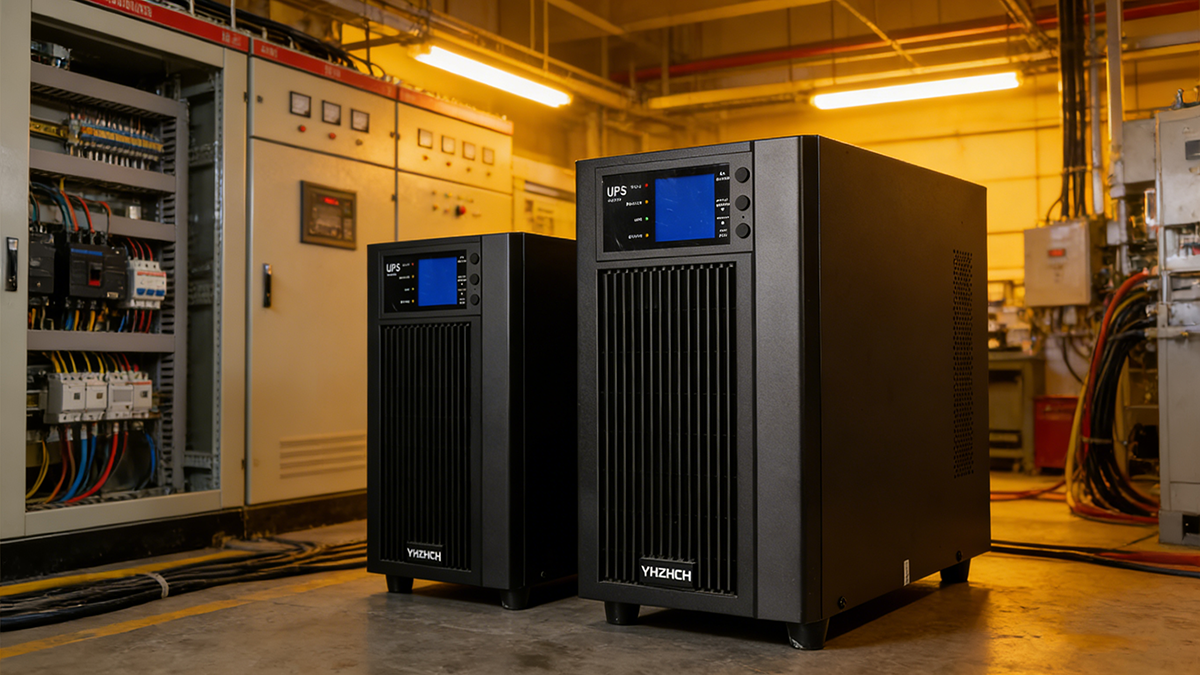
Derating: The actual on-load power of UPS is less than the rated output power of UPS, aiming at reducing temperature rise, prolonging service life and improving reliability. The best derating is not as low as possible, and reliability, cost and battery backup time should be taken into account.
First, make clear two basic parameters.
Rated capacity of UPS: general standard kVA, active power = kVA × power factor PF.
Example: 100kVA UPS, PF=0.9 → rated active power 90kW.
Active power of load: \(P_{load}\)(kW)
Load rate = actual active load ÷ rated active power of UPS
Second, the industry's general recommended load range (optimal derating range)
form
Description of recommended optimal load rate (derating interval) for UPS type
30% ~ 70% of power frequency ups is lower than 30%, and the efficiency is low; > 70% temperature rise, lack of redundancy.
The light load efficiency of 40% ~ 75% high-frequency modular UPS is better than that of power frequency, and the upper limit can be higher.
40% ~ 60% of small on-line UPS (within UPS(10kVA) have small heat dissipation margin, so long-term high load is not recommended.
The best point recognized in engineering: 50% load rate
50% load: UPS efficiency is close to the peak value, device temperature rise is moderate, battery discharge depth is shallow, enough redundancy is reserved to deal with sudden load increase, and capacity expansion space is sufficient.
Taboo: Long-term > 80% full load operation, accelerated aging of components; Long-term < 20% light load, low efficiency, harmonic deterioration of some models, and easy under-charging of batteries.
Third, the best derating power
Statistical active power of all loads
Add up the rated power of the back-end equipment, and consider:
Impact load (motor, starting current): Reserve starting margin.
Future expansion: reserve 10%~30% new load.
Check the battery backup time (very critical)
Battery backup time is directly related to load: the lower the load, the longer the backup time; However, excessive derating will lead to a significant increase in battery configuration costs.
When the load rate is too low (< 30%): in order to meet the backup time, the number of batteries is not much, but the investment of UPS mainframe is too large and the economy is poor.
High load rate (> 70%): Under the same battery configuration, the backup time is shortened, the battery discharge current is large, and the service life is shortened.
Combined with UPS efficiency curve correction
Check the efficiency-load ratio curve of UPS manufacturer:
Find the load interval corresponding to the highest efficiency and give priority to this interval. The peak efficiency of many high-frequency UPS ranges from 40% to 70%.
Fourth, additional constraints (decide whether to take 50%)
Redundancy requirements (N+1/2N)N+1 Redundancy: If a single UPS fails, the remaining UPS should be able to carry all loads.
Example: 2 sets of 100kVA N+1, the total load cannot exceed the rated capacity of a single set, so the upper limit of load rate is limited.
Harmonic and output distortion nonlinear load (server, switching power supply): the load rate is too high, and the output THD increases; When the load is too low, the inverter stability of some UPS becomes worse.
The ambient temperature is high (> 30℃) in the computer room, so the derating of devices should be increased. It is suggested to lower the upper limit of load rate by 5%~10%.
Battery discharge depth DOD derating = the load decreases, the battery discharge current decreases, the DOD decreases, and the battery life increases; However, the economy of excessive derating has declined.
V. Simple process for quickly judging the optimal derating.
Statistical load+capacity expansion+impact margin → Calculate the maximum actual active load.
Look at the primary target load rate of UPS architecture (power frequency/high frequency/small machine) (50% priority)
Check the redundancy scheme: Can the residual UPS capacity after the failure take all the loads?
Check the manufacturer's efficiency curve and make sure it falls in the high efficiency range.
Check the battery configuration and backup time, and evaluate the economy.
Final determination: long-term operating load power = rated active power of UPS × target load rate.
Sixth, common misunderstandings
The lower the load, the safer it is: < 20% light load, low efficiency of UPS, poor load capacity and harmonic characteristics of some models, and waste of cost.
Don't just use kVA to directly calculate the load rate, you must use active kW, and the UPS power factor can't be ignored.
Deregulation only depends on the host, ignoring the battery: when the load drops, the battery cost should be evaluated simultaneously.
Sum up a sentence
The optimal derated operating power of UPS is 50% of the rated active power of UPS, and then fine-tuned in the range of 30%~75% according to the model, room temperature, redundant architecture and battery backup time; At the same time, ensure that the fault redundancy conditions meet and fall within the high efficiency range of UPS.


