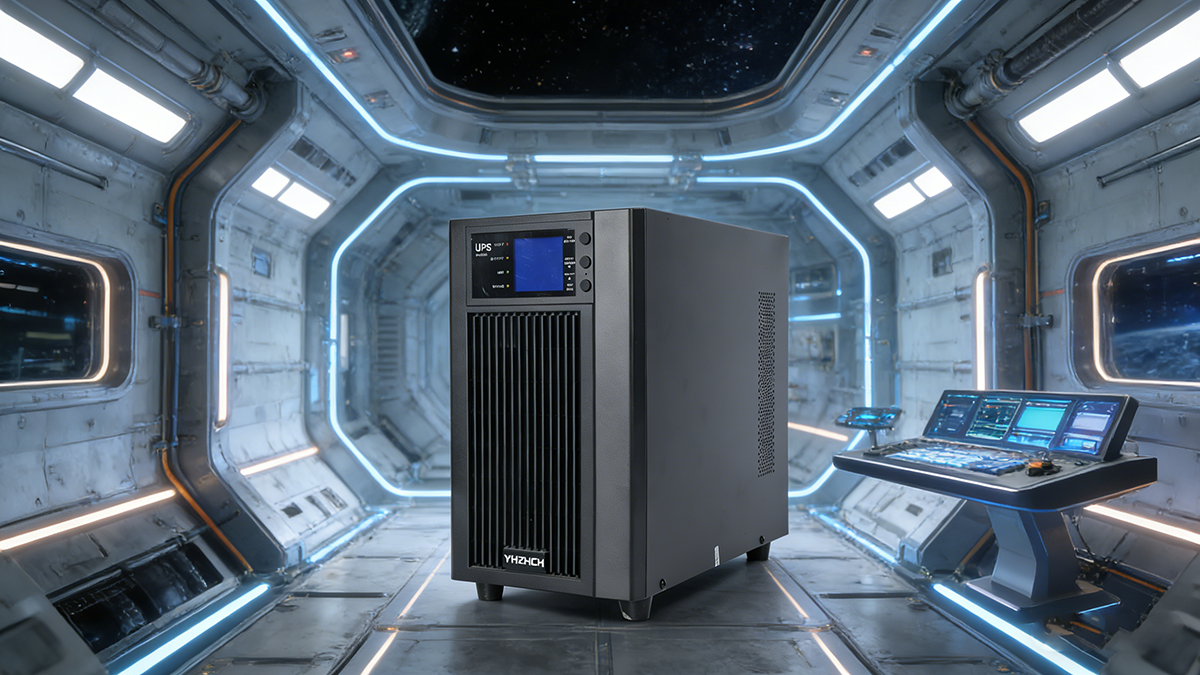
Core architecture of high-frequency on-line UPS: double conversion on-line (AC-DC-AC full-range inverter power supply), which is different from the power frequency machine. The switching device is high-frequency IGBT, which is small in size and faster in inverter response; The evaluation is divided into five dimensions: switching performance index, fault self-healing/protection logic, fault handling ability of the whole machine, actual measurement and verification, and hardware architecture.
1. Judgment of core switching ability (most critical, switching between utility/battery/bypass)
Ideal state of on-line UPS: In normal mode, the load is powered by the inverter, and the commercial power only charges the rectifier, and the main loop does not go through static bypass. Three main scenarios are switched, and the switching time, waveform continuity and no power failure are the standards:
1. Power interruption → battery inverter switching (most commonly used)
Judgement criteria:
switching time
Qualified high frequency online machine: 0ms switching (zero interruption)
Principle: Rectifier and inverter run synchronously. When the commercial power disappears, the battery seamlessly takes over the rectifier to supply power to the inverter bus, with no power-off gap.
Inferior model: switch > 2 ms, precision industrial control, server will be power off, restart, directly unqualified.
Output voltage waveform distortion
Observe with an oscilloscope at the switching moment: sine wave has no sag, drop and peak, and the rated voltage with voltage fluctuation ≤ 5% is preferred; Fluctuation > 10% belongs to poor switching control algorithm.
2. Inverter failure/overload → static bypass switching (inverter to mains direct supply)
When the inverter is abnormal (over-current, over-temperature, abnormal DC bus), it will trigger the static switch STS to switch to the mains bypass, so as to ensure uninterrupted power supply to the load:
Decision points:
Switching time: ≤1ms (required by the national standard of the industry). Because of its fast driving response, the high frequency machine is generally 0.4~0.8ms, which is better than the old power frequency machine;
Switching process: no voltage drop, no phase out-of-step impact;
Inferior problems: the bypass is cut when the phase is not synchronized, resulting in surge and burning of switches and industrial control boards;
Failback ability: after the fault is eliminated, it can automatically switch back to the inverter online mode (with automatic reset), and it is equipped without manual closing; The low-end machine must be reset manually after cutting the bypass.
3. Commercial power recovery: battery inverter switches back to commercial power rectification mode.
After the mains call, the battery exits the power supply and the rectifier works again:
Excellent model: seamless connection, no disturbance of load voltage;
Poor machine: the voltage rises at the moment of incoming call, and the back-end equipment restarts.
Supplement: Overhaul bypass switching (maintenance without stop)
It is necessary to have a three-level switch for manual maintenance bypass (main circuit, bypass and maintenance), with continuous power supply during switching and power-off maintenance of UPS. Most of the household low-power high-frequency machines have no independent maintenance bypass, so the operation and maintenance fault tolerance is poor.
Second, all kinds of fault handling ability item by item evaluation list
(1) Disposal of input side mains failure
Under-voltage/over-voltage of mains supply and frequency offset
Outside the normal range: automatic battery switching inverter; Automatic recovery when the mains return to normal range;
Decision: Voltage threshold and frequency threshold can be set, and it will not switch back and forth frequently (no oscillation jitter).
Input phase loss, abnormal zero line and serious harmonic distortion.
High-frequency machine has built-in PFC power factor correction, which has strong anti-harmonic ability: it can tolerate bad power grid and still stabilize inverter output; Low-cost high-frequency machine without PFC is easy to report failure and stop when the power grid is poor.
(B) battery system failure (UPS high-frequency failure)
Fault handling ability:
Low-voltage battery protection: when the voltage drops to the cut-off voltage, shut down the battery smoothly, and prevent the battery from being damaged by over-discharge;
Deterioration detection of single battery: the voltage and internal resistance of each battery can be inspected, and the backward battery can be warned in advance, instead of the whole battery being out of power;
Charging management: automatic switching of uniform charging/floating charging, overcharge protection, and high-temperature downflow charging; If the ambient temperature is too high, automatically lower the charging voltage to avoid bulging;
Battery disconnection alarm: the battery wiring is loose and the fuse is blown, so that the inverter will not collapse due to abnormal bus.
(C) UPS internal power circuit fault protection (core safety capability)
The power devices (IGBT, inverter bridge, driving board) of high-frequency machine are fragile, and whether the protection logic is perfect or not is a watershed;
Output overload/short circuit protection
Instantaneous short circuit: immediately block the inverter pulse and turn off the power tube in milliseconds, which will not blow up the machine; Then automatically cut the bypass;
Continuous overload: alarm at different levels (early warning → demotion → bypass cutting), and do not burn the hardware hard;
Overtemperature protection
Multi-point temperature measurement of radiator, IGBT and transformer: when the temperature rises, the load will be reduced first, the over-temperature alarm will be given, and the bypass will be automatically cut off in case of serious failure; Fan fault detection alarm;
DC bus overvoltage/undervoltage, IGBT overcurrent, drive failure
Double protection of hardware and software: hardware is extremely current-limited, software records fault codes and latches fault information for easy investigation;
Lightning protection and surge resistance
Input the first-level and second-level lightning protection modules, which can withstand lightning surge impact, and the power grid peak will not break through high-frequency power devices.
(four) alarm, recording and remote fault handling capabilities
Local: acousto-optic alarm, LCD accurate fault code (classified prompts such as abnormal mains supply, battery fault, overtemperature, overload, inverter fault, bypass operation, etc., rather than general error reporting);
Historical fault log: it can store hundreds of fault records, occurrence time and operation parameters, which is convenient for the cause of resumption;
Remote monitoring: it supports RS485, SNMP and trunk node communication, can be connected to the dynamic ring system, and actively pushes the alarm when faults occur; Can remotely view the running status and set parameters; High-end models support remote shutdown/reset.
Third, distinguish: the advantages and disadvantages of high-frequency online UPS compared with power frequency machine (switching-fault level)
Advantages of high frequency machine:
Digital DSP fully digital control, faster switching response, 0ms mains to battery, bypass switching delay is lower;
The voltage regulation precision is high, and the output voltage stabilization effect is good when the load is disturbed (sudden start and stop of high-power equipment);
The logic of heat dissipation control and digital protection is more refined, and the fault self-healing of low-power scenarios is stronger;
PFC correction has stronger ability to adapt to power grid fluctuation.
Shortboard of high frequency machine (fault tolerance weakness):
There is no power frequency isolation transformer, which is less resistant to load impact, short circuit to ground and industrial harsh dust/wet environment than power frequency machine; At the scene of high power and heavy load and heavy industry, the stability of the bottom after failure is slightly poor;
Power devices are highly integrated, single drive board failure is easy to shut down as a whole, and power frequency machine discrete devices have higher redundancy.
Fourth, the practical judgment method (on-site rapid detection)
1. No-load/on-load switching test
1) With 50%~80% of the rated load (nonlinear loads such as servers and switching power supplies are the best), the utility power is repeatedly turned on and off:
No restart of back-end equipment, black screen = qualified switching;
2) Manually set the overload (gradually increase the load to 110% of the rated value): check whether to give an alarm first, and then smoothly cut the bypass.
2. Instrument testing
Oscilloscope: grab the output voltage waveform at the moment of switching and see the interruption duration and voltage fluctuation;
Power quality analyzer: test the voltage stabilization accuracy and THD harmonic content.
3. Destructive simulation failure (careful operation)
Disconnect the battery, block the cooling vent, and short-circuit the output for a short time, and observe whether the UPS protection action logic is orderly, and it will not explode or misoperate.
4. Check the key parameters in the technical specification.


