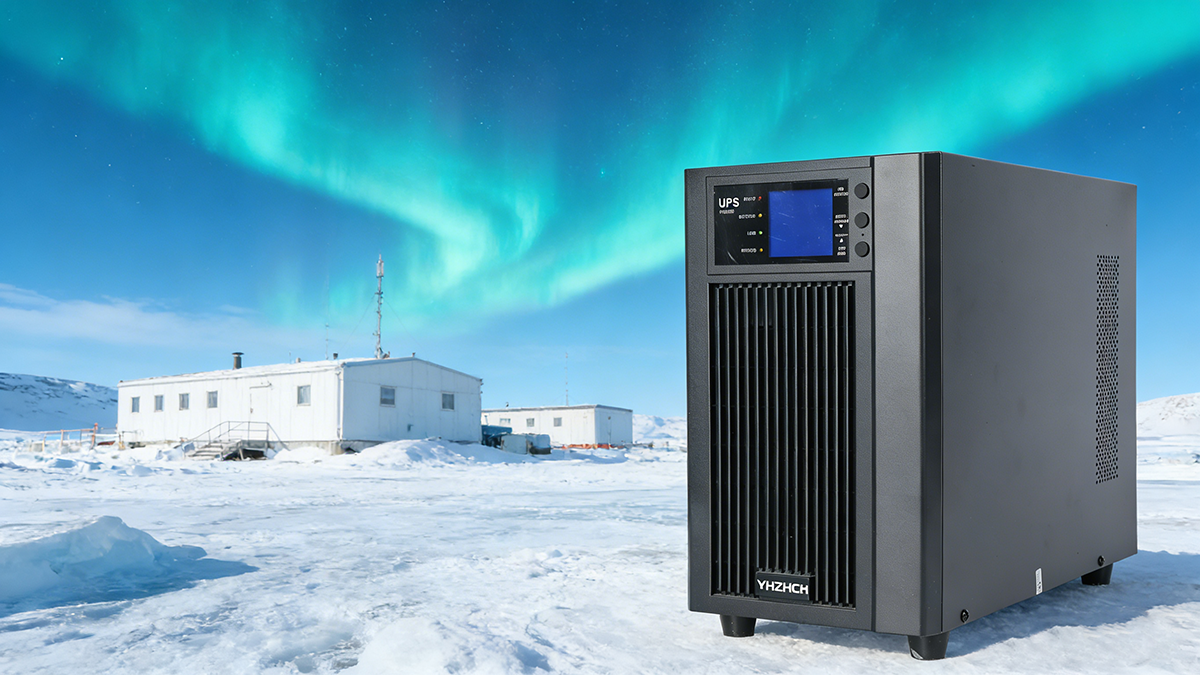
High-frequency on-line UPS (double-conversion high-frequency architecture, power frequency transformer without output) has high component density, IGBT, electrolytic capacitor and driving board are more sensitive to temperature, dust and power grid disturbance. The long-term stability judgment revolves around eight dimensions: * * real-time electrical parameter steady state, temperature rise aging trend, switching reliability, battery health, environmental adaptation, protection logic, long-term data ledger and parallel redundancy (multi-machine scene) * *, combined with daily inspection.
I. Basic operation status: real-time panel+visual quick judgment (daily inspection)
1. The working mode must be stable.
In normal long-term operation, the inverter mode should be always on and the bypass indicator light should be off; Frequent automatic bypass is the core symptom of stability deterioration;
Causes of frequent bypass: overload, IGBT temperature rise exceeding the standard, input voltage exceeding the standard, internal soft fault and control board drift.
Judgment: bypass automatic jump > 3 times in a single month, and there are hidden dangers in long-term reliability.
2. Alarm statistics (the most intuitive long-term hidden danger)
After continuously counting the alarm logs for 3~6 months, the following alarms at high frequency represent a decline in stability:
Over-temperature, over-current, output overvoltage/undervoltage, input overrun, abnormal charging, abnormal module communication and fan failure.
No accidental alarm = stable foundation; Sporadic alarm needs to locate the root cause; Periodic alarm = hardware aging precursor
3. Appearance and cooling system (No.1 short board of high frequency machine)
There is no dust jam at the air inlet and outlet, and the cooling fan has no abnormal sound, stop running and fast or slow speed.
Infrared temperature measurement of power radiator, terminal and copper bar: steady-state full load ≤ 65℃; > 70℃ to accelerate the aging of capacitors and IGBT for a long time; > 80℃, it is easy to stop the overheating protection from time to time.
There is no dust, condensation, moisture and mosquito accumulation inside (high-frequency PCB is dense, condensation is easy to leak electricity and strike a light)
2. Steady-state power quality: measure the long-term voltage and waveform stability of inverter (monthly/quarterly detection).
According to IEC 62040 and GB/T 7260 standards, long-term comparison is made under three working conditions: no load, 50% load and full load:
Steady-state accuracy of output voltage
Qualified: 1% ~ 2%; Long-term fluctuation continues to exceed 3% → the inverter loop drifts and the driving circuit is aging.
Total harmonic distortion of output voltage THDv
Linear load ≤3%, nonlinear load (server, frequency converter) ≤ 5%; THD continues to rise = attenuation of filter capacitor and distortion of inverter waveform, which interferes with the back-end precision load for a long time.
frequency stability
Mains synchronization mode: within ±0.5Hz; The accuracy of battery inverter mode is higher, and the frequency offset drift represents the aging of the master crystal oscillator/sampling circuit.
Input side index (power grid adaptability, which determines the stability against power grid disturbance)
Input power factor ≥0.99, input current harmonic thdi < 5%; Long-term THDi exceeding the standard will lead to the heating of the rectifier bridge and the temperature rise of the whole machine year by year.
Zero ground voltage
High-frequency machine has no isolation transformer, and the zero-ground voltage should be < 2 V; Long-term > 3v is likely to cause server network card restart and abnormal communication, which is a long-term hidden instability.
III. Dynamic immunity and switching reliability (quarterly special test to verify the stability of sudden working conditions)
1. Switching of mains battery (double conversion core)
The switching time is less than 4 ms, and the switching has no output interruption and no voltage sudden drop and surge.
Repeated on-off test for more than 10 times, with consistent switching logic, no misoperation and no downtime; Abnormal switching for many times = aging of control circuit and relay, failure at the critical moment of power failure.
2. Load step dynamic response (to test the long-term robustness of high-frequency DSP control)
0→50%→100% sudden loading and 100%→0 sudden unloading load:
Voltage transient amplitude ≤ 5%, and recovery time ≤ 20 ~ 40 ms.
After many tests, the transient amplitude is getting bigger and bigger, the recovery is slower → the parameters of the control loop drift, the power device is aging, and the long-term fluctuating load is easy to protect.
3. Long-term diagnosis of wide voltage adaptability
Pull the input voltage to the nominal high and low voltage limit of UPS, and run continuously with full load for 8h:
The output does not exceed the limit, the bypass is not frequently cut, and the alarm is not wrong, which represents the long-term response to the voltage fluctuation and stability of the power grid; On the contrary, the power grid will jump frequently if it is slightly worse, and its long-term reliability is poor.
4. Logic check of overload and short circuit protection
125% rated load: delay about 1min to cut the bypass (in line with the model design threshold)
Output instantaneous short circuit: fast locking inverter and alarm, no IGBT explosion and no crash.
The protection action is too early/too late, and the protection fails, which is a long-term major instability hazard.
Four, temperature rise and components aging trend judgment (high frequency machine life core bottleneck)
Shortcomings in the service life of high-frequency machines are concentrated in electrolytic capacitors, IGBT, driving boards and fans, and temperature is the first inducement to accelerate aging:
Establish a monthly temperature rise account: under the same load rate, the capacitor temperature of the whole machine, radiator and DC bus increases slowly year by year = internal dust accumulation and capacitor loss increase, and the stability decreases year by year.
Law: For every 10℃ increase in environmental temperature of electrolytic capacitor, its service life will be roughly halved; Continuous high temperature operation for 3~5 years is prone to capacity attenuation, bulging and liquid leakage, which leads to output drift and crash.
Check DC bus voltage: long-term slight drift and large ripple are typical characteristics of bus capacitor aging.
V. Stability of battery system (short availability of UPS, which must be tracked for a long time)
Half of UPS failures are caused by batteries, which require quarterly inspection and annual deep discharge:
Floating charge voltage: 13.4~13.8V for a single piece of 12V lead acid, and the pressure difference of the whole group of monomers is ≤ 0.05 V; The pressure difference is increasing year by year, and the floating charge voltage continues to be low/high, which means that the battery is unbalanced and vulcanized and aging.
Internal resistance of monomer: early warning of internal resistance rising by ≥50% compared with the new machine, and judging aging by ≥100%; The monthly rise of internal resistance is a clear trend of capacity attenuation.
Quarterly actual discharge test with load: the deviation between the actual battery life and the nominal value is ≤15% for stability; The battery life has shrunk seriously year by year, and the reliability of power failure is insufficient.
Charging logic: even charging/floating charging switching is normal, charging with temperature compensation; Over-charging and under-charging will damage the battery in batches for a long time.
Six, environmental adaptability (determine the long-term failure rate)
High-frequency machines are much stricter on the environment than power frequency machines, and the long-term operating environment must meet the following requirements:
Ambient temperature: 20~25℃ is the best, and the aging of the whole machine is accelerated when it is longer than 30℃.
Humidity: 40%~60% RH to prevent condensation and high humidity from corroding PCB.
Dust, corrosive gas, oil fume and saline-alkali environment must be protected against dust, otherwise the failure rate will rise significantly within 3 years.
Judgment: The long-term stability of high-frequency UPS will inevitably decline due to severe temperature and humidity fluctuation and inadequate dust removal in the computer room.
VII. Determination of additional stability of multi-machine parallel/modular UPS (multi-machine parallel scenario)
Module current sharing accuracy: the output current deviation of each power module is ≤ 3%; The current-sharing deviation is getting bigger year by year, and the uneven current alarm is frequent, and the parallel system oscillates for a long time, which is easy to spread the overheating fault of a single module.
N+1 redundancy fault tolerance: when a single module goes offline/fails, the other modules will take on the load smoothly, and there will be no accidental shutdown or bypass.
Parallel communication has no frequent disconnection and abnormal synchronization.
Eight, long-term stability comprehensive judgment conclusion standard
Long-term stability (it can be safely operated continuously for 5~8 years)
There is almost no abnormal alarm for 6 months in a row, and there is no automatic jump of bypass.
The steady-state and dynamic responses of electric parameters have good consistency and no drift.
The temperature rise is slow and steady, and there is no rising trend year by year.
The internal resistance and voltage consistency of the battery are good, and the discharge capacity decays slowly.


