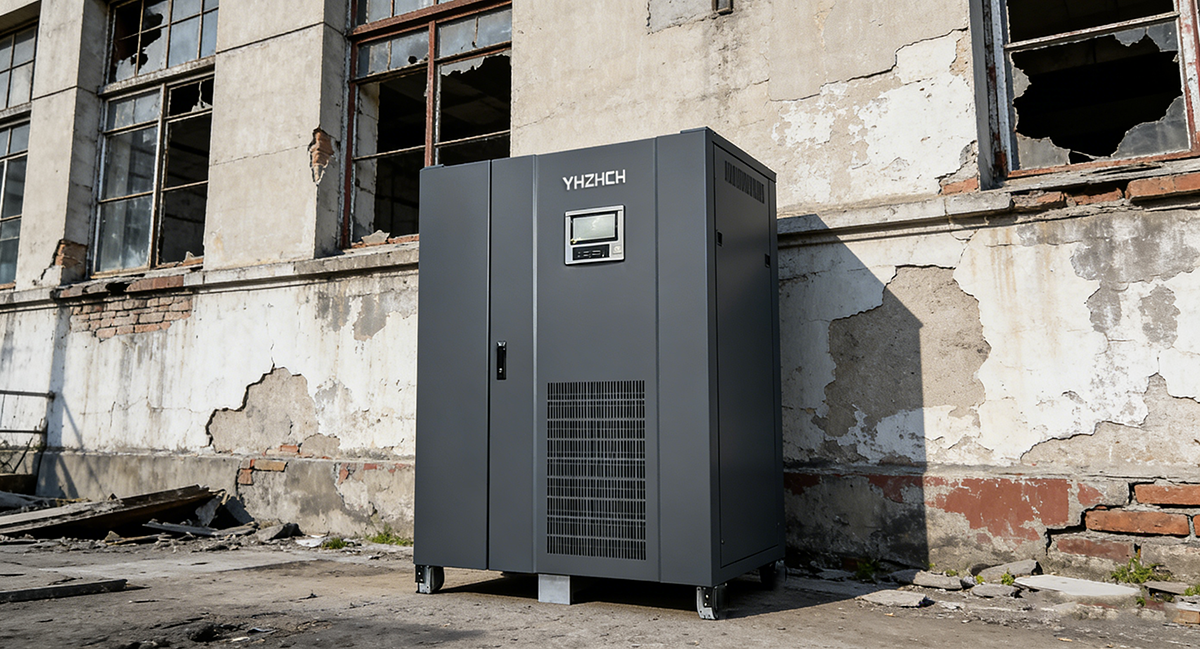
First, the intelligent operation and maintenance function of power frequency online UPS mainly reflects
Power frequency on-line UPS is mostly used in key load scenarios such as industry, computer room, data center, electric power, medical treatment, etc. Its own hardware (transformer, rectifier and inverter, bypass, battery pack, heat dissipation) is complex, and intelligent operation and maintenance is realized around six dimensions: state monitoring, fault early warning, remote control, automatic disposal, data management and linkage coordination:
1. Full-dimension real-time state online monitoring
(1) Monitoring of host electrical parameters
Real-time acquisition of three-phase input/output voltage, current, power, power factor, frequency, harmonic content, rectifier/inverter bus voltage, IGBT module temperature, transformer winding temperature, cooling fan speed, static switch state, bypass loop state, grounding fault, insulation resistance and other power frequency model-specific indicators;
Different from the high-frequency machine, the power frequency UPS has an isolation transformer, and the system will focus on monitoring the temperature rise, leakage current and core condition of the transformer to avoid overheating and burning.
(2) Fine monitoring of battery pack (core operation and maintenance pain point)
Single battery voltage, whole group voltage, charge and discharge current, battery internal resistance, battery temperature, equilibrium state, floating charge/equalizing charge mode switching record;
Support multi-channel battery inspection, automatically identify backward monomer, bulging, water loss and vulcanization hidden dangers, and solve the problem of high cost of manual inspection of large-capacity lead-acid batteries in power frequency room.
(3) environment and supporting equipment linkage monitoring
Temperature and humidity of cabinet/machine room, smoke sensation, water leakage, air conditioning operation state, switch state of power distribution cabinet, and access of fire signal;
Power frequency UPS generates more heat, and the system is linked with temperature control to prevent high-temperature capacity reduction and shutdown.
2. Fault early warning and intelligent diagnosis (predictive operation and maintenance)
Hierarchical alarm mechanism: divided into four levels: early warning, general fault, serious fault and shutdown protection, which are pushed through local sound and light, touch screen pop-up, SMS, APP and platform;
Automatic fault root cause analysis: the system has built-in fault knowledge base to distinguish module damage, battery deterioration, power grid distortion, overload, heat dissipation failure, bypass abnormality, etc.
For example: the output harmonics continue to exceed the standard → predict the aging of the filter capacitor; The temperature rise of the transformer continues to climb → the early warning air duct is blocked; Sudden increase of battery internal resistance → early warning of monomer scrapping;
Trend curve prediction: based on long-term operation data, the curve of temperature rise, internal resistance and harmonic changes is fitted to predict the life of components, and predictive maintenance is realized to replace traditional periodic passive maintenance;
Record the fault snapshot: save the voltage and current waveforms for 5 minutes before and after the fault occurs instantly, which is convenient for engineers to locate it remotely and does not need to reproduce the fault on site.
3. Remote centralized management and operation (unattended core)
Multi-communication interfaces: RS485, Modbus and SNMP are standard, and support uploading Ethernet, 4G/5G and LoRa to the dynamic monitoring platform, building BA and industrial SCADA;;
Remote full-function operation: remotely check the operation parameters, export the operation log, remotely turn on and off the machine, switch the power frequency UPS mains/battery/bypass mode, remotely adjust the floating charge voltage and alarm threshold;
Multi-equipment cluster management: multiple power frequency UPS in the factory area are connected to the cloud platform in a unified way, and the load and battery health are counted by regions, and the shipment strategy is made in batches;
Mobile terminal operation and maintenance: mobile APP/applet can be viewed in real time, and alarm can be pushed in real time, which supports remote assistance of engineers in different places.
4. Automatic operation and self-healing control to reduce manual intervention.
Intelligent charge and discharge management: the floating charge voltage is automatically adjusted according to the battery temperature, and the battery life is prolonged without manual periodic discharge test.
Intelligent load balance: three-phase unbalanced load automatically adjusts output balance to reduce equipment loss;
Automatic fault switching and self-healing: the static bypass is automatically switched when the inverter is slightly faulty, and the alarm is reported at the same time, and the load is guaranteed without stopping; After the power grid is restored, it automatically switches back to the inverter mode without manual operation;
Energy-saving adaptive operation: automatically adjust the fan speed under light load, reduce rectification loss, record energy consumption data, and assist energy-saving operation and maintenance.
5. Digital management of operation and maintenance data and automatic report generation
Automatically store annual operation logs, alarm records, charging and discharging records, equipment energy consumption and battery health data;
Automatically generate daily/weekly/monthly reports: load rate statistics, battery health report, fault statistics, energy consumption analysis, and equipment life assessment;
Support data export and docking enterprise ERP and equipment management system to meet the annual inspection and audit needs of electric power, hospitals, IDC and other industries;
Component life ledger management: automatically count the running time of fans, capacitors, contactors and IGBT, and remind them to replace spare parts in advance when they expire.
6. Intelligent management of security and authority
Multi-level account authority (operator, administrator, factory engineer), leaving traces throughout the operation; Remote operation encryption check to prevent misoperation;
Support access control and fire fighting linkage: UPS automatically cuts off non-critical loads when fire alarm is given to ensure power supply for fire fighting equipment.


