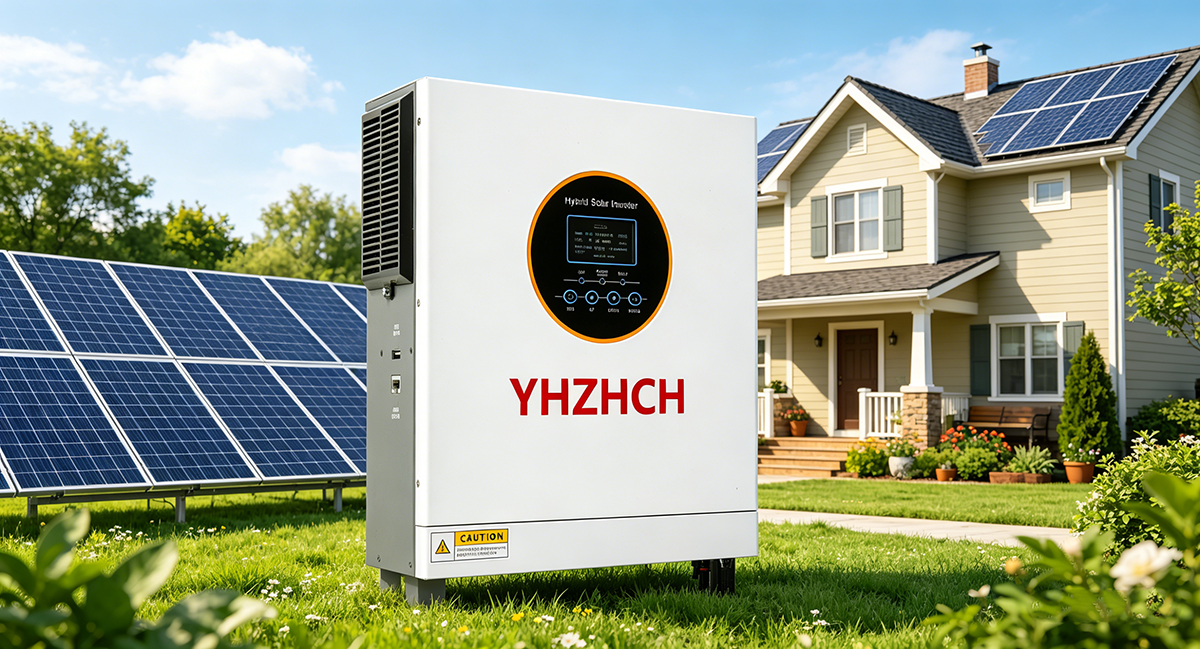
Photovoltaic panels emit direct current (DC), and household/grid appliances and commercial power are alternating current (AC). The core function of inverter is to convert photovoltaic DC energy into standard sinusoidal AC, and at the same time realize voltage stabilization, grid connection, protection and power regulation.
I. Energy flow of complete photovoltaic system
Photovoltaic module (solar panel) → DC junction box → inverter → AC distribution box → load/national grid.
Photovoltaic panel: light excites photovoltaic effect and outputs low voltage/high voltage DC; Voltage fluctuates greatly with illumination and temperature.
Inverter: handle unstable DC and output stable 220V/380V 50Hz sinusoidal AC.
Second, the inverter internal core module and step-by-step working principle
1. DC-DC Boost circuit (Boost boost, MPPT maximum power tracking)
The voltage of photovoltaic panel changes greatly during the day (tens of V in the morning and 300-1000V at noon), so it cannot be directly inverted.
MPPT maximum power point tracking: real-time collection of photovoltaic voltage and current, automatic adjustment of the duty cycle of the booster circuit, so that the photovoltaic panel can output the maximum power generation at all times (equivalent to the automobile throttle, continuously extracting the maximum power generation).
Boost boost: the photovoltaic low-voltage unstable DC is boosted to a stable high-voltage DC bus voltage.
2. DC bus capacitor energy storage and voltage stabilization
The boosted high-voltage DC is stored in a large-capacity bus capacitor, which smoothes the voltage fluctuation and provides a stable DC power supply for the later inverter bridge.
3. DC-AC inverter bridge (core inverter link)
The full-bridge inverter circuit composed of IGBT/MOSFET power switches is the core of "DC to AC";
The controller modulates the signal according to 50Hz sine wave, and alternately turns on and off four power tubes at high speed;
Constant high voltage DC is cut into square wave pulses with adjustable pulse width (SPWM sine pulse width modulation);
The pulse width varies according to the sinusoidal law, which is equivalent to simulating sinusoidal alternating current.
4. LC filter circuit
The pulse square wave output by inverter contains a lot of harmonics. After inductance and capacitance filtering, high-frequency clutter is filtered out, and the output is smooth and pure, which meets the national standard sinusoidal alternating current.
5. Sampling control and protection unit
Real-time monitoring of DC voltage and current, AC voltage/frequency/phase, temperature and insulation resistance;
Unique to grid-connected inverter: synchronous phase locking
Grid-connected models need to completely synchronize the output AC voltage, frequency and phase with the power grid, otherwise it will damage the equipment and trip. The controller follows the power grid waveform in real time to ensure the same frequency and phase when connected to the grid.
Full set of protection functions: overvoltage, undervoltage, overcurrent, leakage, island protection, overheating, DC reverse connection lightning protection.
Islanding protection: When the power grid fails, the inverter immediately stops generating electricity, so as to prevent photovoltaic power from being reversely sent to the power line, endangering the life safety of maintenance personnel and forcing the national standard requirements.
Third, the principle differences of three major inverter types
1. Series inverter (most commonly used in household/industry and commerce)
Each photovoltaic series is boosted by MPPT independently, and each power generation does not interfere with each other, and one board does not affect other branches. Principle: multi-channel independent DC-DC boost → shared inverter bridge to output AC.
2. Centralized inverter (large ground photovoltaic power station)
After a large number of photovoltaic series confluence, the power of a single unit is several thousand kW, and there is only one set of total MPPT, which partially blocks the decline of overall power generation.
3. Micro inverter (each photovoltaic panel is inverted separately)
Single photovoltaic panel has its own micro-inverter, board-level DC-AC direct conversion, no high-voltage DC, high security; Each board is independent of MPPT, which has little shielding effect and higher cost.
Four, a popular sentence summary
The solar panel sends out alternating current, and the inverter first uses MPPT to boost the voltage to stabilize the maximum power generation, and then "cuts" the direct current into simulated sinusoidal alternating current through the high-speed switch. After filtering and purification, it outputs the same alternating current power supply as the household commercial power for use or transmission to the power grid.
Supplement: Extra logic of off-grid inverter
Off-grid energy storage inverter without power grid: increase battery charging and discharging management, and charge the battery with excess photovoltaic power; When there is no light, the battery DC is reversed to AC, and 50Hz AC voltage is established independently without phase locking.


