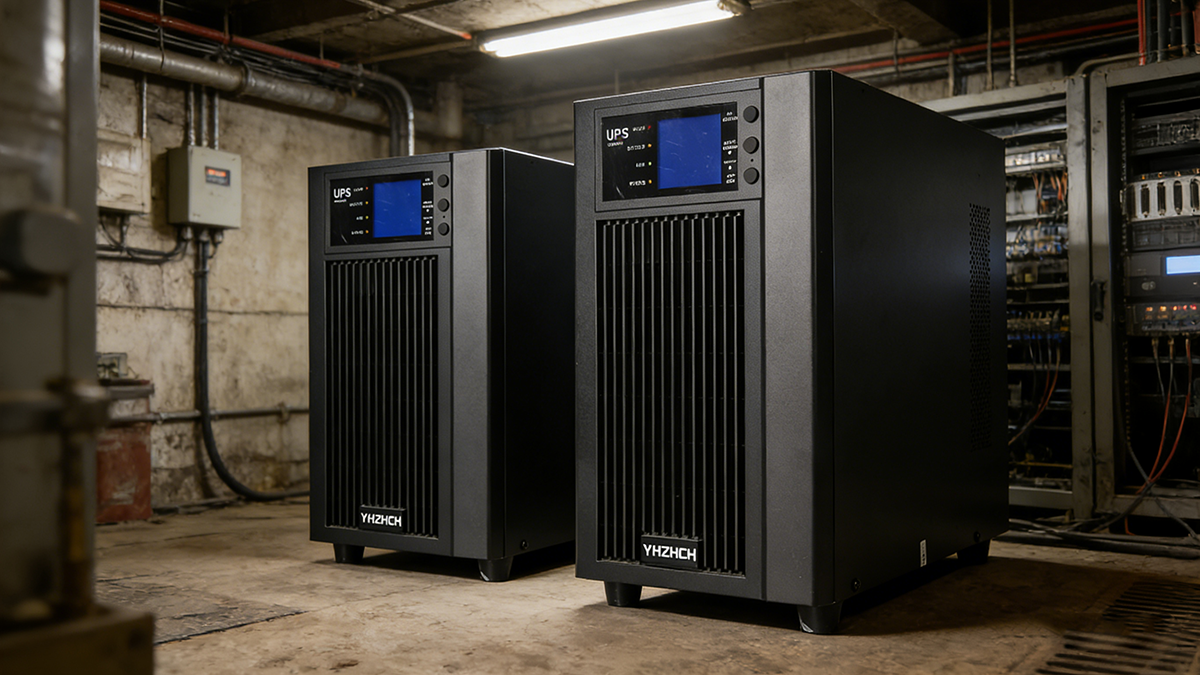
The "anti-manufacturing ability" of high-frequency online UPS is essentially the long-term stable operation tolerance under harsh power grid, impact load and high-temperature dust environment, and its core is verified by data from five dimensions: overload/short circuit ability, input adaptability, dynamic response, environmental protection and reliability index. The following is a detailed description from three aspects: key indicators, verification methods and qualified thresholds:
First, the core anti-manufacturing performance index (data verification)
1. Overload capacity (the core impact index)
Definition: the ability to withstand over-rated power in a short time, reflecting the ability to resist load impact and hard start.
Key data:
125% overload: ≥10 minutes (long-term small overload resistance)
130% overload: ≥ 1min (industrial standard)
150% overload: ≥30 seconds (resistance to motor starting shock)
200% overload: ≥1 second (short circuit instantaneous tolerance)
Verification: Run for 10 minutes with 130% load, without tripping and overheating, and the output voltage is stable ≤ 1%.
2. Input voltage/frequency range (anti-grid fluctuation)
Definition: The wider the working range where the battery is not turned and the rating is not reduced when the mains electricity is abnormal, the stronger the anti-building.
Qualified data:
Voltage: 35% (160–275 VAC), and the industrial level can reach 110–300 V.
Frequency: 40–70 Hz (suitable for generators/inferior power grids)
Verification: the input voltage is 160V/275V, the output accuracy is ≤ 1%, and THD is ≤ 3%.
3. Dynamic response (load mutation resistance)
Definition: voltage fluctuation and recovery speed during sudden load loading/unloading, reflecting transient resistance.
Key data:
Transient amplitude: ≤ 5% (100% sudden loading/unloading)
Recovery time: ≤20ms (the sooner, the more resistant)
Verification: 0→100% load step, voltage drop ≤5%, stabilized to 1% within 20ms.
4. Output short-circuit tolerance (hard fault resistance)
Definition: protection speed and device tolerance when the output terminal is short-circuited.
Qualified data: short-circuit tolerance ≥500ms, no explosion, no damage to power devices, and automatic recovery after fault removal.
Verification: output short circuit, ≤100ms trip protection, IGBT/rectifier bridge without burning trace.
5. Environmental adaptability (high temperature/dust/vibration resistance)
Temperature: 0-40℃ (industrial grade-25℃~55℃), full load at 40℃ without derating.
Protection grade: IP21 (dustproof and drip-proof), and IP31/IP42 is required for industrial scenes.
Vibration: 0.1g, 10–10-100Hz (industrial vibration resistance).
Verification: Run at 40℃ with full load for 72 hours, with temperature rise ≤25K and no abnormal alarm.
6. Reliability index (long-term anti-manufacturing)
MTBF (mean time between failures): ≥ 150,000 hours (industrial grade ≥ 200,000 hours).
MTTR (mean time to repair): ≤30 minutes (modularization ≤5 minutes).
Verification: continuous operation for 1000 hours, no fault, no device aging acceleration.
7. Harmonic and surge suppression (anti-grid pollution)
Input THDI: ≤ 3% (anti-grid harmonic interference).
Surge tolerance: ≥6kV/3kA(8/20μs), lightning/spike resistance.
Second, the data verification scheme (measured anti-manufacturing capacity)
1. Overload impact test
Steps: 100%→130%→150%→200% step overload, and record time, voltage, temperature and alarm.
Qualified: 130%/10min, 150%/30s and 200%/1s without tripping, and the output is ≤ 1%.
2. Extreme Power Grid Simulation
Voltage: 160V/275V, running at full load for 2 hours.
Frequency: 40Hz/70Hz full load operation for 2 hours.
Qualified: the output accuracy is ≤ 1%, THD is ≤ 3%, and the battery is not turned.
3. Load step+short circuit
Step: Cycle 0.100% for 10 times, and record the transient and recovery.
Short circuit: the output is short-circuited for 5 times, each time for 1 second, and the protection and recovery are verified.
Qualified: transient ≤ 5%/20 ms, short circuit without damage, automatic power recovery.
4. High temperature aging+dustproof
Full load at 40℃ for 72 hours, IP21 dustproof test (12mm dust/vertical drip).
Qualified: temperature rise ≤25K, no alarm, insulation resistance ≥ 1mω.
Third, the difference of high frequency vs power frequency resistance (data comparison)
form
Index high frequency online UPS power frequency online UPS
Overload capacity is 130%/10min, 150%/30s, 200%/1min and 300%/10s (stronger).
Input range 35% (160–275v) 20% (176–264v).
Ambient temperature 0–40℃-25℃ ~ 55℃ (wider)
MTBF ≥15 150,000 hours ≥ 200,000 hours (more durable)
Surge resistance 6kV/3kA 10kV/5kA (stronger)
Four, selection of anti-building threshold (direct reference)
Overload: 130%/10min, 150%/30s.
Input: 160-275V, 40–70hz.
Dynamic: ≤ 5%/20ms
Short circuit: ≥500ms withstand, ≤100ms protection.
Environment: 0-40℃, IP21, MTBF ≥ 150,000 hours.
Conclusion: The anti-manufacturing capability of high-frequency online UPS needs to be verified by six dimensions: overload, input range, dynamic response, short-circuit tolerance, environmental protection and MTBF. Industrial strong impact scenarios give priority to power frequency, and commercial/data center scenarios have enough high frequency and are more energy-saving.


