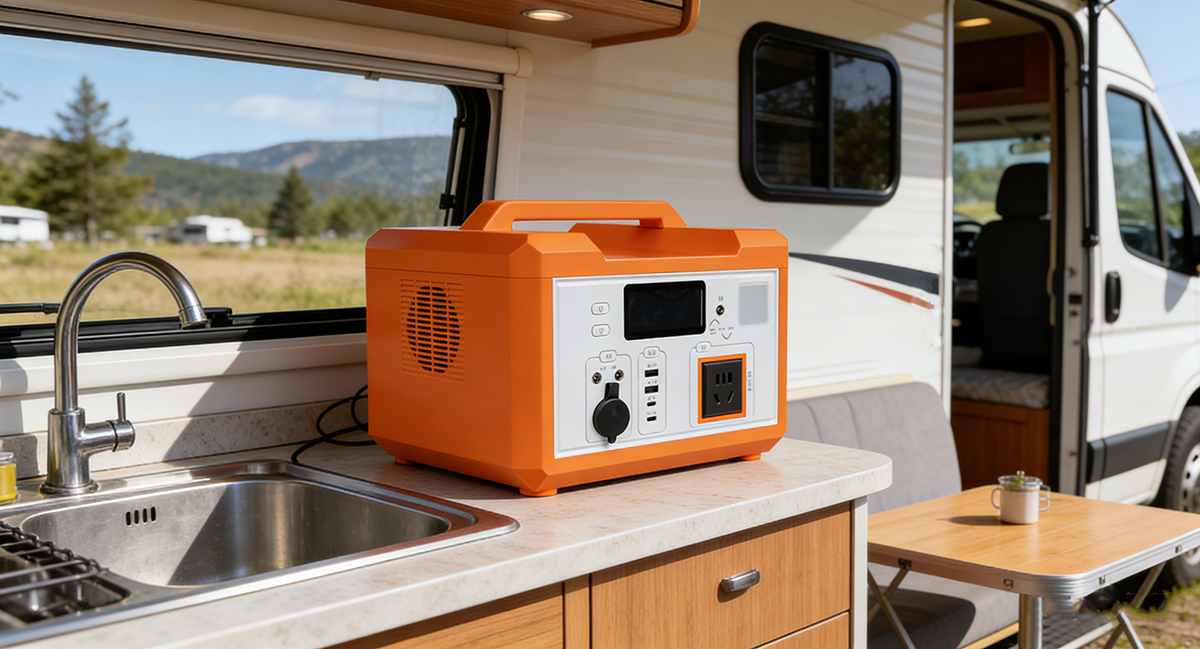
Outdoor camping must see! How can portable power supply support "freedom of electricity use"? Attached are the measured data of three scenarios.
Camping wants to bid farewell to "power anxiety" and realize the freedom of electricity consumption for boiling water, refrigeration, watching movies and using multiple devices at the same time. The core is to choose the right capacity+power, match the scene load and supplement electricity in various ways. Below, how to choose and use portable power supply is explained from three aspects: core logic, three types of scene measurement and key points of purchase.
First, portable power supply: the core logic of camping electricity freedom
1. Understand the core parameters first (the key is not to step on the pit)
Capacity (Wh): stored power, 1000Wh=1 kWh, which determines the battery life; Actual availability is calculated by **80%** (battery protection).
Rated power (W): continuous power supply capacity, which determines what equipment can be driven; The peak power (start-up moment) is usually 1.5-2 times the rated value, and the equipment with motors such as refrigerators and water pumps should be focused on.
Battery type: Ferrous lithium phosphate is preferred, with cycle LiFePO4 3500+times, low temperature resistance (-20℃~60℃), safety and stability; Ordinary ternary lithium has the advantages of fast power failure at low temperature and short life.
Power supply mode: support three modes of power supply: fast charging of commercial power+vehicle charging+solar charging. When there is no commercial power outdoors, it depends on solar energy to continue power supply, and bid farewell to power failure anxiety completely.
2. The underlying formula of power consumption freedom
Total power consumption = equipment power (W)× service time (h)
Common camping equipment power reference:
Car refrigerator: 45-60W(24-hour operation)
Electric cooker/kettle: 800-1200W (for short-term use)
Projector: 50-100W (2-3 hours for watching movies)
Camp lights/small fans: 30-50W (6-8 hours at night)
Mobile phone/camera/drone: 50-100Wh/day.
Measured data of two or three camping scenes (direct copying operation)
Scene 1: single person traveling light/camping in the park (1-2 days, low load)
Equipment combination: mobile phone ×2, camera, camping lamp, small fan, Bluetooth speaker.
Measured power supply: 500Wh/500W (such as Zhenghaorui 2)
Measured data:
Mobile phone charging: 20 times+
Camping light (10W): 50 consecutive hours+
Small fan (30W): continuous 15 hours+
Total power consumption: 150-300Wh/day, 2 days when fully charged+
Recommended configuration: 300-500Wh power supply+100W solar panel (daytime power supply)
Scene 2: Exquisite camping for two (2-3 days, medium and high load)
Equipment combination: car-mounted mini refrigerator (45W), projector, electric cooker, electric blanket, and multi-device charging.
Measured power supply: 1000Wh/1800W (such as BLUETTI AC180 and Zhenghaode 3C).
Measured data:
Car refrigerator (45W): continuous for 22 hours (remaining 20% power)
Projector (80W): 16% power consumption in 2 hours.
Electric cooker (1000W): Boil water for 8 minutes and consume 14% electricity.
Electric blanket (60W): 8 hours at night, 48% power consumption.
Total power consumption: 600-1000Wh/day, 1.5 days when fully charged, with 200W solar panels, it can be continuously charged indefinitely.
Recommended configuration: 800-1200Wh power supply+200W solar panel (daily average power supply is 30%).
Scenario 3: Family self-driving camping (3-5 days, high load)
Equipment combination: large refrigerator (60W), rice cooker, electric baking pan, projector, electric blanket, multi-equipment.
Measured power supply: 2000Wh/2200W (e.g. 2000Pro)
Measured data:
Car refrigerator (60W): 24-hour power consumption of 144Wh, available for 13 days+
Electric baking pan (800W): continuous 1 hour, power consumption 40%.
Rice cooker (800W): Cooking for 3 times consumes 30% power.
Projector+lighting: 3 hours, 20% power consumption
Total power consumption: 1,200-2,000 Wh/day, full power can be used for 1 day+,and 400W solar panels can meet the needs of camping without commercial power for 3-5 days.
Recommended configuration: 1500-2200Wh power supply+400W solar panel+vehicle fast charging.
Third, camping power supply selection & a guide to using electricity to avoid pits
1. Purchase priority (novice must see)
Battery type: Ferrous lithium phosphate is the first choice, which is safe and durable and does not lose power at low temperature.
Rated power: Exquisite camping ≥1000W, self-driving high load ≥1800W, avoid taking immobile equipment.
Capacity matching: 300-500Wh for single person, 800-1200Wh for double person and 1500-2200Wh for family.
Power supply capacity: three modes of solar energy+vehicle+city power supply must be supported.
2. 3 main points of using electricity to avoid pits
Do not use 0% of electricity: replenish the remaining 20% to protect the battery life.
Separate use of high-power equipment: Don't turn on the electric baking pan+kettle at the same time to avoid overload tripping.
Keep warm in low temperature environment: Although Ferrous lithium phosphate is resistant to low temperature, it is recommended to put insulation bags below-10℃, and the battery life can be maintained at 85%-90%.
Fourth, summary
The essence of camping "free electricity use" is scene matching+capacity and power adaptation+multi-way power supply. Choose 300-500Wh for a single person, about 1,000 Wh for a double person, and 2,000 Wh for a family to drive by car. With solar panels, you can completely bid farewell to power anxiety, and you can use electricity as freely as you do at home outdoors.


