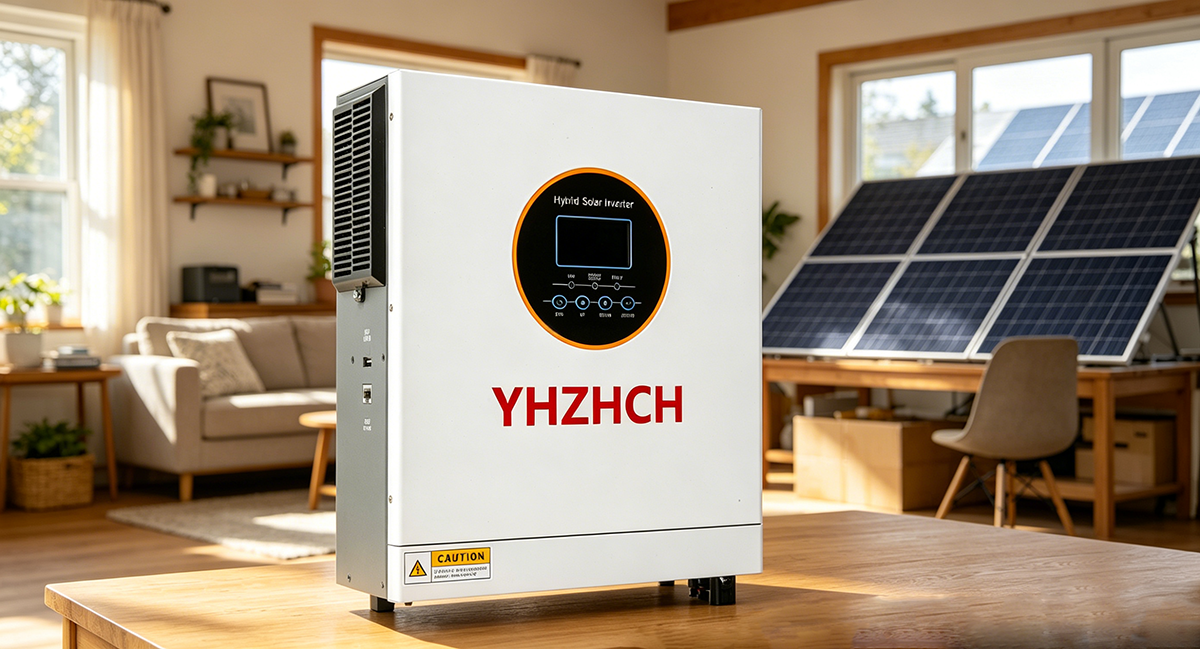
Omnibearing judgment method for reliability of solar inverter
To judge the reliability of photovoltaic inverter, look at seven dimensions: brand warranty, core parameters, hardware materials, environmental tolerance, safety protection, field operation and certification qualification, and quickly identify long-term stable, less fault and long-life models.
First, look at the brand and warranty (the most intuitive and reliable)
Warranty period of the whole machine
Household assembly: the whole machine is ≥5 years, and the power IGBT/capacitor core is ≥10 years; First-line brands generally have a 10-15 year warranty.
Inferior model: only guaranteed for 1~3 years, and the cost of later maintenance and replacement is extremely high.
MTBF mean time between failures
Excellent industry: ≥ 100,000 hours; The higher the value, the lower the long-term failure rate.
After-sales and operation and maintenance
Support remote monitoring, fault alarm and on-site quick repair; Are there any national after-sales outlets and extended warranty services?
Second, the core electrical parameters (hard reliability bottom line)
1. Conversion efficiency (long-term efficiency = durability)
Maximum efficiency: in series **≥98.5%**, and the minimum for household use is not less than 97%.
CEC weighted efficiency: The higher the power generation efficiency under real working conditions, the slower the attenuation.
MPPT tracking accuracy: ≥99%, no power loss in low light and shadow.
2. Power quality (grid adaptation+low fault)
Total harmonic thd: < 3%, the lower the waveform, the cleaner the device will generate less heat.
High-low-voltage/high-low-frequency ride-through: the power grid fluctuates without tripping off the grid and restarting frequently.
Anti-islanding protection: fast off-line within 2 seconds, safe without burning equipment.
3. Wide voltage adaptation
The wider the range of DC MPPT, the more stable it is in cloudy days, low temperature and component attenuation, and the wide voltage of 200~1000V is recommended for home use.
Third, hardware materials and heat dissipation (life core)
Power device
Priority is given to IGBT/SiC silicon carbide modules, and domestic manufacturers' gauge devices are superior to miscellaneous discrete components, with high temperature resistance, impact resistance and slow aging.
electrolytic condenser
Long-life high-temperature resistant capacitor, the capacitance decay after aging at 85℃ is less than 10%; Capacitor is a fragile and short-lived part of inverter.
Heat dissipation design
Protection grade: IP65 for outdoor roof, and IP67 for rainy and wet.
Heat dissipation structure: large area aluminum radiator, intelligent temperature control fan; Low temperature rise at full load and no local overheating.
Infrared temperature measurement: radiator temperature difference < 15℃, too large temperature difference = poor heat dissipation and easy failure.
Protective structure
Three-proof coating, anti-condensation, anti-corrosion, more durable in humid southern and coastal salt spray environment.
Fourth, extreme environmental tolerance (the key to long-term outdoor reliability)
High and low temperature cycle: **-40℃~85℃** Normal start-stop operation, no downtime, no power reduction.
High temperature and high humidity: 85℃/85% RH will run for a long time, and the insulation will not drop and the circuit board will not corrode.
Earthquake resistance and impact resistance: it can withstand transportation, strong wind and outdoor vibration, and the solder joint does not come off and the wiring is not loose.
Lightning surge: DC+AC two-stage lightning protection, lightning is not easy to burn the motherboard.
Five, safety protection function (less failure, not easy to catch fire)
DC arcing detection: the accuracy rate is 99.98%+, which eliminates the hidden danger of photovoltaic fire.
Full closed-loop protection for DC overvoltage, AC overvoltage, overcurrent, overheating and insulation faults.
The components can be quickly turned off RSD, which is safer for maintenance and necessary for power grid compliance.
Multiple protections of reverse connection, short circuit and electric leakage make it difficult for novice wiring to burn the machine.
Six, the field operation measurement (quick judgment after installation)
Look at the power generation: in sunny days, under the same irradiation, the power is stable, and there is no frequent shutdown and restart.
Listening noise: even low-frequency humming, no harsh abnormal sound, crazy fan rotation and intermittent noise.
Look at the indicator light: the green light is always on normally; Yellow light alarm, red light fault = poor reliability
Temperature measurement inspection: AC/DC terminals are less than 65℃, and the wiring is not heated or oxidized and blackened.
Look at the fault records: frequent over-temperature, abnormal power grid, low insulation, and poor reliability of the whole machine with high probability.
VII. Authoritative Certification Qualification (Compliance+Endorsement of Factory Reliability)
There is no formal test report and non-standard model, and it is easy to fail in batches in extreme weather.
Shenzhen Yunhai has complete qualifications, quality assurance and reliable choice ~


