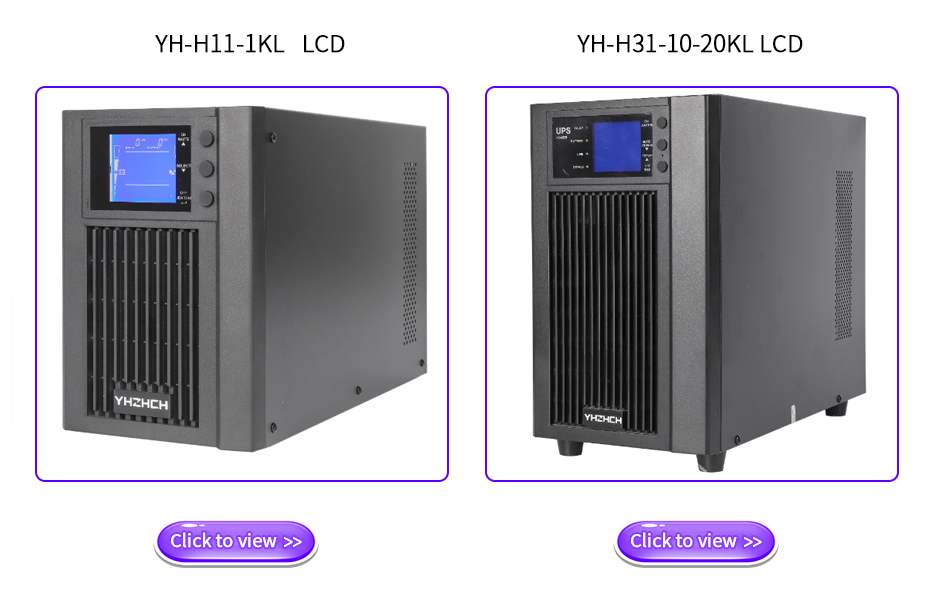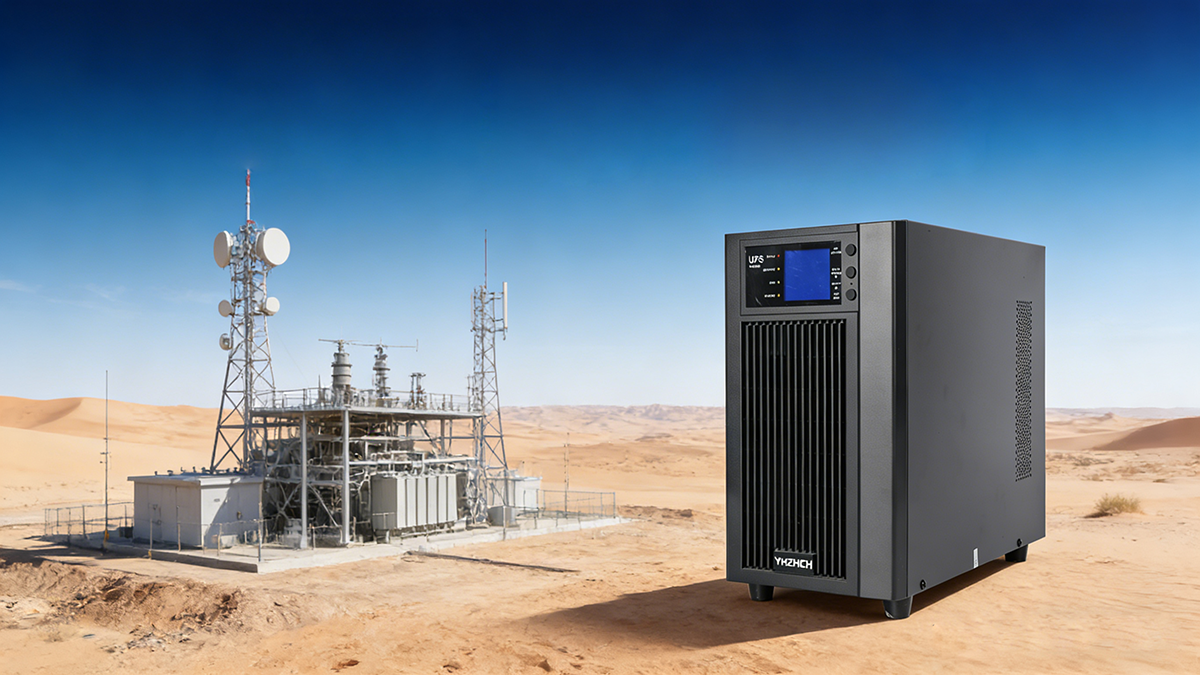
The core basis for judging whether the adaptability of high-frequency on-line UPS meets the standard is GB/T 7260.3-2024 (equivalent to IEC 62040-3:2021), which is verified from five dimensions: parameter index, power grid disturbance simulation, harmonics and EMC, switching and fault handling, and long-term operation.
I. Core parameter indicators (basic threshold)
1. Input voltage range (stable range of non-rotating battery)
Single phase (220v): 160v ~ 275v (excellent: 110V~300V)
Three-phase (380 V): 304 V ~ 456 V (excellent: 176 V ~ 478 V)
Judgment: The battery will not be switched when it is fully loaded within this range and the output voltage stabilization accuracy is ≤ 1%.
2. Input frequency tolerance
Standard: 47 Hz ~ 63 Hz (50/60 Hz adaptive)
Excellent: 40 Hz ~ 70 Hz, stable synchronization under generator power supply.
Judgment: When the frequency drift is 5 Hz, the output frequency tracking error is ≤±0.1Hz, and there is no out-of-step.
3. Input power factor (PF) and harmonics (THDi)
Power factor: ≥0.99 (full load), reducing reactive power pollution of power grid.
Input harmonic THDI: ≤ 5% (full load), with strong suppression of 3rd/5th/7th harmonic.
Judgment: it conforms to GB/T 14549, and the injected power grid harmonics do not exceed the standard.
Second, the power grid disturbance simulation test (key)
Using programmable AC power supply+power grid simulator, according to GB/T 7260.3-2024.
1. Voltage sag/surge
Test: rated voltage * * 30% abrupt change (within 20ms) * * for 10s.
Up to standard: output voltage fluctuation * * ≤ 3% * *, without interruption or battery change.
2. Phase mutation
Test: input phase * * 30 step * *
Up to standard: PLL phase-locked loop **≤20ms** is re-locked, and the output is undistorted.
3. Harmonic superposition
Test: 3/5/7th harmonic (single **≤20%**, total THD≤30%) is superimposed.
Up to standard: output THD**≤3% (linear load) * *, DC bus ripple ≤5%.
4. Frequency drift+voltage fluctuation compound disturbance
Test: voltage-40%+ frequency+5Hz is applied synchronously.
Reaching the standard: stable operation, no accidental battery switching and no accidental protection.
Third, switching and bypass adaptability (reliability)
1. Mains → battery switching
Requirements: zero switching time (≤10μs), no breakpoint in output.
Test: simulate the interruption of commercial power, and the oscilloscope captures the output waveform without power failure and distortion.
2. Adaptability of bypass mode (in case of overload/failure)
Bypass input range: consistent with main input (20%)
Reaching the standard: when the harmonic thd of the bypass voltage is less than or equal to 20% and the frequency is 5 Hz, the switch will be seamless and the power will not be turned off.
3. Generator compatibility
Test: Connect a diesel generator (frequency 45 ~ 55hz, voltage 25% fluctuation).
Reaching the standard: stable rectification, no generator oscillation caused by harmonic feedback, and normal output.
Four, EMC and immunity (electromagnetic environment adaptability)
According to GB/T 7260.3-2024 and IEC 62040-2.
Surge (1.2/50μ s): 6kV common mode/differential mode, no damage, no restart.
Electrical fast transient (EFT/B): 2kV, working normally.
Electrostatic discharge (ESD): 8kV contact/air discharge, trouble-free.
Conduction/radiation disturbance: meet GB/T 9254 Class B, and do not interfere with other equipment.
V. Long-term limit operation (stability verification)
Full-load marginal voltage: the voltage is within the tolerance limit (such as 160V/275V), and it runs at full load for 24 hours, and the temperature rise is ≤40K, without protection misoperation.
High and low temperature environment: 0 ~ 40℃ (industrial grade-20 ~ 55℃), running stably with full load.
Six, the standard judgment list (one-stop check)
form
Standard value of dimension key indicators
The range of input voltage is 160 ~ 275 V/304 ~ 456 V for single phase/three phase.
The input frequency tolerance range is 47 ~ 63Hz.
The steady-state accuracy of output voltage stabilization is ≤ 1%
Harmonic suppression input THDi/output THD ≤5%/≤3% 3%
Switching time → battery ≤ 10μ s (zero switching)
Power grid disturbance voltage 30%/phase 30 output fluctuation ≤ 3% without interruption.
EMC immunity surge/EFT/ESD standard level, trouble-free.
After long-term operation, the edge voltage is fully loaded for 24h hours, and the temperature rise is normal, with no protection misoperation.
Seven, the standard basis
National standard: GB/T 7260.3-2024 Uninterruptible power supply system (UPS) Part 3: Method for determining performance and test requirements.
International: IEC 62040-3:2021 (equivalent adoption)
Conclusion: The adaptability of high-frequency online UPS is up to standard = parameter compliance+disturbance tolerance+reliable switching+EMC qualification+long-term stability, which are indispensable.