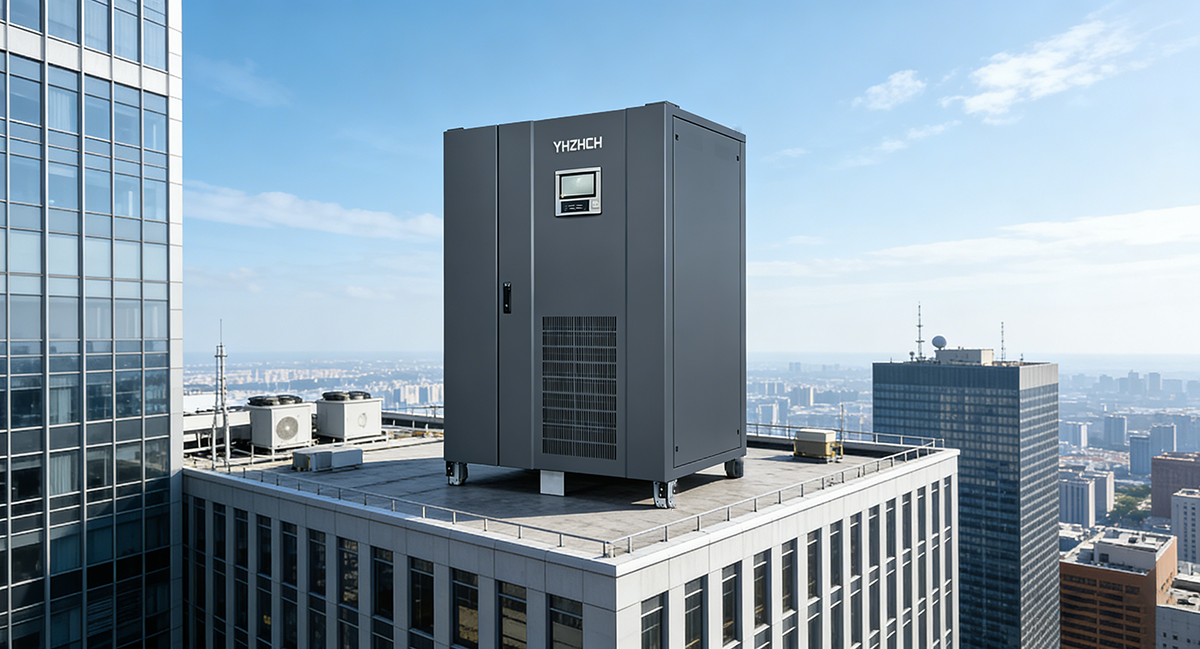
The core performance difference between power frequency on-line UPS and high frequency on-line UPS is essentially derived from two different power conversion technology routes, namely power frequency transformer and high frequency switch (IGBT), which is directly reflected in five key dimensions: stability, efficiency, volume, impact resistance and electrical isolation.
First, the core principles and structural differences
Power frequency on-line UPS
Core: Built-in power frequency transformer (50/60Hz)
Topology: mains supply → rectifier (SCR)→ inverter → power frequency transformer → load.
Essence: The bulky transformer is used to realize three functions: voltage conversion, electrical isolation, filtering and anti-interference.
High frequency on-line UPS
Core: High frequency switching technology (IGBT, >20kHz) is adopted, and there is no large power frequency transformer.
Topology: commercial power → high frequency rectifier → DC-DC converter → high frequency inverter → load.
Essence: high-speed electronic switch is used to realize voltage conversion, which is small in size and high in efficiency, but weak in electrical isolation.
II. Comparison of Core Performance Indicators (Table)
form
Core conclusion of comparative dimension power frequency online UPS and high frequency online UPS
The conversion efficiency is 85% ~ 92% ~ 92%. The high-frequency machine is more energy-saving and the long-term electricity cost is low.
Large volume/weight, bulky (40% ~ 60% of the same power), small, portable high-frequency machine saves space and is easy to install.
Strong overload/shock resistance (300% overload for 10 seconds) and weak (150% overload is protection) power frequency machines are more suitable for motors and industrial loads.
Electrical isolation, full isolation (output transformer), no isolation (additional isolation transformer is required), and the power frequency machine has stronger anti-interference, lightning protection and safety.
The power quality of power frequency machines with extremely high output purity (THD<2%, zero-ground voltage < 1V) and high output purity (THD<3%, zero-ground voltage tends to be high) is better.
High-frequency machines with high input harmonics (< 5%) and very low input harmonics (< 3%) are more environmentally friendly and less polluting to the power grid.
The noise is obvious (power frequency vibration) and low (super audio, inaudible to human ears). The high frequency machine is quieter.
MTBF (service life) > 200,000 hours (simple components, manufacturing resistance) > 150,000 hours (many components, high-frequency stress) power frequency machines are more durable and have longer service life.
Adapt to the environment-25℃ ~ 55℃ (wide temperature, dust resistance) and 0℃ ~ 40℃ (high environmental requirements) power frequency machine is suitable for harsh industrial environment.
High cost (copper/silicon steel sheet, expensive material) and low cost (semiconductor, lightweight) high frequency machine.
Third, in-depth analysis of key performance
Overload and impact resistance (core difference)
Power frequency machine: SCR rectifier+power frequency transformer, which is extremely resistant to surge, short circuit and instantaneous overload, and can carry motor-like inductive loads (3~7 times of starting current) hard.
High-frequency generator: IGBT is sensitive, with weak overload capacity, and it is easy to trip when the power grid fluctuates greatly and the impulse current is large.
Electrical isolation and anti-interference (key to industrial reliability)
Power frequency generator: output transformer = natural isolation barrier, which completely blocks the common mode interference, ground potential difference and lightning conduction path of power grid.
High-frequency generator: without electrical isolation, the power grid interference is easy to connect to the load, and the zero-ground voltage is too high (> 3V), which may lead to the abnormality of servers and precision equipment.
Efficiency and operating cost
Power frequency machine: transformer iron loss+copper loss, low efficiency, light load and more electricity consumption.
High-frequency machine: no transformer loss, high full/light load efficiency, and the annual power saving of 100kVA model in data center is about 40,000 kWh.
Applicable scenarios (selected by performance)
Data center, computer room, server, IT equipment
Office building, office, commerce, precision electronics
Limited space, energy saving and low noise are required.
Power grid is stable, and there is no strong impact load.
Industrial environment (metallurgy, petrochemical, mines, factories)
With motor, compressor, water pump and other inductive loads.
Bad power grid, large voltage fluctuation (25%) and lightning-prone areas
Medical imaging (CT/MRI), military and telecommunication base stations
Preferred power frequency UPS
Preferred high frequency UPS
Four, a sentence summary
Power frequency machine = heavy tank: stable, durable, anti-jamming, well isolated, suitable for industry/harsh environment/critical load.
High frequency machine = energy-saving sports car: light, small, efficient, quiet and cheap, suitable for data center/office/stable power grid.


