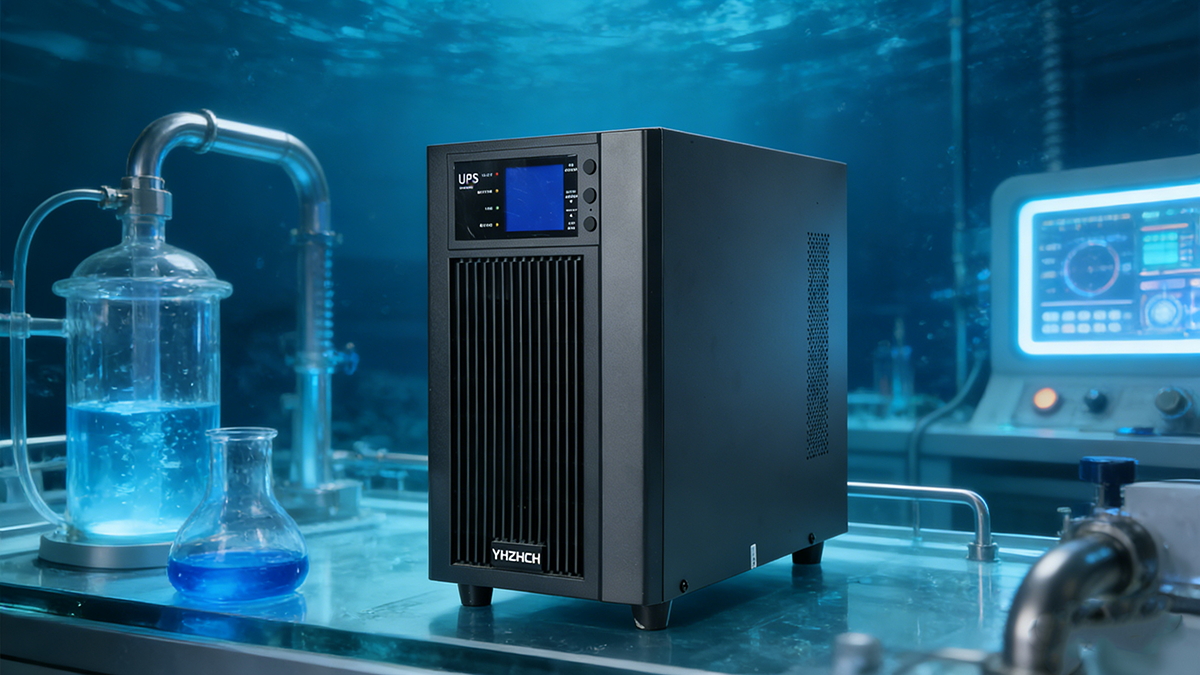
The core of the adaptability matching of high-frequency online UPS is to accurately align UPS parameters with field conditions from five dimensions: power grid adaptation, load power/characteristics, power supply quality, environment and management, and standby power supply linkage, so as to ensure stable, efficient and long-life operation.
First, the power grid environment adaptation (most affect the stability)
1. Input voltage range (must be wide)
High-quality high-frequency machine: single-phase 110–300 V/three-phase 138–485 V ultra-wide range.
Significance: When the voltage fluctuates greatly, the battery is not turned, and it is directly rectified and stabilized, thus prolonging the battery life and reducing the switching risk.
2. Input frequency range
Standard: 45–65hz (up to 40–70hz when equipped)
Adaptability: generator, remote power grid, variable frequency power supply (frequency is easy to drift)
3. Anti-power grid distortion ability
THDi (input current harmonics): ≤ 5% (excellent), reducing the pollution to the power grid.
Tolerance: voltage sag/surge, peak, lightning surge capacity.
Suggestion: Choose the model with input filter and PFC power factor correction for bad power grid.
Second, the load power and characteristics matching (the core)
1. Capacity calculation (redundancy is required)
Formula:
The rated capacity (kva) of UPS is more than or equal to the apparent power (kva) of total kVA) ÷ 0.7~0.8.
Redundancy: 20%–30% (to cope with startup shock and future expansion)
Optimum load rate: 60%–80% (the best efficiency, life and reliability).
Example:
The total load power is 5kW, and the power factor is 0.8 → apparent 6.25kVA
→ Select 8–10kVA UPS (with 60%–80% load).
2. Power factor (PF) matching
High frequency UPS output PF: 0.9 ~ 1.0
IT equipment (server/switch): PF ≈ 0.65-0.95 → Direct matching.
Inductive/shock load (motor, pump, air conditioner): low PF (0.6–0.8)
→ Select the aircraft with high crest factor (≥3:1) and strong overload capacity.
→ or add output reactor/isolation transformer.
3. Load type adaptation (high frequency machine vs power frequency machine)
High frequency machine priority scene:
IT/computer room/server/network/storage (stable capacitive load)
Office equipment, precision instruments, medical testing equipment.
Small space, high efficiency, low noise and clean power grid.
Cautious use of high frequency machine:
High-power motor, frequency converter, welding machine, impact load
Medical operating room (strong electrical isolation is required)
Extremely harsh power grid and outdoor industrial environment
→ This kind of priority power frequency machine or high frequency machine+isolation transformer
Third, the output power supply quality matching (protection of sensitive equipment)
Output waveform: pure sine wave (THD < 3%)
Voltage stabilization accuracy: 1% (ideal)
Frequency stability: ±0.1Hz
Switching time: 0ms (double conversion online)
Overload capacity: 125% 1min and 150% for more than 10s.
Four, the environment and management adaptation
Size/Weight: The tuner is small in size and light in weight (suitable for computer rooms/buildings).
Efficiency: ≥94%(ECO mode can reach 95%–98%)
Heat dissipation/temperature: the working temperature is 0-40℃, and the heat dissipation is enhanced in high temperature environment.
Monitoring interface: SNMP, RS485, dry contact and remote monitoring (necessary for computer room).
V. Linkage with standby generator (key scenario)
Key points of generator+UPS matching:
UPS wide voltage/wide frequency (45–65hz)
UPS input has low harmonics and high power factor (without disturbing the generator).
Generator capacity ≥ UPS capacity× 1.5 ~ 2 times (to deal with startup shock)
VI. Matching Steps (Quick Check List)
Calculate the load: total power+power factor+impulse current → find the apparent power.
Redundancy: UPS capacity = total load ÷ 0.7~0.8(+20%~30%)
Check the power grid: voltage fluctuation, frequency and harmonic → select wide-range models.
Look at the load type: IT/precision → high frequency machine; Impact/sensibility → power frequency/high frequency+isolation
Nuclear quality: pure sine wave, 0ms switching, voltage stabilization accuracy.
Environment/management: size, efficiency, monitoring, temperature
Generator linkage: broadband, low harmonic and generator capacity amplification.
Seven, typical scene matching suggestions
Small computer room/server (≤10kW): single input and single output with high frequency of 1–10kVA and wide voltage of 110-300V.
Medium-sized computer room/industrial control (10–10-100kW): three inputs and one output/three inputs and three outputs with high frequency, input 138–485 V.
Data center/core business: high-frequency modular N+X redundancy, hot plug
Industrial/shock load: power frequency machine or high frequency machine+output isolation transformer


