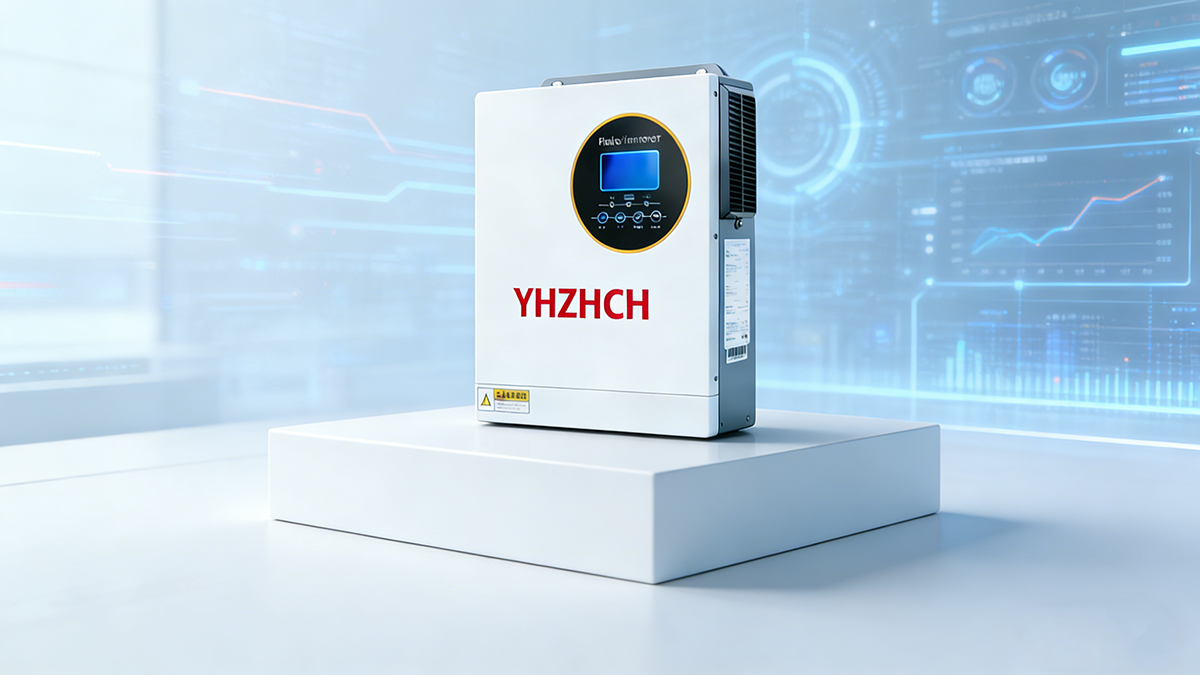
Complete working principle of solar inverter (easy to understand+professional disassembly)
First, the core positioning: the "heart+translator" of photovoltaic system
The electricity generated by solar photovoltaic panels is direct current (DC), and the alternating current (AC) is used at home/power grid;
The core function of solar inverter:
Convert the low-voltage direct current of photovoltaic panel into standard 220V/380V alternating current by boosting and stabilizing voltage;
Control voltage, current and power in the whole process to maximize light absorption and power generation;
Protect the whole machine, prevent islanding, lightning protection and grid connection safety.
Second, first understand: the basis of photovoltaic panel power generation
Sunlight irradiates photovoltaic modules → semiconductor PN junction produces photovoltaic effect → electrons move directionally → output low-voltage and fluctuating direct current.
Features: The intensity of light and the temperature will make the voltage/current keep drifting, so it can't be directly used or directly connected to the grid.
Three, the inverter internal core workflow (step by step disassembly)
Step 1: DC DC pretreatment (filtering+lightning protection+anti-reverse connection)
Photovoltaic direct current enters first:
Lightning surge module: to prevent lightning strike and high voltage surge from burning the machine;
EMI filter circuit: filter out foreign waves and interference;
Anti-reverse connection protection: the positive and negative electrodes are directly locked without burning the device.
Step 2: MPPT maximum power point tracking (the key to generating electricity and making money)
This is the core intelligent function of inverter:
Photovoltaic panels have a "peak power generation" under different illumination and temperature.
The MPPT chip will scan the voltage and current at high frequency every second, dynamically adjust the impedance, and cling to the maximum power point without wasting a trace of light energy.
? ? ? ? It is equivalent to: the throttle is automatically stepped on with the road conditions, and the whole process is full of power generation.
Step 3: DC-DC boost conversion (low voltage to high voltage)
The single string voltage of photovoltaic panels is low (tens of volts to hundreds of volts), which is not enough for inverter grid connection;
Low-voltage fluctuating DC is converted into stable high-voltage DC (bus voltage) through Boost boost circuit/high-frequency transformer.
Function: Raise the voltage, stabilize the bus, and lay the foundation for subsequent inverter.
Step 4: full-bridge inverter (DC to AC, core transformation)
High-voltage stable direct current is sent to IGBT/MOSFET power bridge (full-bridge inverter circuit);
The controller switches the power tube at high speed, cutting the DC "straightened electricity" into the prototype of sine wave AC.
Principle analogy: fast positive and negative commutation, pushing DC into alternating current that fluctuates back and forth.
Step 5: AC filtering+sine wave shaping
The AC just inverted is a rough square wave/sine wave, with harmonics and burrs;
After LC filter circuit, the clutter is filtered out and trimmed into standard pure sine wave alternating current (exactly the same as the commercial power).
Step 6: Grid-connected/off-grid output+safety protection
Grid-connected model: synchronize the frequency, phase and voltage of the power grid, accurately fit the commercial power and then transport it into the power grid; At the same time, start the "islanding protection"-the inverter will stop immediately when the power grid fails, to prevent people from being injured by electrification.
Off-grid model: self-contained voltage and frequency stabilization, directly charging and discharging with household appliances and energy storage batteries.
Whole process monitoring: overvoltage, undervoltage, overcurrent, overheating, short circuit, leakage, full-dimensional real-time protection.
Fourth, the principle differences of three major inverter types
Series inverter
Every few strings of photovoltaic panels correspond to one MPPT, which is decentralized and inverted; Adapted to the roof, complex shielding, high power generation efficiency, and now it is the mainstream of civil/industrial and commercial.
Centralized inverter
After the photovoltaic convergence of the whole field, the inverter is unified and centralized, with single high power; It is suitable for large-scale ground photovoltaic power stations, and it will suffer if it is blocked more.
Micro inverter
Each photovoltaic panel is equipped with a small inverter, board-level MPPT;; One board is blocked, which does not affect all other power generation, and the cost is high and it is extremely resistant to blocking.
Five, with advanced principle of energy storage (with battery model)
Light → photovoltaic panel →DC→ inverter:
Give priority to the use of electricity for their own loads;
Excess electricity → bidirectional inverter → charging energy storage battery;
No light at night → battery discharge → reverse to AC power supply;
In case of power failure, it will automatically cut off the grid mode to be an emergency standby power supply.
Six, a brief summary
Photovoltaic DC generation →MPPT to find the maximum power generation → Boost and stabilize DC → Power bridge high-speed commutation inverter → Filter into standard AC → Safe output to household appliances/power grid, intelligent regulation and control throughout the process+multiple protection.


