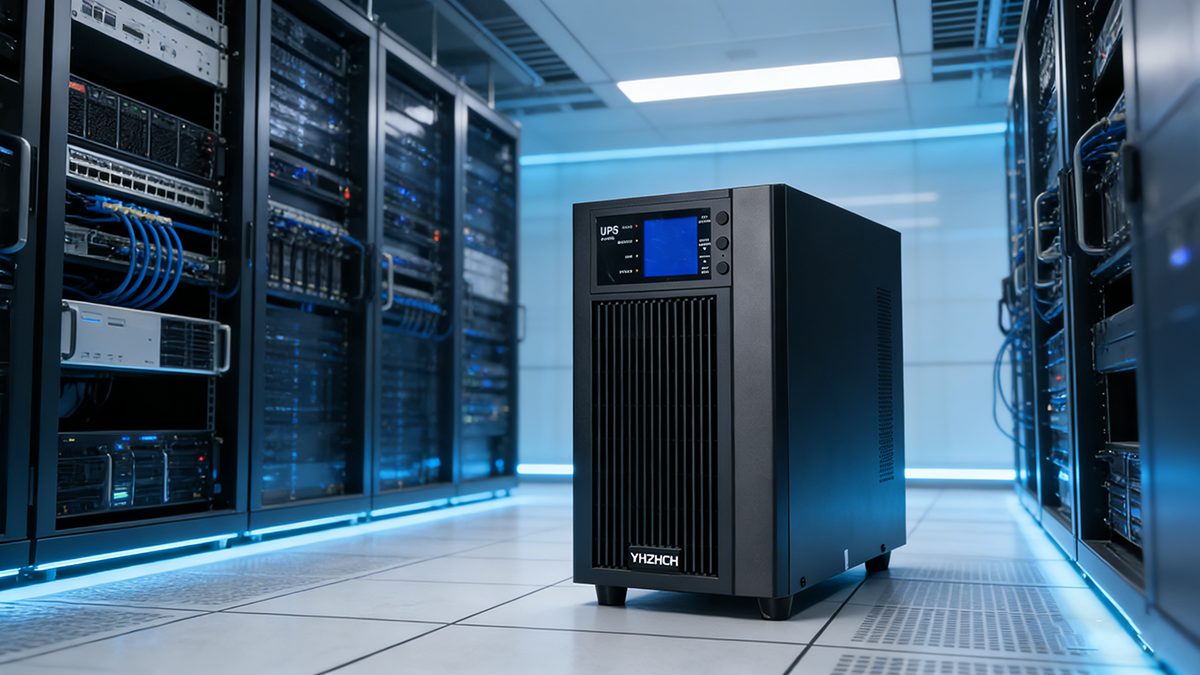
The core of protection and redundancy design of high-frequency on-line UPS is to eliminate internal faults and external interference through multi-level electrical/electromagnetic/structural protection, and then eliminate single-point failure through N+X, 2N and module-level redundancy, so as to realize high reliability, maintainability and high availability of power supply.
First, the core protection design of high-frequency online UPS
1. Input/output electrical protection (grid side+load side)
Wide voltage/frequency adaptation
Input voltage: 110–300 V (single phase) and 280–480 V (three phase).
Frequency: 40–70hz (generator compatible)
Avoid frequent battery cutting and prolong battery life.
Active PFC+low harmonic rectification
IGBT three-level/VIENNA rectifier, THDI < 3%, PF≥0.99.
Restrain harmonic pollution, surge, spike and voltage sag.
Output voltage stabilization and disturbance rejection
Double transformation online: AC→DC→AC full isolation
Output accuracy: 1%, THDU < 1.5% (linear)
Zero millisecond switching (inverter battery bypass)
Full link protection function
Inputs: over-voltage, under-voltage, lack of phase, inversion and surge (IEC 61000-4-5).
Output: overload (125%–150% long time), short circuit, overtemperature.
Battery: overcharge, overdischarge, overcurrent, temperature compensation and balanced charging.
Devices: IGBT overcurrent soft turn-off, drive redundancy, EPO emergency stop.
2. Electromagnetic compatibility (EMC) and shielding protection
Full electromagnetic shielding of control circuit (metal shielding cover of key card)
Strong and weak current partition wiring, differential signal, common mode filtering
Meet IEC 61000 and EN 62040 conducted/radiated immunity.
3. Structure and environmental protection
IP protection: mainstream IP20/IP21 (dustproof and drip-proof), industrial optional IP30/IP54.
Intelligent temperature control: multi-fan+speed regulation+over-temperature protection, dustproof filter screen/air duct design.
Three-proof paint (wet/salt fog/dust environment) and vibration-proof reinforcement
4. Control, monitoring and protection (digital DSP)
Dual DSP redundancy control (master/slave monitoring)
Power-on self-check, periodic self-check, fault recording and alarm classification.
Communication: RS485/USB/SNMP, supporting remote monitoring and dry contact alarm.
Second, the core redundancy design of high-frequency online UPS
1. Internal redundancy of single machine (module level/board level)
Power link redundancy
Multi-phase/multi-module inverter parallel connection and current sharing control
Redundancy of 3×2 power supply: 3 channels of power supply, and 2 power boards for mutual backup.
Control redundancy
Dual DSP, dual sampling, dual drive and dual fan
Battery redundancy
Multi-battery parallel connection, single cell voltage equalization and disconnection detection
2. System-level redundancy (mainstream architecture)
(1)N+X parallel redundancy (most commonly used)
Definition: N units meet the load+X units are redundant (X=1/2).
Typical: N+1 (cost-best reliability)
Capabilities: automatic exit of single fault, full load sharing and online hot plug maintenance.
Support: multi-machine battery, maximum 6-8 parallel machines.
Application: data center, financial and industrial production line.
(2)2N/dual bus redundancy (highest level)
Two completely independent UPS systems (A/B way)
Each circuit meets 100% load, independent input/battery/power distribution.
STS static switching realizes zero millisecond switching
Availability 99.995%+ (annual downtime < 30 seconds)
Application: Tier IV data center, medical care, securities and communication core.
(3) Modular N+X redundancy (new generation)
Power module+control module+bypass module is fully modular.
Module level N+1, hot plug, online expansion/maintenance
High power density, small floor space and high energy efficiency (96%+)
3. Input/bypass redundancy
Dual mains input (automatic switching of two independent mains)
Automatic bypass+maintenance bypass
When repairing UPS, the load will not be cut off.
Cascade backup (UPS+STS+diesel generator)
III. Comparison of Typical Architecture (Reliability-Cost)
form
Applicable Scenarios for Architecture Availability Cost Maintenance
Single machine 99.67% low downtime non-critical, small office
N+1 parallel connection 99.74%–99.98% online hot plug general data center, industry
2N Dual Bus 99.995%+High Online Maintenance of Financial, Medical and Core Computer Rooms
Modular N+1 99.98%+medium and high module hot plug cloud data center and high-density computer room
Fourth, summary of design points
Protection: double conversion isolation+wide range input+full protection+EMC shielding+intelligent temperature control
Redundancy:
Single machine: dual DSP, multiple power supplies, dual fans and battery grouping.
System: N+1 parallel (mainstream), 2N (high reliability), modular (flexible)
Maintenance: hot plug, common battery, dual input, maintenance bypass
Monitoring: full parameter acquisition, fault diagnosis and remote management.


