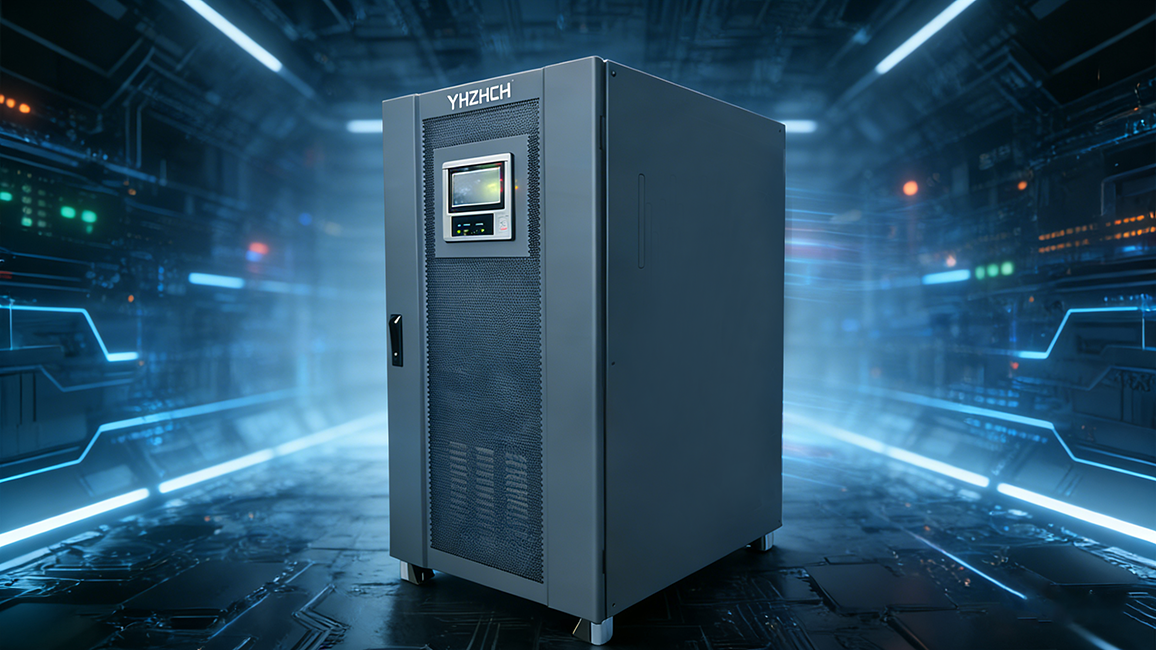
The selection of power frequency and high frequency on-line UPS, the core is to match the load characteristics, power grid environment, space/energy efficiency and reliability requirements: industrial/impact load/bad power grid priority power frequency machine; Data center/IT/stable power grid priority high frequency machine.
First, the core differences (quick judgment)
form
Comparison of power frequency online UPS and high frequency online UPS
Core structure with power frequency isolation transformer (50/60hz) without power frequency transformer and IGBT high frequency switch (> 20kHz).
Efficiency is 85%-90% (transformer loss) and 94%-97% (slightly decreased under light load)
Large volume/weight, small weight (about 1.5-2 times that of the high frequency machine) and light weight (volume reduced by 50%-67%)
Strong overload/impact: it can carry 200% load in a short time, and the adaptive motor/inductive load is weak: 120%–150%, which is not suitable for heavy impact load.
The adaptability of power grid is extremely strong: it is resistant to surge, voltage distortion and strong electromagnetic interference. It is suitable for a stable and clean environment of power grid.
Electrical isolation comes with its own isolation, and there is no isolation with high safety level, so an additional isolation transformer is needed.
High noise/heat dissipation, low heat dissipation requirements, suitable for office/computer room.
High initial cost, high long-term operation and maintenance cost, low initial cost and long-term power saving (energy efficiency advantage)
Second, the key dimensions of selection
1. Load type (core)
Priority is given to power frequency machines:
Inductive/impact loads: motors, machine tools, compressors, elevators, laser equipment, industrial production lines.
Medical precision equipment (need electrical isolation to prevent leakage current)
High-power and fluctuating industrial load
Priority is given to high-frequency machines:
IT/data center: servers, switches, routers, storage
Office equipment, routine medical testing instruments, financial network equipment.
Capacitive/linear, load stable scenario
2. Power grid and environment
Priority is given to power frequency machines:
Bad power grid: large voltage fluctuation, distortion > 10%, high harmonics and strong electromagnetic interference (mining, petrochemical, metallurgy).
Harsh environment: high temperature (-20℃~55℃), humidity, dust, vibration, outdoor/industrial site.
Key infrastructure: electric power, nuclear power, military industry and rail transit.
Priority is given to high-frequency machines:
A computer room/office/data center with stable and clean power grid
Scenes sensitive to noise and space
3. Space, energy efficiency and budget
Limited space, pursuit of energy saving: choose high-frequency machine (small size, high efficiency, long-term electricity saving)
Limited budget, medium and small power (< 100kVA): the high frequency machine is more cost-effective.
High power (> 200kVA) and long-term full load: the reliability and overload of the power frequency machine are better, and the comprehensive cost is more controllable.
4. Reliability and maintenance
Power frequency generator: with mature structure and strong fault resistance, it is suitable for unattended/extreme scenes.
High-frequency machine: high intelligence, convenient remote monitoring and maintenance, but high environmental requirements.
Third, the selection decision-making process (three-step method)
Judge the load: Does it include motor/compressor/laser/inductive equipment? → Yes → Power frequency machine; No → high frequency machine
Judging the environment: Is the power grid stable and the environment clean? → bad → power frequency machine; Good → high frequency machine
Weighing space/energy efficiency/budget: small space, power saving → high frequency machine; Reliability first, regardless of volume → power frequency machine
Fourth, typical scene recommendation
The first choice of power frequency machine: industrial production line, mine/petrochemical, medical operating room/video, power substation, motor drive equipment, outdoor base station.
High-frequency machines are preferred: small and medium-sized data centers, server rooms, office areas, financial outlets, communication base stations, and conventional medical testing equipment.
V. Selection of pit avoidance
Don't blindly pursue "high-frequency new technology": high-frequency machines in industrial/shock load scenarios are prone to overload and high failure rate.
High-frequency machine with inductive load: output isolation transformer must be added, otherwise the equipment will be easily damaged.
Light load (< 20%) scenario: the efficiency of power frequency machine is higher, and the light load efficiency of high frequency machine plummets.


