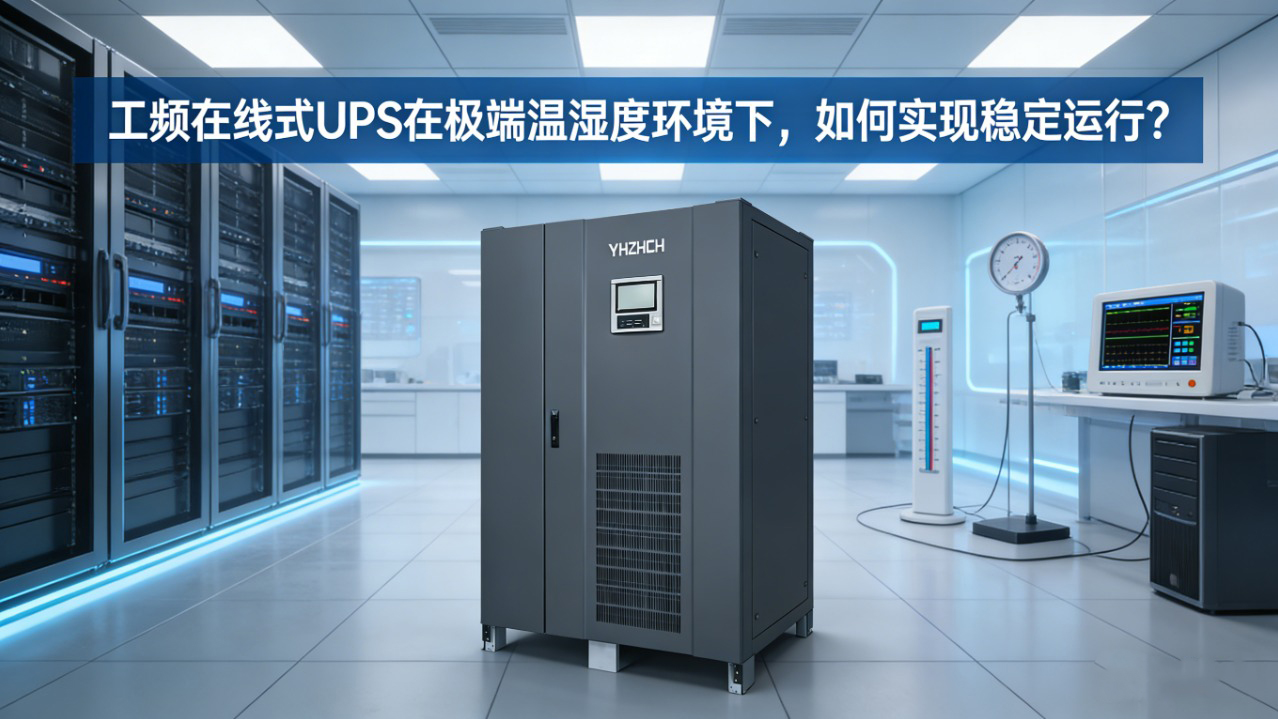
On-line UPS with power frequency isolation transformer has the advantages of strong anti-interference and stable loading capacity. However, the transformer has a large calorific value and components are more sensitive to temperature and humidity, and it is prone to heat dissipation failure, battery capacity collapse, condensation corrosion and electrostatic breakdown under extreme temperature and humidity (high temperature ≥40℃/ low temperature ≤0℃, high humidity ≥85% RH/low humidity ≤30% RH). To achieve stable operation, the core is innate design adaptation+site environment control+dynamic operation and maintenance guarantee+redundant emergency coverage. The specific scheme is as follows:
First, innate design: from the hardware level to build a solid foundation for extreme temperature and humidity tolerance.
This is the core premise of stable operation, and it needs to be specially designed according to the characteristics of "transformer heating, battery sensitivity and high insulation requirements" of the power frequency machine:
1. Extreme high temperature adaptation (core solution to heat dissipation+heat resistance of components)
Selection of high temperature resistant components
Transformer: H-class insulation (180℃) winding is selected (superior to the conventional F-class 155℃), and the core is made of low-loss silicon steel sheet to reduce self-heating;
Power devices: IGBT and rectifier bridge are selected with junction temperature above 150℃, and aluminum electrolytic capacitor is selected with high temperature of 105℃/125℃ (to avoid high temperature bulging and leakage);
Heat dissipation components: the fan is an axial fan with high temperature resistance of 105℃, and the heat sink is made of copper-aluminum composite material to increase the heat conduction efficiency.
Optimize the heat dissipation structure (for the core heat source of power frequency transformer)
The transformer is provided with an independent heat dissipation cavity, and the side air inlet+top air outlet is adopted to avoid the heat interference between the power module and the transformer;
Outdoor industrial frequency UPS: install forced air cooling/liquid cooling heat dissipation system, or use heat exchanger (no condensate, suitable for high humidity+high temperature) to avoid sudden temperature rise in the cabinet caused by direct sunlight.
Reserve for derating design: preset the high-temperature derating curve at the factory (for example, for every 5℃ increase above 40℃, the output power will be derated by 10%~20%) to avoid overload and heat generation from the hardware logic.
2. Extreme low temperature adaptation (core solution startup+battery capacity+cold resistance of components)
Selection of low temperature resistant components
Capacitors and relays shall be **-40℃ low temperature resistant models * * to avoid capacitance attenuation and contact adhesion at low temperature;
Battery: Give up the conventional lead-acid battery (capacity drops by 50%+ below -10℃), and choose low-temperature lead-acid battery (dischargeable at -20℃) or lithium iron phosphate battery (wide temperature range from-40℃ to 60℃), and build-in battery preheating module (PTC heating).
Low-temperature start-up protection: the main engine is equipped with a low-temperature preheating circuit, which automatically starts preheating below 0℃, and it is not allowed to start until the temperature of the core module (inverter and rectifier) rises above 5℃ to avoid the impact damage of IGBT and transformer at low temperature.
3. Adapting to high humidity environment (core solution: condensation+corrosion+insulation degradation)
Three-proof+seal design
PCB board and transformer winding are coated with three-proof paint (moisture-proof+salt fog-proof+mildew-proof), and metal structural parts are galvanized+plastic-sprayed to avoid high humidity corrosion;
The protection level of the cabinet is ≥IP54 (outdoor type ≥IP55), and the key modules (power board and control board) are fully sealed with glue to prevent moisture from invading.
Prevention and control of condensation: when condensation (humidity ≥90% RH+temperature ≤ dew point) is detected, the heating plate in the cabinet (heating to above dew point)+condensation dehumidifier will be automatically started to avoid short circuit and insulation breakdown caused by condensation.
4. Low-humidity environment adaptation (core to solve electrostatic breakdown)
Low humidity (≤30% RH) is easy to generate static electricity, and it is necessary to breakdown MOS tubes and control chips:
The cabinet is equipped with an electrostatic eliminator (ion fan) to neutralize static electricity in real time;
Anti-static coating shall be made on the surfaces of air ducts and components, and the grounding system shall be optimized (grounding resistance ≤4Ω) to conduct away static electricity;
Control the lower humidity limit ≥30% RH to avoid extreme dryness.
Second, on-site deployment: environmental transformation to achieve "zoning control of temperature and humidity"
There is a big difference between the optimal temperature and humidity of power frequency UPS host and battery (host: 0 ~ 40℃/20 ~ 80% RH; Battery: 20~25℃/40~60% RH), which needs to be controlled by zones to avoid mutual interference;
1. On-site transformation at extreme high temperature
Indoor type: install precision constant temperature and humidity air conditioner (refrigeration capacity matches UPS heat dissipation+heat load of machine room), and the air outlet is aimed at the heat dissipation area of transformer and power module;
Outdoor type: choose an integrated outdoor cabinet with air conditioning/heat exchange, add a sun visor on the top of the cabinet, and install a dust-proof and insect-proof net in the vent to avoid dust blocking the air duct and aggravating the heat;
It is forbidden to install UPS in direct sunlight and close to heat sources such as boilers/air compressors.
2. On-site transformation of extreme low temperature
Indoor type: insulation layer (rock wool/polyurethane) is made in the machine room, PTC electric heating device is installed (linked temperature sensing, automatically started below 0℃), and the battery cabinet is insulated and preheated separately;
Outdoor type: choose insulated outdoor cabinet with built-in battery preheating system to avoid UPS startup failure and insufficient loading capacity caused by low battery temperature.
3. High humidity field reconstruction
Indoor type: the machine room shall be waterproof+ground elevation (≥15cm), and an industrial dehumidifier shall be installed (the dehumidifying amount shall match the volume of the machine room) to avoid ground moisture regain and wall water seepage;
Outdoor type: the bottom of the cabinet is provided with a drainage hole, and the top is provided with a rain eaves to avoid rainwater infiltration. The dehumidification module operates 24 hours a day.
4. Low humidity field transformation
Indoor type: install ultrasonic humidifier and linkage humidity sensor to stabilize the humidity at 40% ~ 60% RH;
It is forbidden to operate directly in dry desert and plateau areas without humidification measures.
Third, dynamic operation and maintenance: real-time monitoring+active intervention to avoid failures.
Under extreme temperature and humidity, "passive protection" is far from enough, and dynamic control should be realized through monitoring+derating+regular maintenance;
1. Full-dimensional temperature and humidity monitoring (core early warning)
Multi-point deployment of temperature and humidity sensors (transformer cavity, power module area, battery cabinet, inside/outside the cabinet), access to UPS monitoring system, and set hierarchical alarm threshold:
High temperature: ≥40℃ early warning, ≥45℃ derating, ≥50℃ emergency shutdown;
Low temperature: early warning at ≤0℃, preheating at ≤-10℃, and no loading at ≤-20℃;
High humidity: ≥85% RH early warning, ≥90% RH start dehumidification, ≥95% RH shutdown protection;
Low humidity: ≤30% RH warning, ≤25% RH start humidification.
Support remote monitoring (cloud platform/SMS/APP alarm), operation and maintenance personnel can view data in real time and intervene remotely.
2. Active derating and load optimization
In extreme high temperature/humidity, manual or automatic derating operation (such as derating to 70%~80% of rated power according to design curve) can reduce the heating of transformers and power devices and avoid overload;
Optimize load distribution: temporarily disconnect non-critical loads (such as office equipment), give priority to core loads (servers, industrial control equipment), and reduce the on-load pressure of UPS.
Special battery maintenance: charge the battery evenly every quarter, shorten the charging cycle at high temperature (avoid overcharging), and avoid large current discharge at low temperature (discharge after preheating).
Fourth, redundant emergency: the bottom is guaranteed to avoid power failure in extreme cases.
1. System redundancy configuration
Parallel redundancy: N+1 or 2N parallel scheme is adopted, so that one UPS fails in extreme temperature and humidity, and the other UPS automatically takes over the load to avoid single point failure;
Module redundancy: The key modules (rectifier, inverter, transformer) are designed redundantly, and will be automatically switched in case of failure, which will not affect the operation of the whole machine.
2. Emergency safeguard measures
Standby cooling/dehumidification: equipped with standby fan and portable dehumidifier, which can be quickly put into operation when the main equipment fails;
Emergency power supply: outdoor UPS is equipped with standby battery pack (low temperature type) to ensure that the temperature control/dehumidification system can still run for a short time when the mains power is interrupted;


