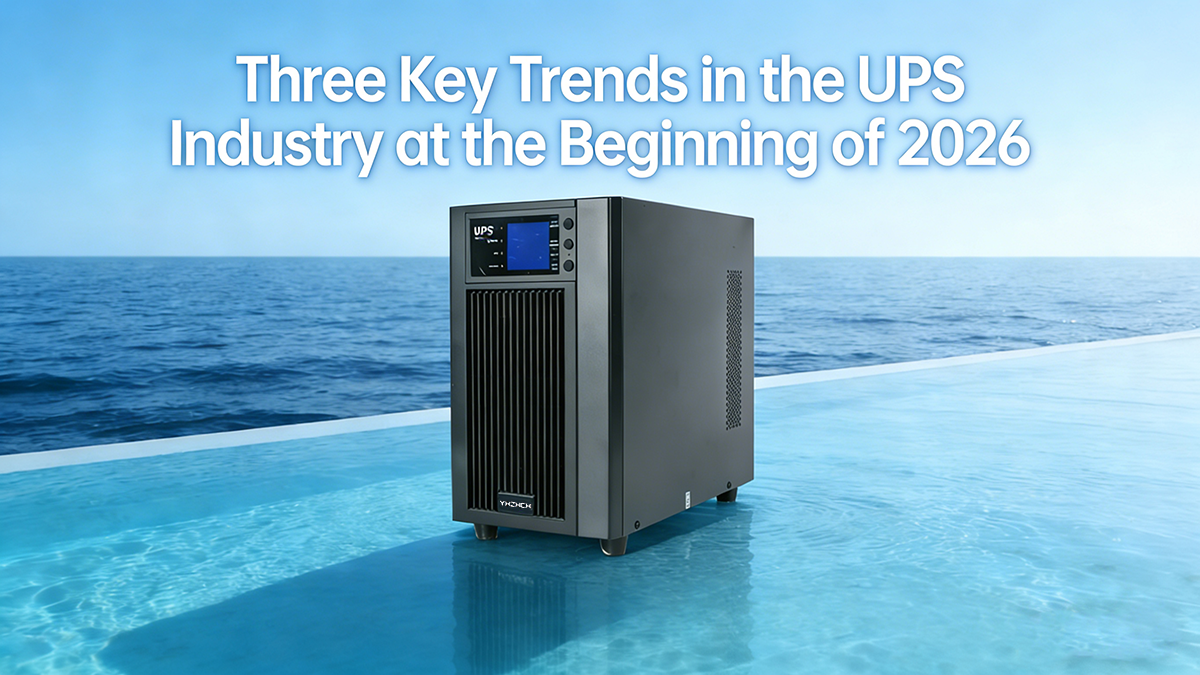
(January 22, 2026) Driven by the explosive demand for AI computing power and the deep promotion of the global "double carbon" goal, the UPS (Uninterruptible Power Supply) industry is welcoming structural changes. At the beginning of 2026, the industry clearly showed three core trends: the integration of portable energy storage and UPS opened up a new consumer-grade track, lithium electrification and intelligence deeply penetrated the core scene, the integrated scheme of "optical storage and charging +UPS" expanded the application boundary, and the traditional standby power supply was accelerating its transformation into the core component of intelligent energy management, providing a more reliable, efficient and green power guarantee system for various industries.
Trend 1: the integration of portable energy storage and UPS activates the new growth of consumer market.
The consumer market has become a new growth engine of UPS industry, and the cross-border integration of portable energy storage and UPS functions has become the mainstream direction. With the popularization of home digital equipment and the upgrading of outdoor electricity demand, portable energy storage products with UPS uninterrupted power supply capability have quickly entered home and outdoor scenes with the advantages of instantaneous switching, high efficiency and fast charging. At the CES exhibition in 2026, a number of new products were unveiled. Its China Baoxinneng Explorer 1500 Ultra realized 20ms instantaneous switching, and IP67 dustproof and waterproof design took into account family emergency and outdoor work. Anker entered the market through Solix brand, and launched E10, an energy storage product with integrated UPS function, marking the official layout of this cross-border track by the consumer electronics giant, and pushing the product to extend to the dual scene of "daily standby+outdoor energy storage".
This convergence trend not only enriches the form of consumer-grade products, but also reconstructs users' cognition of UPS, shifting from professional scene tools to household emergency equipment, which drives the rapid expansion of the consumer-grade market in the industry.
Trend 2: Lithium electrification and intelligence, reshaping the pattern of data centers and industrial scenes.
As the core application scenario of UPS, data center and industrial field are welcoming the dual upgrade of lithium electrification and intelligence. The explosive growth of AI computing power demand puts forward extreme requirements for power stability. The traditional lead-acid battery UPS has been difficult to adapt to the needs of pulsed loads such as GPU clusters. The peak power of such loads can rise several times in 2 milliseconds, which is easy to cause voltage fluctuations and interruption of training tasks. A flash-off may cause millions of dollars in losses.
With the advantages of high energy density, long cycle life and fast response, lithium-ion UPS has become the first choice in the scene. At present, 54% of new data center projects give priority to lithium-ion UPS, and the maintenance cost is reduced by more than 30% compared with traditional products. At the same time, the intelligent technology is deeply integrated with UPS to form the full link capability of "prediction-protection-optimization": microsecond detection is realized through the mixed architecture of DSP and FPGA, and the risk of voltage sag is avoided in advance by combining edge AI prediction; Digital twin technology can monitor the health status of the battery in real time, and prolong the battery life by more than one time; In the industrial scene, lithium battery UPS cooperates with all-vanadium liquid flow energy storage system to provide millisecond power response for precision manufacturing and effectively improve product yield. Modular lithium-ion UPS launched by Huawei, Schneider and other enterprises has continuously broken through in power density and energy efficiency, further accelerating technology penetration.
Trend 3: "Optical storage and charging +UPS" integration, expanding the application boundary of the whole scene.
The maturity of the integrated scheme of "optical storage and charging +UPS" is breaking the positioning of UPS as a single backup power supply, achieving large-scale landing in hotels, factories, scenic spots, parks and other scenes, and building a closed-loop energy system of "power generation-energy storage-power supply-interaction". In the hotel scene, Doubletree by Hilton Suzhou's light storage, charging and discharging integration project integrates photovoltaics, energy storage and charging piles, and runs stably through UPS guarantee system, providing 318,000 kWh of green electricity every year, reducing carbon emissions by 602 tons, and at the same time, the potential for annual income increase through peak-valley arbitrage exceeds 200,000 yuan; In the industrial and park scenarios, Hangzhou Zero Carbon Park adopts a combination scheme of 0.57MW photovoltaic+energy storage +UPS+ charging network. Through intelligent dispatching, the cost of using electricity is reduced by 80%, and the investment payback period is shortened to 5-6 years.
Transformation and upgrading, going to a new energy future together.
Behind the transformation of UPS industry is the same frequency resonance between technological innovation and the needs of the times. UPS upgrades to high precision, high response and intelligence, and the global "double carbon" goal drives products to iterate in the direction of green and integration. In the future, UPS will play a more central role in the energy Internet, providing more solid power support for digital economy, intelligent manufacturing, green travel and other fields.
We will keep up with the industry trend, take technological innovation as the core, deeply cultivate lithium electrification, intelligence and integration solutions, and continue to empower customers in various industries to achieve power security upgrade and green transformation, and build an efficient, reliable and sustainable smart energy future.


