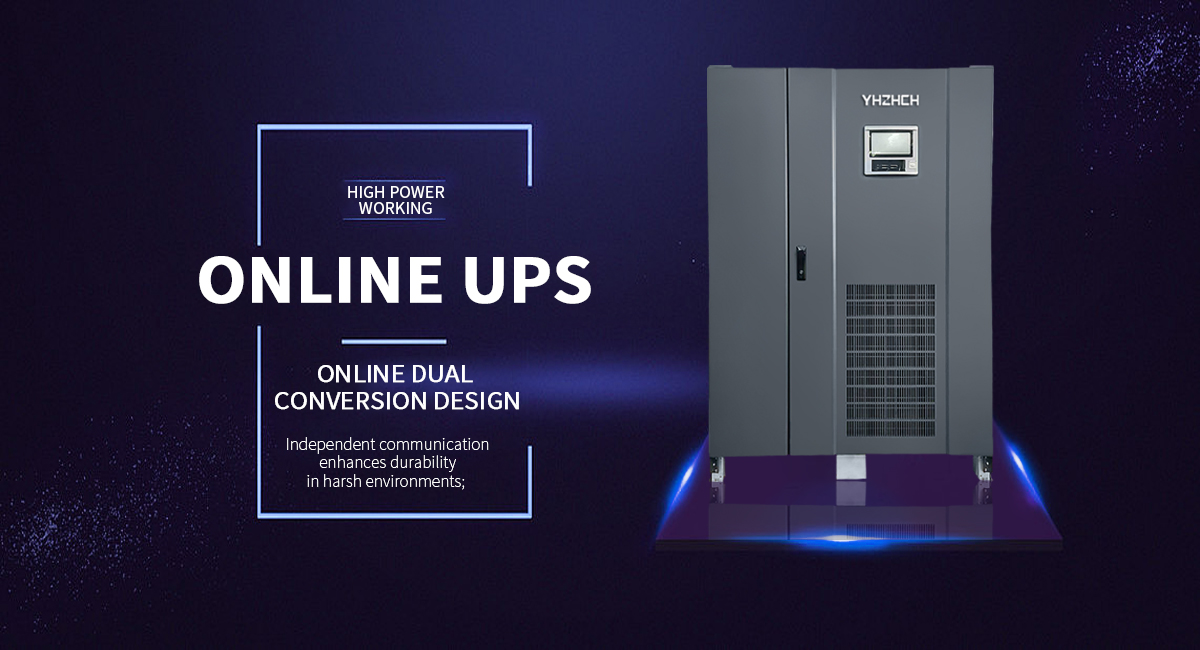
The switching time of high-power industrial-frequency on-line UPS (usually refers to the on-line dual conversion topology with power ≥ 10 kV and isolated by industrial-frequency transformer) is defined as "the interruption time of switching from mains power supply to battery inverter power supply when the mains power is abnormal" (the on-line UPS is 0ms in theory, but there is microsecond fluctuation in practice). The influencing factors of its switching time can be divided into four categories: topology design, hardware selection, control algorithm and operating environment, and the specific disassembly is as follows:
1. Core Topology and Circuit Design (Basis for Determining Switching Time)
The "double conversion" architecture of power frequency online UPS is the core to realize low switching time, but the design details directly affect the stability and response speed:
Topological structure of inverter bridge and rectifier bridge
When using "full bridge inverter" (instead of half bridge) design, the switching frequency of power device (IGBT) is higher (usually 10-20kHz), the response speed is faster, and the voltage gap during switching is smaller.
If the rectifier bridge adopts "active PFC rectification" (instead of passive rectification), it is more sensitive to the detection of abnormal mains supply, which can trigger inverter switching in advance and reduce delay.
Parameter matching of power frequency transformer
The leakage inductance and excitation inductance of transformer will affect the energy transfer speed: the smaller the leakage inductance, the better the phase and amplitude synchronization of inverter output voltage and mains voltage, and there is no obvious interruption during switching;
The winding material (copper winding is more efficient than aluminum winding) and technology (vacuum dipping reduces parasitic parameters) of transformer will reduce the energy loss and voltage fluctuation during switching.
Design of Static Switch (Key Switching Component)
Device type of static switch: IGBT or SCR (silicon controlled rectifier) is used as switching device, and the switching speed of IGBT (nanosecond level) is much faster than that of SCR (microsecond level), but SCR has stronger current surge resistance and needs to be balanced according to power level;
Parallel redundancy design of static switches: High-power UPS (such as ≥50kVA) usually adopts multiple groups of static switches in parallel, which can disperse current and pressure and avoid switching delay caused by single device failure.
Second, hardware selection and device performance (core variables affecting switching speed)
Parameters of power semiconductor devices
Rated current and voltage margin of IGBT/rectifier bridge: IGBT with high current and low on-voltage drop (such as Infineon FF series and Mitsubishi CM series) should be selected for high-power UPS, which has small switching loss and fast response speed and can quickly complete the current transfer from "commercial power to inverter";
Switching frequency of the device: The higher the switching frequency, the smaller the ripple of the inverter output voltage, the higher the synchronization accuracy with the mains voltage, and the shorter the voltage interruption time during switching (usually, the switching delay can be reduced by 5-10ns for every 1kHz increase in frequency).
Matching between battery pack and inverter
Discharge internal resistance of battery pack: The smaller the internal resistance (for example, the internal resistance of lithium iron phosphate battery is 30% smaller than that of lead-acid battery), the smaller the voltage drop during discharge, and the inverter can quickly obtain stable DC input and reduce the delay of inverter start-up;
Output filter circuit of inverter: LC filter (inductance+capacitance) or LLC resonance filter can quickly filter out the high-frequency harmonics of inverter output, so that the waveform consistency of output voltage and mains voltage is higher, and there is no "burr" or interruption during switching.
Accuracy of detection and sampling devices
Response speed of voltage/current sensor: Hall sensor (response time ≤1μs) instead of electromagnetic sensor (response time ≥10μs) can quickly detect the abnormality of mains voltage (such as voltage drop and frequency shift) and provide accurate signals for switching control;
Sampling frequency: The sampling frequency of high-power UPS is usually ≥10kHz. The higher the sampling frequency, the more timely it is to identify the abnormality of commercial power, so as to avoid the switching delay caused by detection lag.
Third, control algorithm and software optimization (determine the intelligence of switching logic)
Anomaly detection algorithm of commercial power
Voltage/frequency two-parameter detection: not only detect the voltage amplitude (such as the mains voltage is lower than 80% of the rated value), but also detect the frequency offset (such as 50Hz±0.5Hz), and adopt the algorithm of "effective value detection+instantaneous value mutation detection" to avoid false triggering of switching and ensure fast response (detection delay ≤ 20μ s);
Phase-locked loop (PLL) algorithm: The phase and frequency of the mains voltage and the inverter output voltage are synchronized in real time by PLL, so that the phase difference between them is ≤ 1, the current has no impact during switching, and the interruption time approaches 0 ms..
Optimization of switching logic
"Pre-synchronization" control: When UPS is in normal operation, the inverter is always in a "hot standby" state, and its output voltage is synchronized with the mains voltage in real time. When the mains voltage is abnormal, the static switch is directly closed without waiting for the inverter to start;
Redundancy switching strategy: For modular high-power UPS, the algorithm of "uninterrupted parallel switching" is adopted. When one module fails, other modules quickly make up the position, and the switching time is ≤ 10μ s..
Computing ability of CPU and control chip
Using high-performance DSP (digital signal processor, such as TI TMS320 series) or FPGA (field programmable gate array), the operation speed is ≥1GHz, which can quickly process sampling data and execute switching algorithm to avoid switching lag caused by operation delay.
Iv. Operating environment and system status (easily overlooked factors)
Commercial Power Quality and Load Characteristics
Harmonic content of mains voltage: if there are a lot of harmonics in mains voltage (such as inverter and welding machine load in industrial environment), it will interfere with the voltage detection accuracy of UPS, lead to misjudgment of switching algorithm and indirectly increase switching delay;
Load type: The starting current of inductive load (such as motor and air conditioner) is large, which will cause the output voltage of UPS to drop temporarily. If the load power exceeds 80% of the rated power of UPS, the current transfer pressure during switching will increase, which may extend the switching time (usually, the switching delay will increase by 5-10μs for every 10% increase in load rate).
Ambient temperature and heat dissipation conditions
Working temperature of power devices: The optimal working temperature of IGBT is 25-60℃. If the temperature exceeds 80℃, its switching speed will decrease by 20%-30%, and the switching delay will increase significantly.
Efficiency of cooling system: High-power UPS usually adopts the combination of forced air cooling and liquid cooling. If the cooling fan fails or the cooling liquid is insufficient, the device will overheat and the switching performance will be affected.
Equipment aging and maintenance status
Aging of battery pack: after three years of use, the internal resistance of lead-acid battery will increase by more than 50%, and the discharge response speed will decrease, resulting in unstable inverter output voltage during switching;
Contact oxidation of static switch: after long-term operation, contact oxidation of static switch will increase contact resistance, slow down current transfer speed during switching, and even appear "arcing" phenomenon, extending switching time.
V. Industry Standards and Practical Application Reference
Industry standard for switching time of power frequency on-line UPS: usually ≤2ms (microsecond level), high-end products (such as Huawei UPS5000-E and Schneider Galaxy VX series) can achieve switching delay ≤100μs, almost imperceptibly;
Impact on high-power scenes (such as data centers and industrial production lines): If the switching time exceeds 5ms, sensitive loads (such as servers and PLC controllers) may restart or lose data, so UPS products controlled by IGBT static switches and high-performance DSP should be preferred.


