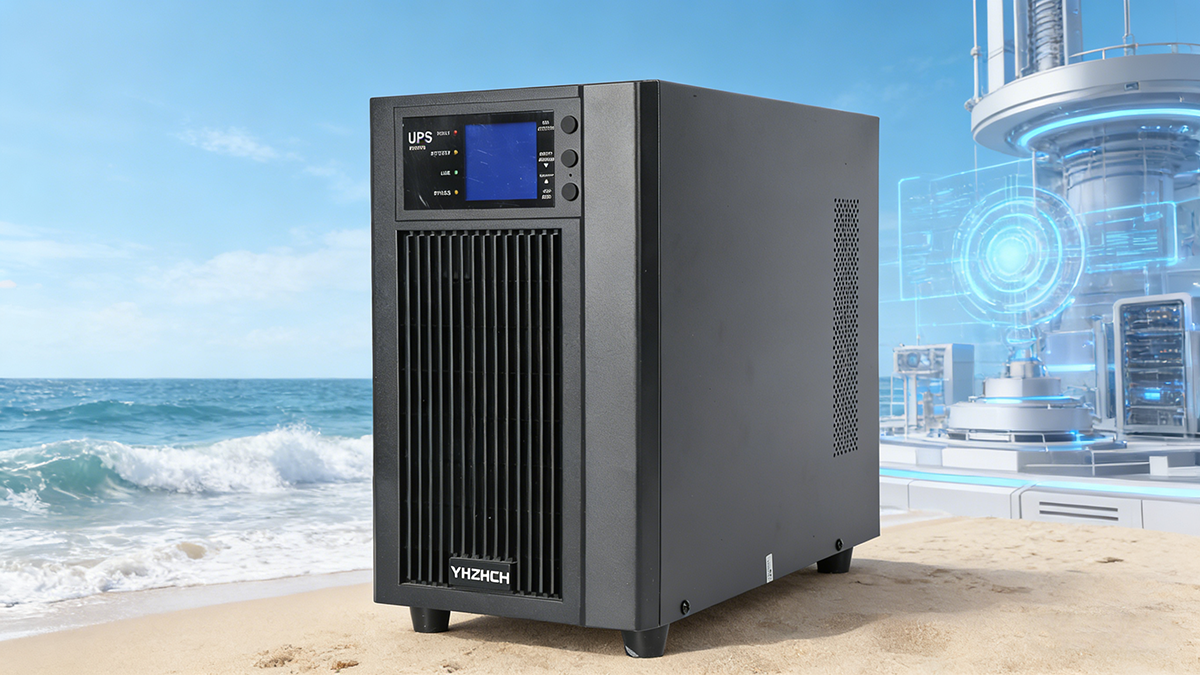
Matters needing attention in adaptability test of high frequency on-line UPS power grid
Power grid adaptability mainly includes: voltage deviation, frequency deviation, voltage sag/sag, harmonics, three-phase imbalance, voltage flicker, abnormal phase sequence, surge and other items. Personal safety, equipment safety, test effectiveness, standard compliance and accurate data should be taken into account in the test, and the high-frequency machine itself is more sensitive to power grid disturbance, so the following aspects should be paid attention to:
I. Precautions for preparation before test
Equipment and wiring inspection
Confirm UPS nameplate parameters: rated power, input voltage range and frequency range, and distinguish single-phase/three-phase high-frequency UPS; Confirm that the tested machine is in high-frequency online dual-conversion mode, and try to work in the dual-conversion online mode throughout the test, and prohibit long-term forced bypass for power grid adaptability.
Confirm the load configuration: use impedance inductance/capacitance to simulate the load, and give priority to the programmable electronic load; The load is recommended to be 25% to 100% of the rated load, and the standard test points generally take 50% and 100% of the load; High-frequency machine can't do disturbance test without load for a long time, which is easy to cause protection misoperation.
Firm wiring: input, output and battery wiring are firm; Wiring polarities of test source, voltage sensor and current transformer cannot be reversed; Pay attention to the phase sequence of the three-phase system, and distinguish L1/L2/L3, N and PE. The PE protective grounding must be reliable to prevent electric shock.
Battery status: the high-frequency online UPS battery must be fully charged, and the battery pack voltage is within the normal floating range; When testing items such as voltage sag and power failure, UPS will switch batteries, which will directly lead to UPS shutdown and test failure.
Test instrument confirmation
Power grid disturbance generator (programmable AC source) can output voltage, frequency, harmonic, sag and unbalanced voltage; The instrument bandwidth and sampling rate meet the requirements of standards (such as GB/T 7260.3‑1).
The power quality analyzer collects the input and output voltage and current of UPS at the same time, and records the waveform, effective value, THD, frequency and switching time.
Oscilloscope observes the output transient waveform and captures the output fluctuation and switching process at the moment of disturbance.
Environment and safety
The ambient temperature and humidity are within the allowable working range of UPS, with good heat dissipation and ventilation, and the power device of high-frequency machine generates a lot of heat, so it can be tested for a long time to prevent overheating protection.
Warning is set in the test area, and the test source outputs high voltage to prevent accidental touch; It is forbidden to connect the output side of UPS with irrelevant equipment on site, and only connect the test load.
Be familiar with UPS protection logic in advance: over-voltage, under-voltage, over-frequency, under-frequency, over-current and short-circuit protection, and predict the possible alarm, bypass and shutdown phenomena under disturbance.
Second, the power grid adaptability test special considerations
1. Input voltage deviation test
Test at the allowable upper limit, lower limit and intermediate point of input voltage with different loads respectively; The input voltage range of high-frequency machine is wide, but under the limit voltage, attention is paid to: output voltage stabilization accuracy, input current harmonics, false alarm, abnormal bypass.
Do not exceed the maximum and minimum input voltage specified by UPS to avoid damaging the high-frequency rectifier module.
2. Input frequency deviation test
Test the upper and lower limits of input frequency; High-frequency UPS rectifier has a limited range of frequency tolerance. If it exceeds the specification, it will be rectified out and switched to battery power supply.
Record: output voltage change, whether to switch batteries, alarm information, and don't run for a long time at out-of-specification frequency.
3. Voltage sag, short-term interruption and temporary rise (key projects)
The core assessment item of high-frequency online UPS will trigger the switching of rectifier batteries.
Set different drop depth, duration, phase angle trigger (zero crossing point, peak point) and different load conditions.
Focus on observing the output voltage transient and switching time, and do not allow the output to be interrupted by power failure; Note: If the sag time exceeds the rectification tolerance time, UPS will cut off the battery, so make sure that the battery can support the whole test.
Avoid continuous and repeated depth sag, frequent rectification/battery switching back and forth, and the high-frequency module is easy to overheat; Leave enough recovery interval between two disturbances.
Interrupt the voltage test for a short time, and confirm that there is no abnormal output in the process of switching the battery from the power grid and switching back to rectification after the power grid is restored.
4. Three-phase input voltage imbalance test (three-phase high-frequency UPS)
Set different unbalance, and record the output performance, input current and protection action.
Some three-phase high-frequency machines have no neutral line rectifier, and the rectifier module will reduce power when it is seriously unbalanced. It is necessary to observe the change of load capacity and not overload.
5. Input harmonic distortion test (including harmonics in power grid)
The programmable source superposes each harmonic, simulates the distortion of power grid, and evaluates the anti-harmonic ability of UPS rectifier.
Observe the distortion of UPS output voltage, whether the rectification exits and whether there is alarm; High-frequency rectification is sensitive to power grid harmonics, and serious distortion may lead to input protection.
6. Phase sequence error and phase missing test (three-phase model)
Phase sequence reversal: most high-frequency UPS will lock the alarm and prohibit rectification; Do not power on for a long time in the phase sequence error test, and restore the correct phase sequence as soon as possible after confirming the alarm to prevent module damage.
Open-phase test: Open A/B/C phases respectively, and observe the working mode of UPS, whether to reduce capacity, bypass or alarm.
Iii. Matters needing attention in the testing process
Mode confirmation: UPS should be in online double conversion mode in most power grid adaptability tests; Only bypass-related items will be switched to bypass mode; It is forbidden to do grid adaptability in battery mode. Confirm the working state of UPS before each disturbance.
Step-by-step disturbance: first, make a small disturbance pre-test to observe the reaction of the equipment, and then do the limit working condition specified by the standard; In case of continuous overcurrent, ignition and abnormal noise, stop the test immediately and disconnect the input.
Complete data recording: at each test point, record the load size, input disturbance condition, UPS working mode, effective value of output voltage, transient waveform, alarm code and whether to bypass/cut the battery.
Bypass switching risk: some high-frequency UPS will automatically cut the bypass when encountering bad power grid disturbance; At this time, the output is directly affected by the disturbed power grid, so it is necessary to record this phenomenon and distinguish whether it is the normal strategy of the equipment or the failure.
Four, after the test matters needing attention
Restore the programmable power supply to normal power grid parameters, and observe whether UPS automatically returns to normal online working mode and the battery recharge function is normal.
Wait for the UPS to fully cool down, and check whether the module and battery are abnormally hot.
Check the wiring, and then remove the test cable after power failure.
Distinguish phenomena: which behaviors are allowed by the standard (such as battery switching beyond the tolerance range of the power grid, alarm) and which are unqualified (output interruption, output overrun, device damage).
V. Standard Reference
GB/T 7260.3‑1 "Uninterruptible Power Supply Equipment (UPS) Part 31: UPS Performance Requirements for Power Grid Interface" is the main reference in China, and the test conditions and criteria for power grid adaptability are subject to this.


