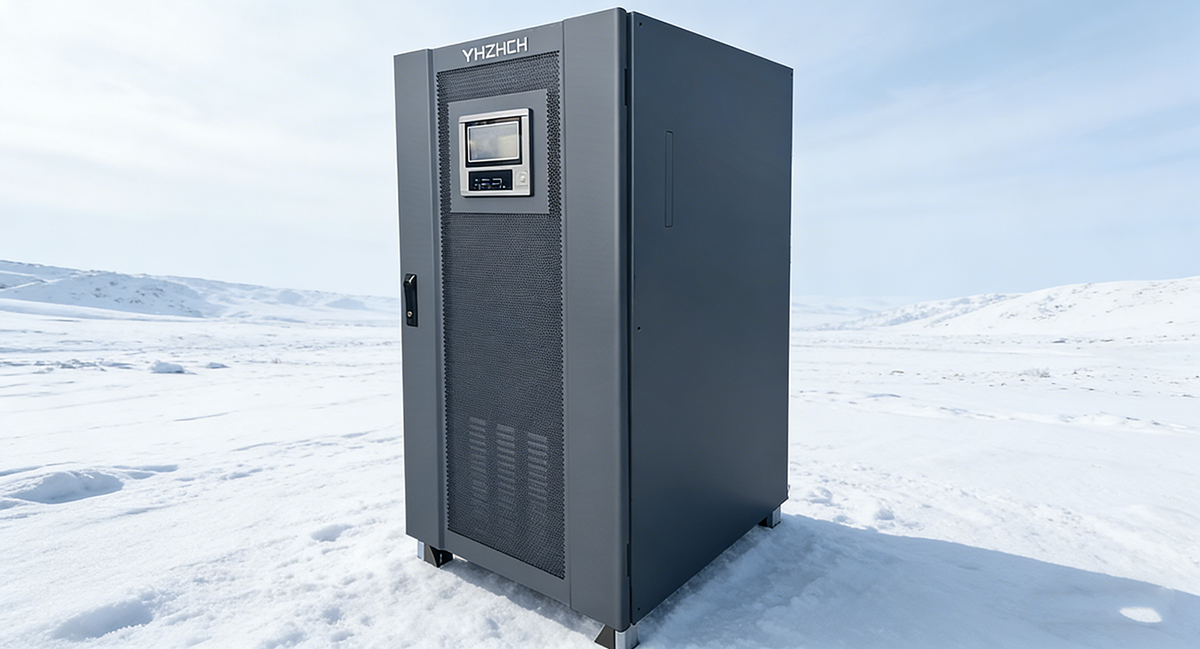
The underlying logic (which must be derated) of power frequency online UPS at high temperature is universal for all brands, but the specific derating curve, critical temperature and derating range are not universal. Each brand/series model has independent standards, and unified values cannot be applied.
1. General bottom rules (all power frequency UPS shall comply with them, which are from national/international standards)
According to GB/T 7260.3-2024 and IEC 62040-3:
Reference environment for UPS rated capacity calibration: 25℃, altitude ≤1000/1500m, and only at this temperature can 100% rated kVA/kW national standard letter be output.
Temperature rise exceeding the limit will damage three types of core heating parts (the pain point of power frequency machine is more prominent):
Output isolated power frequency transformer (silicon steel winding, B/F insulation with fixed temperature rise limit)
Power IGBT, rectifier bridge, DC bus electrolytic capacitor (capacitor life is halved for every 10℃ temperature increase)
Internal reactor, power copper bar
Mandatory principle: if the ambient temperature exceeds the manufacturer's nominal maximum derating temperature, the load must be derated; Otherwise, it will give a high temperature alarm, cut off the bypass, or even stop and burn down, which is true for all power frequency/high frequency UPS.
Because the power frequency machine has its own large-capacity transformer, the loss (85%~90% efficiency) of the whole machine is much higher than that of the high frequency machine, and it generates more heat at the same temperature, and the high temperature derating range is generally greater than that of the high frequency machine of the same specification.
Second, the key differences that are not common (brands/models are defined separately, and there is no unified value)
1. Maximum temperature without derating (the demarcation point is different for each family)
High-end industrial power frequency machines (Kehua, Vitti, Schneider industrial power frequency): 0~40℃ full load without derating;
Ordinary commercial power frequency machines (medium and small power Shante, Costar EPI): fully loaded at 0 ~ 35℃, and derated at > 35℃;
Low-cost small factory power frequency: only 0~30℃ full load, capacity reduction immediately above 30℃.
2. The derating slope after the temperature exceeds the threshold (core difference)
The circulating experience in the industry that "2% for every 1℃ increase above 40℃" is only the general experience value of industrial machines in the Middle East, not the mandatory value of the national standard, and the curves of various manufacturers are completely different:
Schneider industrial power frequency: 40℃ is the upper limit, with linear derating at 40~50℃, and only 60% load is allowed at 50℃;
Kehua high-power industrial power frequency (petrochemical/electric power): no reduction within 45℃, and 1.2% reduction for every 1℃ increase above 45℃;
Ordinary domestic medium and small power frequency (10kVA and below): take-off and landing at 35℃, 2% ~ 3% for every 1℃ increase;
The derating slope of some reinforced cooling models (independent air duct and dual redundant fans) is more gentle.
3. Insulation grade determines transformer tolerance (different series of the same brand are also different).
The core heating source of power frequency generator is isolation transformer;
The temperature rise limit of F-class insulation (high-end industrial power frequency) winding is 100K, with large high temperature margin and less derating;
The temperature rise limit of class B insulation (economical power frequency) is 80K, which has a small high temperature margin and a larger drop in the same temperature.
The same brand of high-end industrial series vs economic commercial power frequency, the derating standard is different.
4. Difference caused by heat dissipation structure
High-power three-phase power frequency: independent air duct, front and rear large fans, and independent heat dissipation bin of transformer, which has better high temperature tolerance;
Low-power single-input single-output power frequency (6kVA/10kVA) has compact body, poor heat dissipation and more severe temperature drop in the same environment.
5. Different protection logic
Some brands: linear continuous reduction of power output when the temperature exceeds the standard;
Some brands: alarm first when reaching the critical temperature, directly limit the maximum output to 70% of the rating when exceeding the threshold, and there is no gradual curve.
Third, the national standard only makes "bottom line requirements" and does not stipulate specific derating values.
GB/T 7260.3-2024 only stipulates two bottom lines, and it is not mandatory to unify the derating percentage:
The manufacturer must clearly indicate the rated working temperature range, high temperature derating curve/derating table in the specification;
During full-load operation, the temperature rise of all components of the whole machine shall not exceed the insulation standard limit;
If the manufacturer does not indicate the high temperature derating, by default, only 25℃ environment allows 100% loading, and users above 25℃ need to take the initiative to offload.
To put it simply, the standard only requires that "derating rules must be made public", but the temperature and amount of derating should be defined by the manufacturer's thermal design.
Four, practical judgment and selection rules
Deregulation data cannot be applied across brands.
Schneider's power frequency 40℃ non-derating standard can't be applied to the models that are derated at 35℃ in small factories. You must refer to the "Environmental Conditions-Temperature Deregulation Curve" in the Technical Specification of the original factory of this machine.
Key points of industrial high temperature scene (workshop, outdoor cabinet, above 40℃)
Give priority to the industrial-grade power frequency with nominal 0~40℃ full load and no derating;
If the environment is 40~45℃ for a long time, no matter the brand, an additional 10%~20% redundancy will be reserved according to the manufacturer's derating curve;
Power frequency transformer has a large heat, so it is forbidden to load more than 80% in high temperature environment for a long time, and it is recommended to control it within 60%.
Quickly distinguish between general logic and brand-specific parameters
form
All brands of the project are common, but all brands/models are not common.
25℃ is the rated calibration benchmark—
Overtemperature must be unloaded or overheating protection—
The power frequency transformer generates more heat than the high frequency machine, and the high temperature is more likely to overload-
Maximum ambient temperature with full load and no derating—
Percentage reduction for every 1℃ increase-
Transformer insulation grade, heat dissipation structure—
High temperature protection strategy (gradual capacity reduction/direct power limiting)—
V. Summary
The underlying safety logic is all universal: when the temperature is higher than the rated reference environment, the power frequency UPS must be derated, otherwise it will overheat, its service life will be sharply reduced and the protection will stop; Power frequency machine has weaker high temperature tolerance than high frequency machine due to transformer loss.
The specific derating standard is by no means universal: the full-load upper limit temperature, derating slope and protection threshold are determined by the insulation and heat dissipation design of transformers of different brands and different series models of the same brand, and there is no unified national standard value.
The only reliable basis for engineering calculation: the temperature-load derating curve in the technical manual of the original factory of the corresponding model cannot be directly applied to all equipment using the industry experience value.


