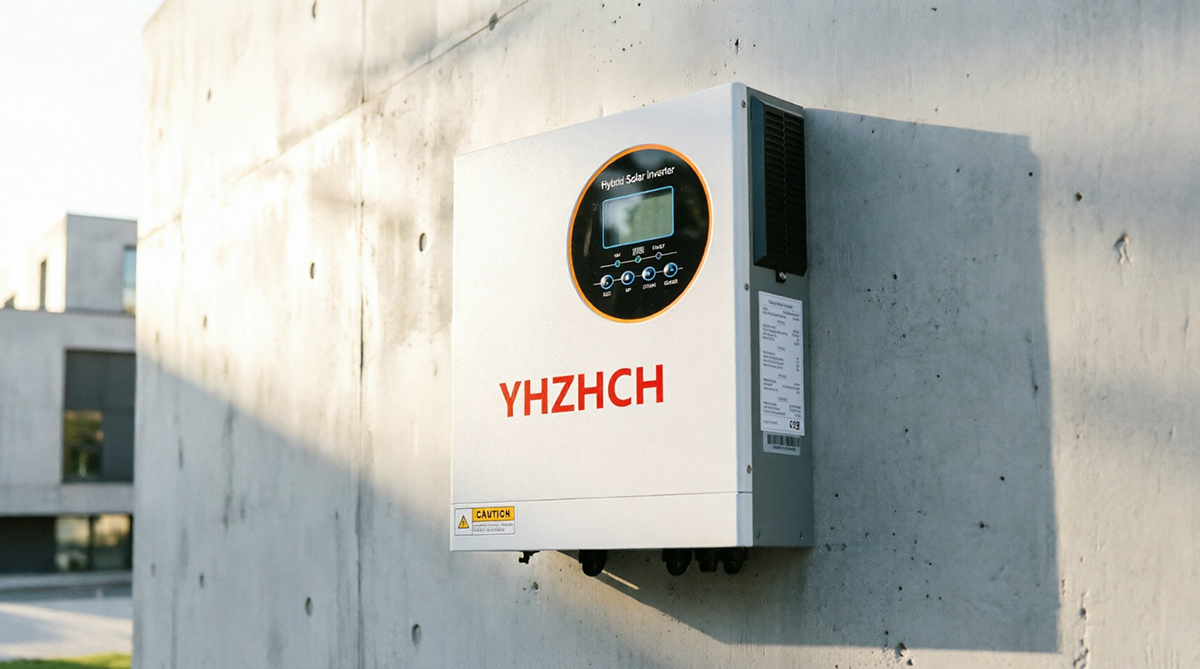
Common causes and classification of low efficiency of solar inverter
First, the load and working conditions (the most common)
Load mismatch
Light load operation: the load power is far lower than the rated power of the inverter, and the conversion efficiency of the low load range itself will be greatly reduced (most inverters have the best efficiency in the 20%~80% load range).
Overload/inductive/capacitive load: motor, water pump, high-power inductive load, reactive power increases, the proportion of active output decreases, and the overall efficiency becomes worse.
Abnormal output voltage/frequency
The inverter is forced to adjust its operating point due to high grid voltage and frequency offset, and the loss increases.
Second, the environment and heat dissipation problems
hyperpyrexia
The installation space is sealed, exposed to the sun, the cooling fan is blocked/stopped, the temperature rise of power devices (IGBT, MOS tube, transformer) is intensified, the conduction loss and switching loss are sharply increased, and the efficiency is obviously reduced.
Environmental dust and humidity
Dust covers the heat sink and circuit board, which hinders heat dissipation; Dampness causes slight leakage and increases additional loss.
Third, the photovoltaic input problem (DC side)
PV module/string fault
The aging of components, shading (dust, shade, shadow), single battery damage, inconsistent series current, unstable DC input power/voltage, the inverter can't work at the maximum power point (MPPT), and the power generation utilization rate is reduced.
MPPT tracking exception
The MPPT module fails and the parameters drift, so it is impossible to accurately track the maximum power point of photovoltaic, and the direct current energy is not fully utilized.
DC line loss
The diameter of photovoltaic cable is too small, the terminal is loose and oxidized, the cable is too long, the DC voltage drop is large, and the front-end power is lost in the line.
IV. Hardware failure/aging of equipment body
Aging damage of power devices
Power tubes, rectifier bridges and transformers are aging after long-term use, and the internal resistance becomes larger, heating and loss increase; Soft breakdown of devices can also lead to a sharp drop in efficiency.
Capacitance performance attenuation
The DC bus capacitance and filter capacitance bulge, the capacitance decreases, the ESR (equivalent series resistance) increases, the ripple increases and the loss increases.
Poor contact of relay/contactor
The contact point of AC/DC side switch is oxidized and ablated, and the contact resistance becomes larger, resulting in extra power consumption.
Internal circuit fault
Abnormal driving circuit and deviation of sampling circuit lead to abnormal working state of switching tube and sharp increase of switching loss.
Five, parameter setting and system matching problem
Improper parameter setting
The maximum power point voltage, protection threshold and reactive power compensation parameters are set incorrectly and deviate from the optimal working range.
Multi-machine parallel connection problem
When multiple inverters are connected in parallel, the communication is abnormal, the circulation increases, and they interfere with each other, which reduces the overall efficiency.
Six, the power grid side problem (AC grid end)
The power grid has large harmonics, unbalanced three-phase voltage and large line impedance, so the inverter needs to suppress harmonics and balance three phases, and the additional loss increases.
Quickly check the priority
First look at the load, occlusion and ambient temperature (easy to check, accounting for the majority of faults);
Check the wiring, cables and terminals for heating and oxidation;
Finally, MPPT, device aging and circuit parameters are detected.


