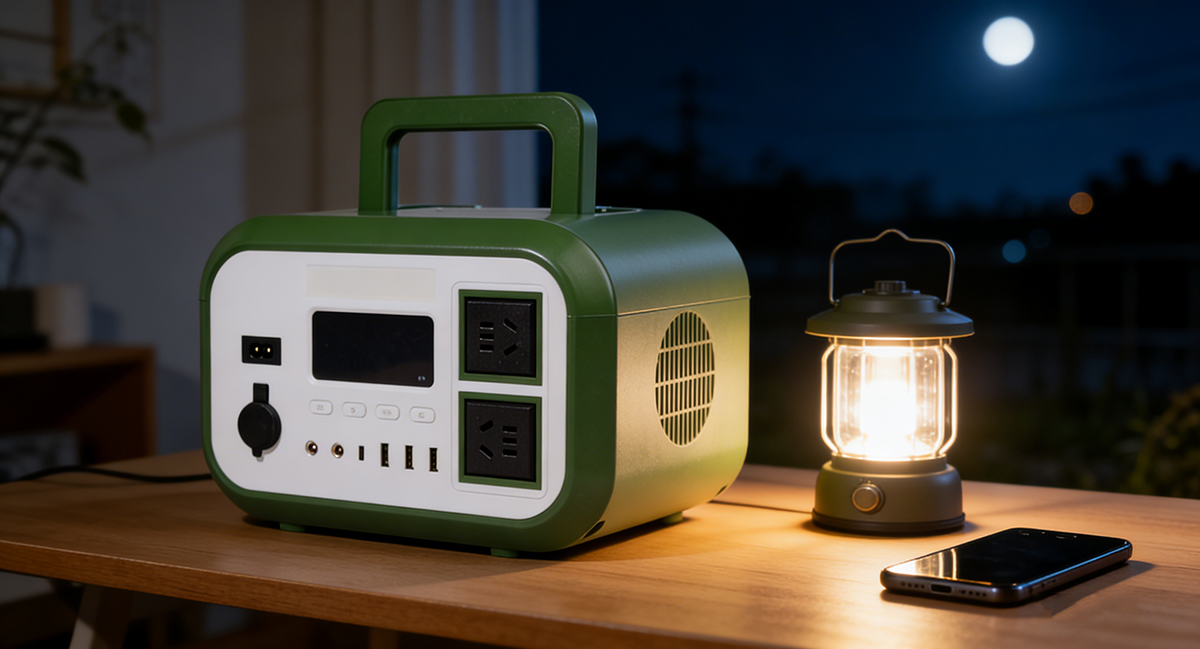
In 2026, the portable power supply is rapidly iterating along the five main lines of high energy and long-term effect, rapid energy replenishment, intelligent interconnection, modularization and full-scene ecology. At the same time, with the upgrade of battery and safety standards, it has evolved from "outdoor standby power supply" to "general intelligent energy storage terminal".
I. Battery: LFP-based, solid state/sodium ion relay.
Mainstream LFP deepening: Ferrous lithium phosphate (LFP) has become an absolute mainstream, with an energy density of about 200Wh/kg and a cycle life of 2000 times+,with obvious advantages in safety and cost.
Solid-state battery preheating: Semi-solid small batch trial production, all-solid state is expected to be large-scale after 2028, the energy density can reach 350-500Wh/kg, and the safety is greatly improved.
Sodium ion sinking: good low-temperature performance and low cost, cut into entry-level and low-temperature scenes.
Second, fast charging: solar energy+mains double speed.
Standard for solar fast charging: 100-400W photovoltaic fast charging is popular, the conversion rate of perovskite/flexible panel is 25%+, and the weight is reduced by 40%; The low light efficiency of MPPT is increased by 50%.
Fast charging speed of commercial power: the mainstream is fully charged in 1-1.5 hours, and the flagship supports two-way parallel connection, charging to 80% in one hour.
Car charging/wireless charging: car **120W+** fast charging and 50W wireless charging are gradually popularized.
Third, intelligence: APP+AI, remote and autonomous
APP full link control: remotely check power/power, switch control, fault alarm, OTA upgrade.
AI energy management: study habits and optimize charging and discharging strategies to extend battery life by 30%; Automatic identification of equipment, dynamic distribution of power, energy efficiency increased by 20%+.
Ecological linkage: docking smart home/photovoltaic, and automatically switching power supply in case of power failure; High-end models are connected to the virtual power plant (VPP).
Fourth, modularization: free combination, lightweight
Free stacking of capacity/power: based on 500 Wh–1 kWh/300–500 W, expand the battery pack to 4–6 kWh with a peak value of 2000W W..
Plug-and-play function modules: LED lighting, SOS, wireless charging, car fast charging, etc.
Lightweight and portability: carbon fiber/aluminum alloy shell, weight reduction of 20-30%; Snap-in tool-free assembly.
V. Scenes and Ecology: From Outdoor to Home/Industry
Outdoor scenes deepened: camping/self-driving/fishing became the basic dish, and the proportion of 1kWh+ large-capacity products rose to 55%(2031).
Home emergency microgrid: linked with roof photovoltaic and energy storage, standby power supply+peak-valley arbitrage, and some models support UPS seamless switching.
B-end industry/specialty: the supporting facilities of construction machinery, communication base stations and medical equipment have increased, and the demand for customization has increased.
Sixth, safety and compliance: the new national standard is forced to upgrade.
2026 new national standard (GB 47372—2026): compulsory acupuncture/high temperature/overcharge test, real-time monitoring of voltage/temperature/cycle times, anti-aging mechanism, and unique code traceability.


