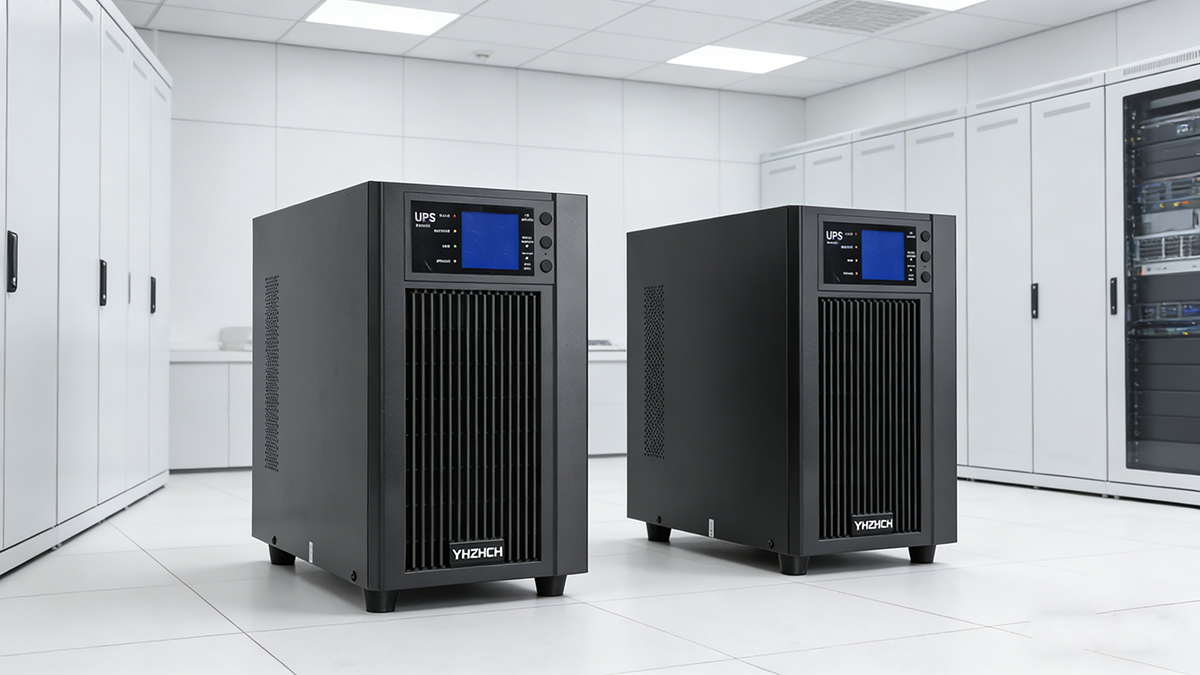
The core of high-frequency online UPS dynamic response test is safety isolation, instrument calibration, full coverage of working conditions, accurate waveform, and limit not exceeding the limit. The whole process is carried out according to GB/T 7260.3/IEC 62040-3 to prevent damage and misjudgment.
First, preparation before test (safety first)
Environment and state
Temperature and humidity: 25 2℃, 45%–75% RH, to avoid high temperature/humidity affecting stability.
UPS preheating: Full-load operation in mains mode is ≥1h, and it is confirmed that there is no alarm and the heat dissipation is normal.
Battery: Wally, normal voltage, battery open and closed, no reverse polarity.
Load: disconnect key business, connect pure resistance+nonlinear electronic load, and the capacity is ≥UPS rated power.
Instruments and wiring
Oscilloscope: bandwidth ≥100MHz, sampling rate ≥100kS/s, dual channel (input/output), preheating and calibration in advance.
Electronic load: programmable, supporting 0-100% step, with accuracy ≥0.5%.
Power analyzer: measure THD, voltage/current and power factor.
Wiring: L/N/GND is correct and the ground wire is reliable; Oscilloscope differential probe isolation to prevent common-mode interference.
Scheme and security
Clear items: load step, mode switching, input disturbance, and determine qualified indicators.
Safety measures: disconnect the back-end sensitive equipment; Set emergency stop; Special care.
Second, the core test items and key points for attention
1) Load step response (core)
Working conditions: the mains mode and the battery mode make **0%→50%→100%, 100%→50%→0%** steps respectively; Record transient deviation, recovery time and waveform distortion.
Judgment (reference): the transient voltage is * *-8% ~+10% * *, and it will return to steady state within 20ms; THD≤5%。
note:
Steps should be millisecond fast to avoid gradual change; Repeat each working condition for 3–5 times to take the average.
Nonlinear load (such as rectifier) must be measured, which is closer to reality.
It is forbidden to exceed 100% rated load to prevent overload damage.
2) Switching response of mains battery
Working condition: under 100% load, simulate power failure/recovery of commercial power, and test whether the switching time and output waveform are interrupted.
Judgment: On-line switching time ≤4ms, the waveform has no breakpoint and the distortion disappears within half period.
note:
Use an oscilloscope to grasp the input (commercial power) and output waveforms at the same time, and accurately measure the time delay.
In battery mode, the inverter should have stable load capacity and no voltage drop/oscillation.
3) Bypass inverter switching (fault/maintenance)
Working condition: under 100% load, the inverter fault (such as overcurrent) is triggered → the bypass is cut; Switch back to inverter after recovery.
Judgment: switching time **≤8ms**, transient deviation ≤ 10%, and no power failure.
note:
The bypass voltage must be synchronized with the inverter (same frequency and same phase), otherwise the switching will have a big impact.
Frequent switching is prohibited to prevent thermal damage of power devices.
4) input voltage/frequency disturbance response
Working conditions: simulate power grid fluctuation (15% rated voltage, 3 Hz frequency), measure output voltage stabilization accuracy, frequency tracking and THD.
Judgment: the steady-state deviation of output voltage is ≤ 2%, the frequency is 50Hz±0.1Hz, and THD is ≤ 3%.
note:
Sweep the frequency/voltage slowly with programmable AC power supply, and observe the dynamic adjustment ability.
Under extreme voltage (e.g. 187V/242V), UPS should output stably, not shut down and not give an alarm by mistake.
III. Key Taboos and Error Prevention in Testing
No business test: the back-end IT/industrial load must be disconnected to prevent transient damage to the equipment.
It is forbidden to overload: the step/switch is within 100% of the rated value, and it is not allowed to overload for more than 125% for a long time.
Prevent misjudgment waveform:
Oscilloscope trigger is set to the falling edge of output voltage to capture switching transient.
Distinguish between "normal transient" and "abnormal oscillation": convergence within 20ms is qualified.
Protect batteries and power devices:
The switching interval of the mains battery is ≥1min, so as to prevent the battery from frequent charging and discharging due to heavy current.
The IGBT of high frequency machine is sensitive to impact, and there is no overcurrent/overvoltage alarm when switching.
Fourth, post-test data and recovery
Data recording: save oscilloscope waveform, voltage/current/THD curve and alarm log; Report according to the standard.
System recovery: switch back to the mains mode and charge normally; Check the temperature/noise/alarm to make sure there is no hidden fault.


