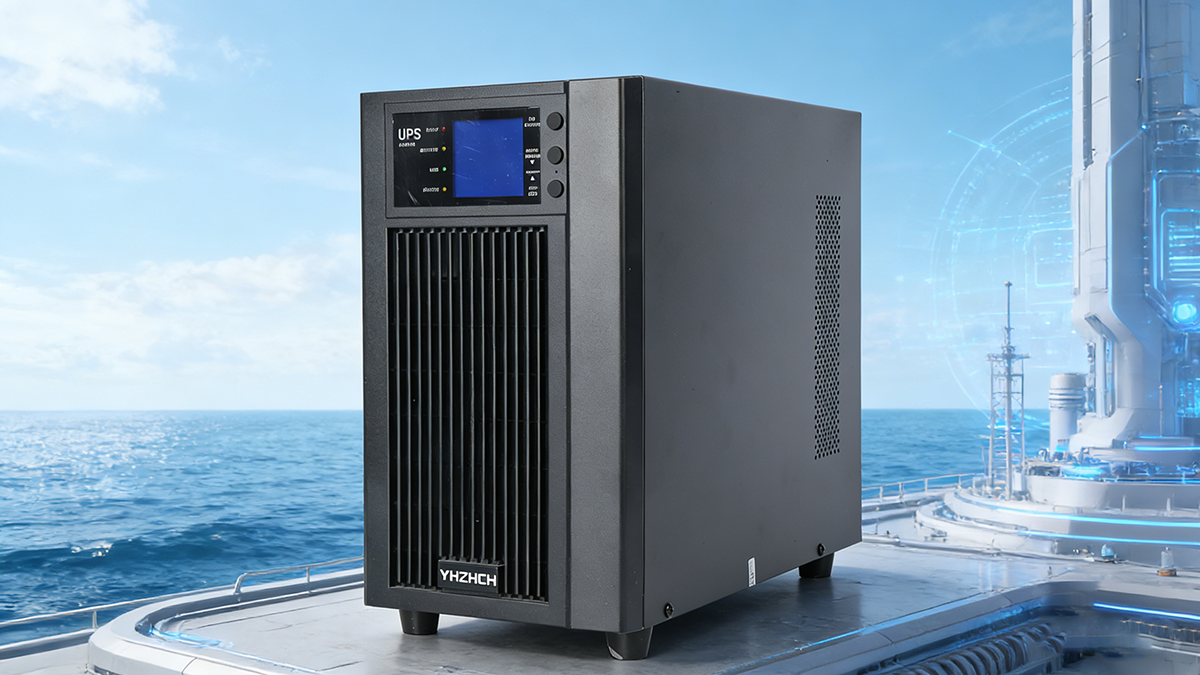
The stability test of high-frequency online UPS should cover five dimensions: steady-state performance, dynamic response, mode switching, power grid adaptability and long-term reliability, and be carried out according to standard processes and indicators to ensure uninterrupted output, controllable parameters and controllable faults under all working conditions.
Preparation before test
Equipment and environment: calibrate AC source, electronic load, oscilloscope/power analyzer, distortion meter, temperature and humidity and EMC environment; Connect UPS input → AC source, output → load/analyzer, monitoring → data recording system.
Configuration and safety: configuration according to rated capacity and load type (linear/nonlinear); Confirm that safety links such as bypass, maintenance bypass and EPO are available; Record the initial parameters (voltage/frequency/alarm threshold).
Core test items and criteria
1. Steady-state performance (basic stability)
Run under no-load, 50% and 100% rated load for 30 minutes, and collect the following parameters:
form
Typical Criterion of Parameter Testing Method (High Frequency Online)
Output voltage stability RMS meter/power analyzer rating 1% ~ 3% (data center 0.5%)
Frequency stability frequency meter/analyzer synchronization mode 0.2%; Battery mode 0.1%
Waveform quality (THD) distortion meter/oscilloscope linear load ≤ 3%; Nonlinear load ≤5%
Efficiency and temperature rise power meter/infrared temperature measurement full-load efficiency ≥ 90%; Temperature rise ≤60K
Display deviation panel value vs instrument value voltage ≤ 2%, current ≤ 5%.
2. Dynamic response (load mutation immunity)
Load step: 0% 50%, 50% 100%, 100% 0%, each stage stays for 10 seconds.
Criteria: voltage transient ≤ 5%, recovery time ≤ 40 ms; No waveform clipping/interruption.
Overload capacity: 125% rated for 1 minute, 150% for 10 seconds, 200% instantaneous impact, without stopping.
3. Mode switching (zero interruption key)
High-frequency online double conversion topology, the core verifies that there is no breakpoint in the switching of mains battery and inverter bypass.
form
Test condition criterion of switching scene
Commercial power → battery 100% load, and the switching time of sudden input interruption is ≤ 5 ms; Output without interruption and fluctuation ≤ 1%
Battery → mains power to restore input, automatically switch back without output interruption; Battery charging current is normal.
Inverter → bypass failure/overload, 100% load switching ≤ 8ms; Output voltage deviation ≤ 5%
Bypass → inverter fault elimination, automatic recovery seamless switching; No surge/drop
4. Power grid adaptability (wide working condition tolerance)
Voltage fluctuation: input rated 15% ~ 20% (for example, 187V~242V), running at full load.
Criterion: the output is stable within rated 3%, and there is no alarm/shutdown.
Frequency fluctuation: input 47Hz~53Hz, fully loaded.
Criteria: output frequency locked, drift ≤±0.5Hz.
Harmonics and distortion: the input contains 10%~20% harmonics and is fully loaded.
Criteria: output THD ≤ 5%; Enter THDi≤5%.
Generator compatibility: frequency conversion power supply/generator simulates low frequency/harmonic, full load.
Criteria: stable operation, error-free switching/shutdown.
5. Long-term reliability (marathon verification)
Full load aging: Run continuously for 72~168 hours, and record parameters every 2 hours.
Criteria: parameter drift ≤ 1%; No alarm/shutdown; Temperature rise is stable.
Cyclic switching: bypass switching of mains battery 3 times a day, with a total of 100 times.
Criterion: there is no abnormality in each switching; Battery capacity attenuation ≤20%.
Parallel system (if any): N+1 architecture, verifying that the load sharing deviation is ≤ 10%; The resection/recovery module is uninterrupted.
6. Safety and environmental adaptability
Fault simulation: inverter fault, EPO emergency stop, fan fault, verify the accuracy of alarm and protection actions.
Environmental tolerance: fully loaded at high temperature of 55℃ for 4 hours and started at low temperature of-10℃, without performance degradation.
EMC: Tested according to CISPR22/GB/T17626, the radiation/anti-interference is up to standard.


