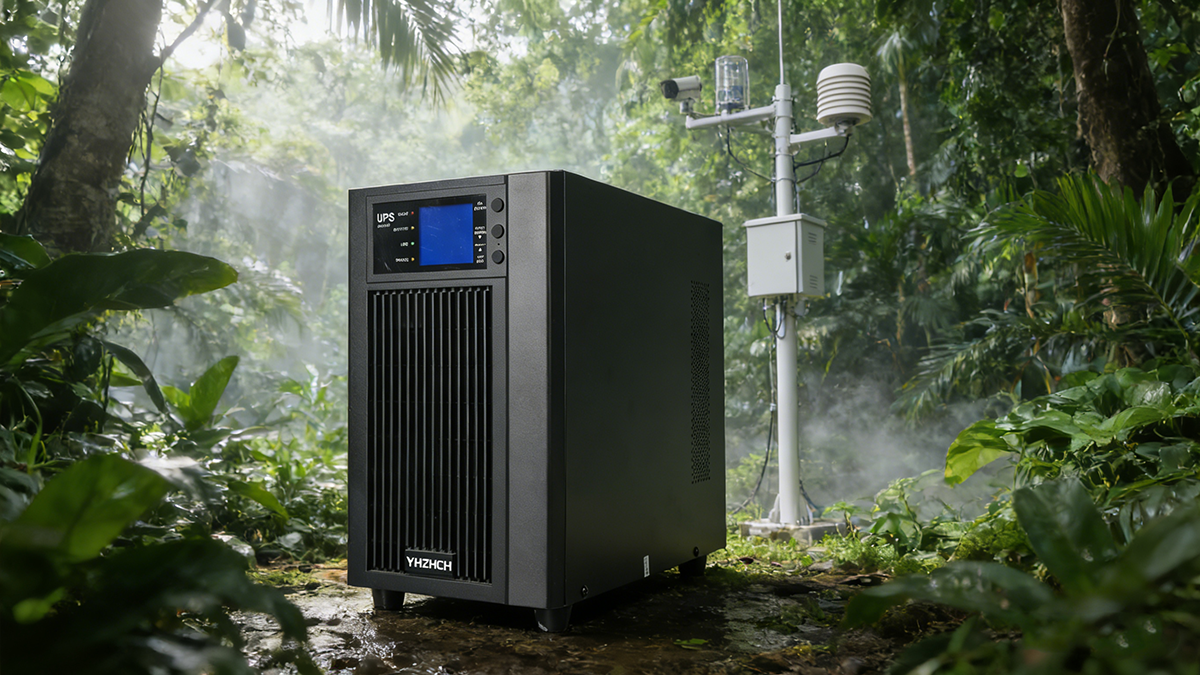
Small size, providing pure and uninterrupted power for servers, computer rooms and precision equipment. The following is a detailed description from three aspects: core functions, typical configuration and key points of selection.
First, the core function (dual conversion online+high frequency advantage)
1. Uninterrupted power supply (core)
Double conversion works online: commercial power → rectification → DC bus → inverter → load. After two conversions, the output is always controlled by inverter.
Zero switching time (0ms): When the commercial power is interrupted, the battery is directly connected to the DC bus, the inverter continues to work, and the load is insensitive.
Wide input range: single-phase common 110–300 V, three-phase 275–485 V, suitable for unstable distribution network or generator scenarios.
Frequency adaptation: 50/60Hz automatic identification, compatible with global power grid and generators.
2. High-quality power purification
High voltage stabilization accuracy: the output voltage fluctuation is within 1%, and the surge, peak and drop are suppressed.
Low harmonic distortion: THD≤3% (full load), suitable for servers, medical care and precision instruments.
Anti-interference: filter out power grid harmonics, clutter and zero line drift, and protect sensitive equipment.
3. High efficiency and energy saving (high frequency core advantage)
The efficiency of the whole machine is 92%-96% at full load and 94%-97% at half load, which is 8%-15% higher than that of the power frequency machine.
ECO/Energy-saving mode: When the mains supply is stable, the direct supply is bypassed, and the efficiency is close to 99%, which greatly saves electricity.
High power factor: input PF≈1, THDi<5%, reducing power grid pollution and line loss.
4. Intelligent management and protection
Comprehensive protection: input overvoltage/undervoltage, output overload/short circuit, overtemperature, battery overcharge/undervoltage, lightning protection.
Intelligent battery management: three-stage charging (constant current/constant voltage/floating charge), temperature compensation, automatic equalizing charge and life prediction.
Monitoring and communication: LCD+LED display, supporting RS232/485, SNMP, dry contact, remote monitoring, alarm and shutdown.
Self-diagnosis: self-check, fault warning, history record, and discover hidden dangers in advance.
5. Flexible expansion and redundancy
Parallel redundancy: Support N+1 parallel connection (usually less than 4 sets), and share the battery pack to improve reliability and capacity expansion.
Double input: main circuit+bypass two-way commercial power, and one-way failure does not affect power supply.
Cold start: when there is no commercial power, it can be started directly with batteries for emergency power supply.
Second, the typical configuration (classified by capacity and architecture)
1. Capacity and power section (common)
Low power (1–20kVA): single input and single output (220V), suitable for servers, small computer rooms and office equipment.
Medium power (20–100kVA): three inputs and one output/three inputs and three outputs (380V), suitable for data centers, communication base stations and industrial control.
High power (above 100kVA): three in and three out, modular design, suitable for large data centers, finance and medical treatment.
2. Core hardware configuration
Rectifier: high-frequency IGBT rectifier+active PFC to achieve high PF and low harmonics.
Inverter: Full-bridge IGBT inverter with high frequency, pure sine wave output and fast response (< 4ms).
Battery pack:
Standard: Valve-regulated lead-acid battery (12V/section), usually 16-40 sections in series (DC 192-480V).
Optional: lithium battery (life 5-8 years, small size, light weight, fast charge and discharge).
Standby time: standard 10-30 minutes, which can be extended to several hours by external battery cabinet.
Control unit: DSP digital control, accurate adjustment of voltage/frequency/waveform, strong stability.
Display and interface: LCD screen (voltage, current, power, battery, fault), RS232/485, SNMP, dry contact, USB.
3. Common architecture types
Single input and single output (1/1): input 220V, output 220V, suitable for small load and office scenes.
Three inputs and single output (3/1): input 380V, output 220V, suitable for medium-sized computer rooms and server clusters.
Three inputs and three outputs (3/3): input 380V, output 380V, suitable for large data centers and industrial equipment.
Modularization: power module+battery module is hot-swappable, which is convenient for expansion and maintenance and high in availability.
III. Selection and Configuration Points
Power matching: Select the type according to the total load power × 1.2–1.5 times, and reserve redundancy to avoid full-load operation.
Input and output system: small load menu in single out; Computer room/industry gives priority to three in and three out.
Standby time: more than 30 minutes is recommended for key equipment, and it can be shortened to 10-15 minutes when it is used with generator.
Battery selection: pursuing low-cost lead-acid selection; Pay attention to life, space and maintenance, and choose lithium battery.
Monitoring requirements: the computer room/data center must be equipped with SNMP remote monitoring to support centralized management.
Redundancy and capacity expansion: N+1 parallel connection is recommended for important systems, and capacity expansion can be smooth later.
Fourth, the application scenario
IT/data center: servers, switches, storage, routers.
Communication industry: base station, core network equipment, transmission equipment.
Medical equipment: CT, MRI, monitor, operating room equipment.
Finance/securities: trading system, server, network equipment.
Industrial control: PLC, automatic production line, precision instruments.
Office/business: computer, printer, POS, monitoring system.


