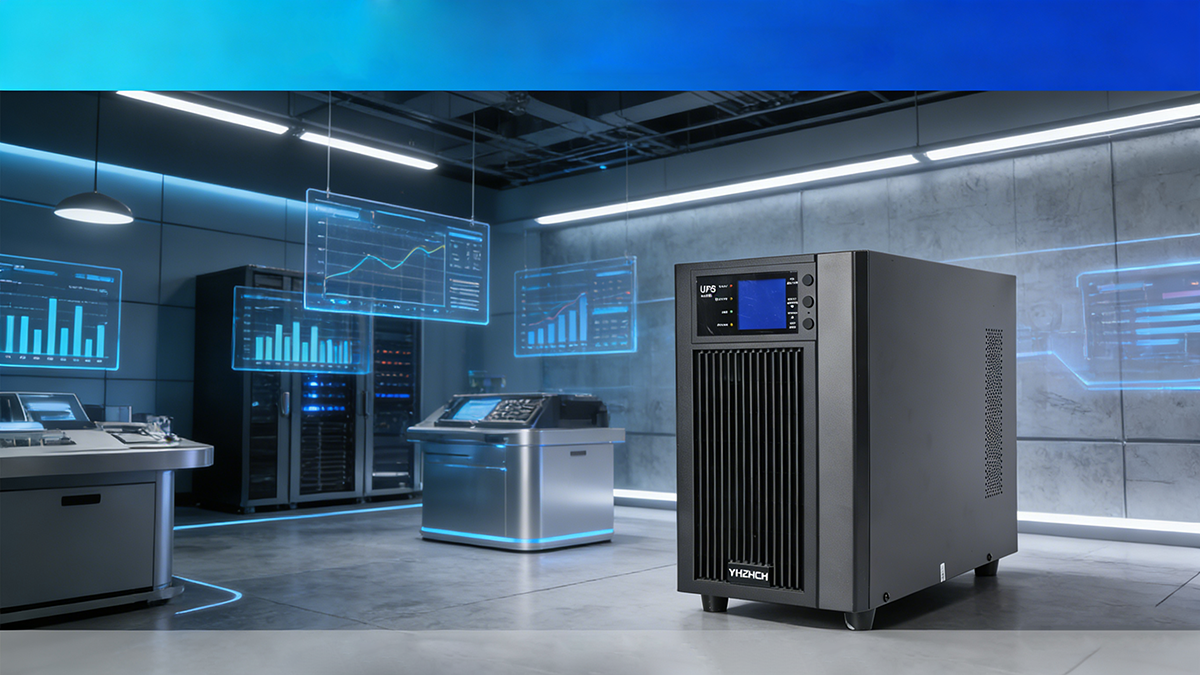
The parallel operation ability of high-frequency online UPS is embodied in five aspects: flexible capacity expansion, redundancy and reliability, accurate current sharing, intelligent control and convenient deployment and maintenance, which is the key to build a highly available and flexible power supply system.
I. System Architecture and Control Capability (Core Foundation)
Fully digital parallel control: DSP high-speed processor is used to realize the precise synchronization of the same frequency, phase and voltage, and with digital circulation control, the parallel circulation is reduced to a very low level to ensure the stability of the system.
Self-adaptive parallel operation without master and slave: all UPS units have equal status and no single master node, thus completely eliminating the risk of single point failure; Support N+1/N+X redundancy, and any fault will not affect the overall operation.
Built-in/wireless parallel machine technology: mainstream models have built-in parallel machine function without additional parallel machine board; Some high-end models support wireless parallel connection, which simplifies wiring and improves reliability.
Multi-machine parallel connection capability: 2~8 UPS of the same model can be connected in parallel, and theoretically unlimited capacity expansion can be realized.
Second, the load and circulation management ability (operation key)
Accurate current sharing control: the parallel system automatically shares the load current, and the current sharing accuracy is ≤ 2%, ensuring the load balance and consistent service life of each unit.
Circulation suppression technology: through closed-loop control and high-speed communication, circulation can be counteracted in real time to avoid equipment heating, efficiency decline and device damage.
Load adaptability: Support 100% unbalanced load, inductive/capacitive load, low distortion rate of output voltage waveform, and strong load carrying capacity.
III. Capacity Expansion and Redundancy (Value Embodiment)
Online seamless capacity expansion: support hot plug and parallel operation, and add UPS units under the condition of uninterrupted power supply to realize smooth capacity upgrade.
N+X redundant architecture: N is the minimum number of units carrying load, and X is the number of redundant units; When a single unit fails, the remaining units automatically share the load and realize zero interruption of power supply.
Shared battery pack: multiple UPS can share a battery pack, greatly reducing battery investment and land occupation cost.
Four, communication and protection ability (security)
High-speed parallel communication: adopt redundant double bus/optical fiber communication and millisecond data interaction to ensure synchronization and quick response to faults.
Comprehensive fault protection: with multi-level protection such as overvoltage, undervoltage, overload, short circuit, overtemperature, circulation overrun, etc., the fault unit automatically goes offline without affecting the system.
Decentralized bypass design: each UPS has built-in independent bypass, which can be switched to bypass power supply in case of failure to ensure continuous load operation.
V. Deployment and operation and maintenance capabilities (ease of use)
Plug and Play: After installing the parallel card/enabling the built-in function, the parallel machine can be set up simply without complicated debugging.
On-line maintenance: Support single-machine off-line maintenance, the system continuously supplies power, and the MTTR (Mean Time to Repair) is extremely short.
Centralized monitoring: the parallel system is monitored in a unified way, and the status, load, alarm and other information of each unit can be viewed through LCD/WEB/SNMP.
Sixth, the parallel advantages of high-frequency architecture
Small size and light weight: the high frequency machine is 30%~50% smaller than the power frequency machine, which is more suitable for intensive deployment and parallel expansion of computer rooms.
Higher efficiency: the efficiency of the whole machine is **≥95%**, the system loss is lower after parallel operation, and the energy saving is remarkable.
Faster response: high-frequency PWM modulation and DSP control, fast dynamic response, more stable parallel synchronization and load switching.
To sum up, the parallel operation ability of high-frequency online UPS is a comprehensive embodiment of its digital control, high-frequency power conversion and intelligent management technology, which provides a highly reliable, scalable and easy-to-maintain power guarantee scheme for key loads such as data centers and industrial automation.


