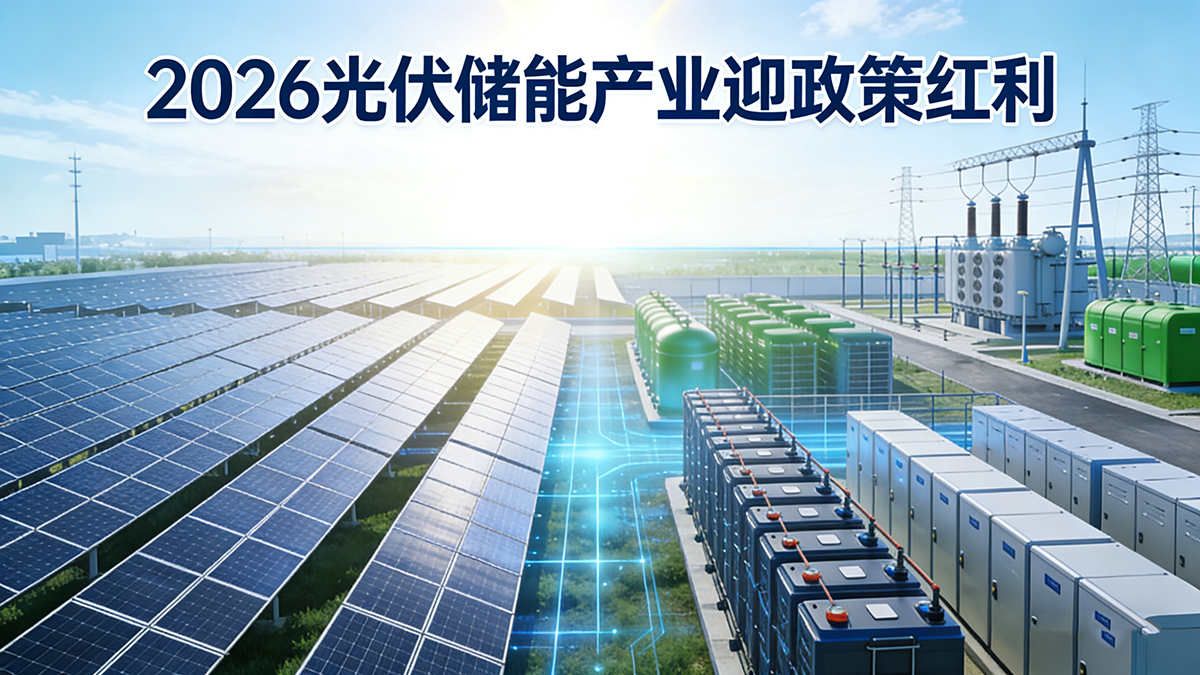
Recently, the Ministry of Industry and Information Technology, the National Development and Reform Commission, the State-owned Assets Supervision and Administration Commission of the State Council, the General Administration of Market Supervision and the National Energy Administration jointly issued the Guidelines for the Construction and Application of Industrial Green Microgrids (2026-2030) (hereinafter referred to as the Guidelines), which clarified that the construction of industrial green microgrids will be promoted on a large scale from 2026 to 2030, requiring industrial enterprises and parks to build photovoltaic and other renewable energy power generation projects with a local self-absorption ratio of not less than 60. The implementation of this policy marks that the green transformation of energy in China's industrial sector has entered a new stage of scale promotion, bringing broad development space for photovoltaic, energy storage and supporting industries.
Industrial green microgrid is an integrated comprehensive energy system with the core of providing green power, integrating photovoltaic, wind power, new energy storage, waste heat utilization and smart energy management and control, which can realize cooperative autonomy with deep integration with industrial production process and friendly interaction with power grid. As the key path to save energy and reduce carbon in the industrial field and implement the goal of "double carbon", industrial green microgrid can not only improve the local consumption capacity of renewable energy, but also strengthen the safety guarantee of industrial energy consumption, and is an important starting point for cultivating new kinetic energy for green development.
Based on the current development situation of the industry, the Guide puts forward five construction principles of "multi-functional complementarity, consumption nearby, friendly interaction, load adjustment and intelligent management", and makes systematic deployment from four dimensions: construction content, mode, scene and requirements. In the core construction content, renewable energy power generation, new energy storage application, clean low-carbon hydrogen production and utilization, digital energy and carbon management are clearly listed as key directions; In the application scenario, combined with the energy consumption characteristics of different industries, it is divided into four categories: high capacity, flexibility, adjustability and high reliability to provide guidance for enterprises to land accurately; In the construction mode, it supports self-financing and self-construction and third-party co-construction to adapt to the energy demand and operational capacity of different enterprises.
It is worth noting that the requirement of 60% self-consumption ratio of green electricity will directly drive the large-scale deployment of distributed photovoltaic and energy storage systems in industrial fields. The data shows that there are over 300 industrial green microgrid projects that have been put into operation in China, but the whole project is still in the pilot demonstration stage. With the in-depth implementation of the Guide, the industry will move from pilot exploration to large-scale application. According to estimates, only the micro-grid transformation needs of three high-energy industries, namely steel, petrochemical and building materials, can drive the investment scale of hundreds of billions, covering distributed power generation construction, energy storage system integration, smart energy management platform and other fields.
The release of policy dividends not only brings market opportunities for industrial chain enterprises such as photovoltaic and energy storage, but also promotes the industry to accelerate technological innovation and model upgrading. The Guide clearly proposes to accelerate the application of advanced technologies, encourage the development of high-efficiency electrolyzed water hydrogen production devices, integrated wind and light flexible hydrogen production systems, new energy storage equipment and digital management and control platforms, and force enterprises to enhance their core technology competitiveness. At the same time, the promotion of the third-party co-construction model will give birth to a number of comprehensive energy service providers, promote the transformation of the industry from "single equipment supply" to "integrated solutions", and build a diversified and coordinated industrial ecology.
The relevant person in charge of the Ministry of Industry and Information Technology said that the next step will be to promote the implementation of the Guide in conjunction with multiple departments, strengthen the classification guidance of key industries, promote the construction of projects according to local conditions, improve the support of supporting policies, and summarize and promote the advanced experience of typical cases. In this context, relevant industrial chain enterprises need to closely follow the policy orientation, focus on technological innovation and scene adaptation, deepen the subdivision of industrial green microgrid, and seize the new track of industrial development while helping industrial green and low-carbon transformation.
In the next five years, with the continuous acceleration of industrial green microgrid construction, the application proportion of renewable energy in the industrial field will be greatly increased, and new formats such as integration of source, grid, storage, virtual power plant and direct connection of green power will be accelerated, which will inject strong impetus into the construction of new energy system and the high-quality development of manufacturing industry in China.


