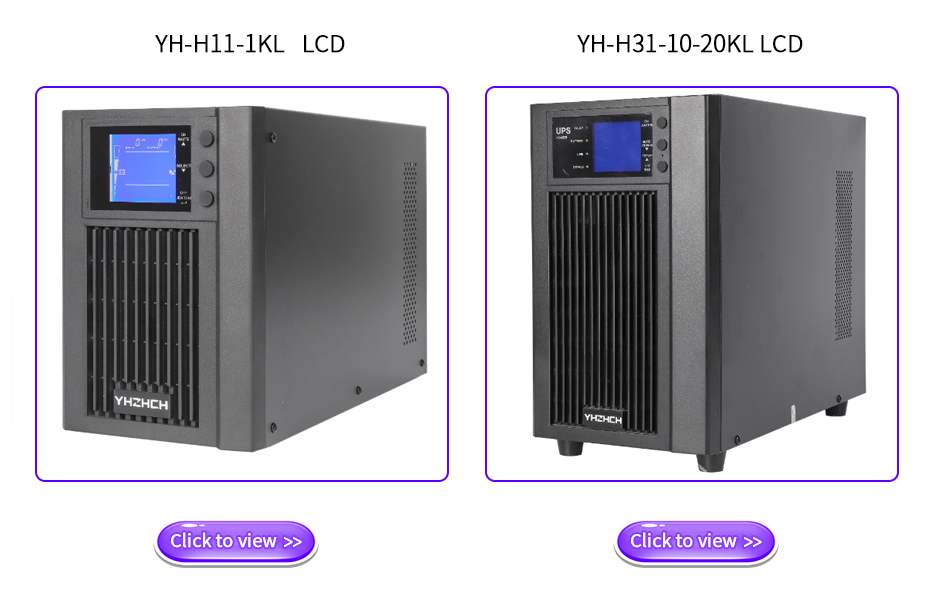
The core of judging the power grid adaptability of high-frequency online UPS is to look at its tolerance range of input voltage, input frequency and voltage waveform distortion, as well as its switching stability and continuous operation ability under abnormal power grid, which can be comprehensively evaluated from the following dimensions:
1. Core electrical parameters: input voltage and frequency tolerance range.
This is the most direct judgment basis. The wider the parameters, the stronger the adaptability of the power grid.
Input voltage range
The nominal input voltage of high-frequency online UPS is usually 220V (single phase) or 380V (three phase), and the voltage tolerance range of excellent products will be very wide, such as 110 V–300 V for single-phase models and 176 V–478 V for three-phase models.
The wider the range, it means that when the grid voltage fluctuates greatly (for example, the peak voltage drops and the voltage rises at low load), UPS can output stably without switching to battery power supply, and it can be adjusted directly by rectifier, which not only prolongs the battery life, but also avoids the switching risk.
Input frequency range
The frequency of standard power grid is 50Hz/60Hz, the frequency tolerance range of high-quality high-frequency online UPS is usually 45Hz-65Hz, and some industrial products can be extended to 40Hz-70Hz.
This parameter determines the adaptability of UPS to variable frequency power supply and generator power supply-for example, the frequency is easy to fluctuate when the generator is used to supply power in remote areas, and UPS with wide frequency range can be connected stably.
2. Tolerance to power grid distortion
There are harmonics, voltage dips/surges, surges, spikes and other distortions in the actual power grid, and the anti-distortion ability of UPS directly affects the operation stability;
Harmonic suppression ability: According to the input current harmonic distortion rate (THDi) of UPS, the THDi of excellent high-frequency online UPS can be controlled within 5%, and it can tolerate the harmonic feedback generated by the load on the output side. If the harmonic content of the power grid is high (such as frequency converter, welding machine and other equipment around), it is necessary to choose a model with active harmonic control function.
Voltage sag/surge response: Test whether UPS can maintain stable output without interruption and not trigger protection shutdown when the input voltage sags (e.g. drops to 50% of the nominal voltage) or rises abruptly (e.g. rises to 150% of the nominal voltage) in a short time.
Surge and spike tolerance: Check the input surge tolerance value marked in the product manual, which usually needs to be able to withstand the surge impact of 2 kV to avoid the instantaneous surge in the power grid from damaging the internal components of UPS.
3. Mode switching and transition stability
High-frequency on-line UPS always works in "rectifier-inverter" mode, and the switching performance when the power grid is abnormal is the key to adaptability;
Power grid/battery switching time: The switching time of real online UPS is 0ms, but some pseudo-online or backup UPS will be marked as "online", and the actual switching time is 10–20 ms.. It can be tested by professional instruments to see whether the UPS output voltage has no breakpoint at the moment of power grid interruption.
Bypass mode adaptability: When UPS is overloaded or faulty, it will switch to bypass mode. The bypass input voltage range of high-quality products is consistent with the main input, and it can tolerate the harmonic and frequency fluctuation of bypass voltage, so as to avoid shutdown due to power grid incompatibility after switching bypass.
4. Test and verification of actual scene
Laboratory parameters need to be verified in combination with actual scenarios, especially for special scenarios such as new energy storage facilities and foreign trade export:
Extreme voltage test: artificially lower or raise the input voltage to the nominal critical value of the product, and observe whether the UPS runs continuously and stably, and whether the output voltage is within the standard range of 220 V 3% (single phase) or 380 V 3% (three phase).
Generator compatibility test: If the generator is used for power supply, it is necessary to test the matching between UPS and generator-the output frequency and voltage of the generator fluctuate greatly, the high-quality UPS can adapt quickly, and the generator speed will not be unstable due to harmonic feedback.
Long-term on-load operation test: When the grid voltage is at the edge of the tolerance range, let UPS run with full rated load for 8-24 hours, and observe whether its temperature rise, output stability and protection mechanism are triggered by mistake.